📅 Published on: 30.05.2026
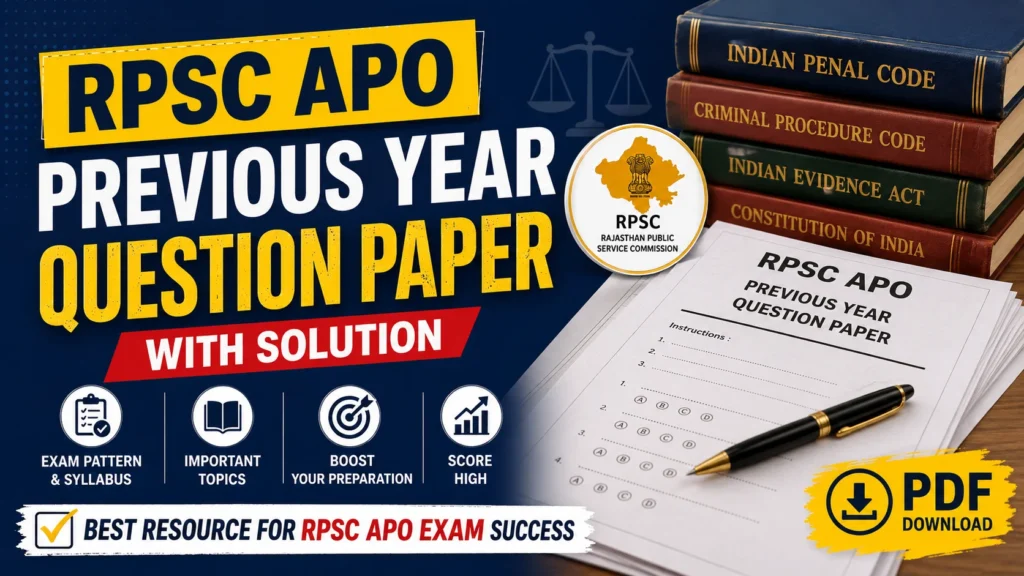
Table of Contents
ToggleRPSC APO Previous Year Question Paper PDF Download with Solution
The RPSC APO Previous Year Question Paper is one of the most valuable study resources for candidates preparing for the Rajasthan Public Service Commission (RPSC) Assistant Prosecution Officer (APO) Examination. Solving previous year papers helps candidates understand the exam pattern, question types, difficulty level, and important topics frequently asked in the examination.
Connect with Us
If you are planning to appear for the upcoming RPSC APO recruitment exam, downloading and practicing the RPSC APO Previous Year Question Paper with solutions should be an essential part of your preparation strategy. In this article, we provide complete information about previous year question papers, their benefits, exam pattern, and how to use them effectively.
What is RPSC APO Exam?
The Rajasthan Public Service Commission conducts the Assistant Prosecution Officer (APO) examination to recruit eligible candidates for prosecution services in Rajasthan. The exam is highly competitive and requires thorough preparation in law subjects, general knowledge, and language sections.
Candidates who aspire to secure a government legal position should regularly practice the RPSC APO Previous Year Question Paper to improve their performance and confidence.
Download RPSC APO Previous Year Question Paper PDF
| Exam Year | Paper | Download PDF |
|---|---|---|
| RPSC APO 2024 | Mains Paper 1 | Download PDF |
| Mains Paper 2 | Download PDF | |
| Pre Question Paper | Download PDF | |
| RPSC APO 2015 | Mains Paper 1 | Download PDF |
| Mains Paper 2 | Download PDF | |
| Pre Question Paper | Download PDF |
Importance of RPSC APO Previous Year Question Paper
Practicing previous year papers offers numerous benefits, including:
1. Understanding Exam Pattern
The RPSC APO Previous Year Question Paper helps candidates understand the structure of the examination, including:
- Number of questions
- Marking scheme
- Subject-wise weightage
- Time duration
2. Identifying Important Topics
Many topics are repeated in competitive examinations. Previous year papers highlight frequently asked topics from:
- Indian Penal Code (IPC)
- Criminal Procedure Code (CrPC)
- Indian Evidence Act
- Constitution of India
- Rajasthan General Knowledge
3. Improving Time Management
Attempting the RPSC APO Previous Year Question Paper within the prescribed time helps candidates improve speed and accuracy.
4. Self-Assessment
Candidates can evaluate their strengths and weaknesses by solving previous year question papers and revising accordingly.
5. Building Confidence
Regular practice reduces exam fear and enhances confidence before the actual examination.
RPSC APO Exam Pattern
Before solving previous year papers, candidates should understand the latest exam pattern.
| Paper | Subject | Marks |
|---|---|---|
| Paper I | Law Paper | 100 |
| Paper II | Language & General Knowledge | 100 |
| Total | Combined | 200 |
The exam generally consists of objective-type questions. Candidates should verify the latest notification for any changes in the pattern.
Subjects Covered in RPSC APO Examination
The RPSC APO Previous Year Question Paper generally includes questions from the following subjects:
Law Subjects
- Indian Penal Code (IPC)
- Criminal Procedure Code (CrPC)
- Indian Evidence Act
- Constitution of India
- Special Laws
General Knowledge
- Rajasthan History
- Geography
- Culture
- Current Affairs
Language Section
- Hindi Grammar
- English Grammar
- Comprehension
- Vocabulary
Benefits of Solving RPSC APO Previous Year Question Paper with Solution
Detailed Explanations
Solutions help candidates understand the correct approach to solving questions.
Error Analysis
Candidates can identify mistakes and avoid repeating them in future mock tests.
Conceptual Clarity
Well-explained solutions improve understanding of legal concepts and provisions.
Better Revision
Solved papers serve as an excellent revision resource before the exam.
How to Use RPSC APO Previous Year Question Paper Effectively
Step 1: Complete the Syllabus
Finish the basic syllabus before starting previous year papers.
Step 2: Attempt Papers in Exam Conditions
Set a timer and solve the paper without interruptions.
Step 3: Check Answers
Compare your responses with the provided solutions.
Step 4: Analyze Performance
Note down weak areas and revise them thoroughly.
Step 5: Repeat Regularly
Practice multiple RPSC APO Previous Year Question Paper PDFs to gain mastery over the exam pattern.
Preparation Strategy for RPSC APO Exam
Focus on Bare Acts
Most law questions are directly based on statutory provisions.
Make Short Notes
Prepare concise notes for quick revision.
Read Current Affairs Daily
Stay updated with national and Rajasthan-specific current events.
Practice Mock Tests
Mock tests combined with the RPSC APO Previous Year Question Paper significantly improve performance.
Revise Regularly
Revision is the key to retaining legal provisions and important facts.
Common Mistakes to Avoid
- Ignoring previous year papers
- Focusing only on theory
- Not revising regularly
- Poor time management
- Skipping mock tests
Avoiding these mistakes can greatly improve your chances of success.
Why Previous Year Papers are Better Than Random Practice Sets
Unlike random question banks, the RPSC APO Previous Year Question Paper contains actual exam questions. This makes it a reliable source for understanding the examiner's mindset and identifying recurring patterns.
Candidates who regularly practice authentic previous year papers often perform better than those who rely solely on study material.
Conclusion
The RPSC APO Previous Year Question Paper is an indispensable resource for serious aspirants. It provides valuable insights into the exam pattern, important topics, and difficulty level while helping candidates improve speed, accuracy, and confidence. By regularly practicing previous year papers with solutions and combining them with a structured study plan, candidates can significantly enhance their chances of securing a high score in the RPSC APO examination.
Start solving the RPSC APO Previous Year Question Paper today to strengthen your preparation and move one step closer to your goal of becoming an Assistant Prosecution Officer in Rajasthan.
Frequently Asked Questions (FAQs)
1. What is the RPSC APO Previous Year Question Paper?
The RPSC APO Previous Year Question Paper contains questions asked in previous Assistant Prosecution Officer examinations conducted by the Rajasthan Public Service Commission. These papers help candidates understand the exam pattern and important topics.
2. Why should I solve RPSC APO Previous Year Question Papers?
Solving previous year papers helps improve time management, accuracy, confidence, and understanding of frequently asked topics. It also provides insight into the overall difficulty level of the examination.
3. Are RPSC APO Previous Year Question Papers enough for exam preparation?
No. Previous year papers should be used along with standard study materials, bare acts, mock tests, current affairs preparation, and regular revision for comprehensive preparation.
4. How many years of RPSC APO Previous Year Question Papers should I practice?
Candidates are advised to solve at least the last 5 to 10 years of question papers to identify trends and recurring topics in the examination.
5. Do questions repeat in the RPSC APO examination?
While exact questions may not always be repeated, similar concepts, legal provisions, and important topics often appear in multiple examinations.
6. Are solutions available with RPSC APO Previous Year Question Papers?
Yes, many educational websites and coaching institutes provide solved question papers with detailed explanations to help candidates understand the correct answers.
7. Which subjects are covered in the RPSC APO examination?
The examination mainly covers law subjects such as IPC, CrPC, Indian Evidence Act, Constitution of India, along with General Knowledge, English, and Hindi language sections.
8. How should I use RPSC APO Previous Year Question Papers effectively?
Attempt the papers under exam-like conditions, analyze your mistakes, revise weak areas, and repeat the process regularly to improve performance.
9. Can RPSC APO Previous Year Question Papers improve my chances of selection?
Yes. Consistent practice with previous year papers helps candidates understand exam trends, improve speed and accuracy, and gain confidence, all of which contribute to better exam performance.