
📅 Published on: 22.04.2026
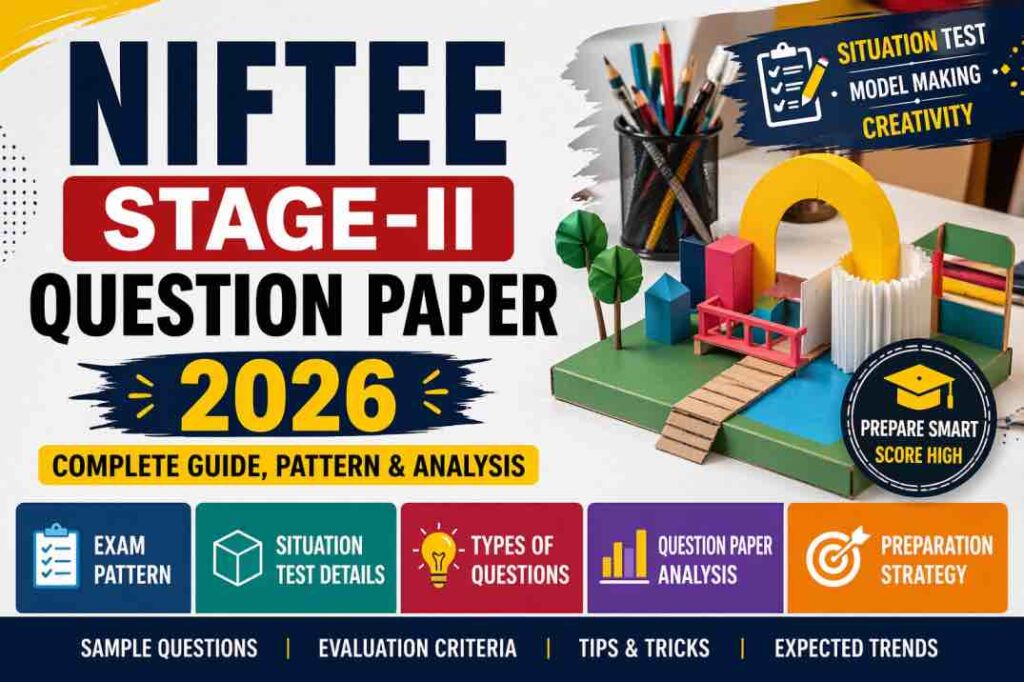
Table of Contents
ToggleNIFTEE Stage-II Question Paper 2026
Introduction
The National Institute of Fashion Technology Entrance Examination (NIFTEE) is one of India’s most prestigious design entrance exams conducted by the National Testing Agency. The exam is conducted in multiple stages to assess candidates’ creativity, analytical ability, and design aptitude.
After successfully clearing Stage I (CAT and GAT), candidates are shortlisted for NIFTEE Stage-II, which plays a crucial role in final selection. The NIFTEE Stage-II Question Paper 2026 is significantly different from the first stage as it focuses on practical skills, creativity, and real-world application rather than theoretical knowledge.
In this article, we will cover the complete details of the Stage-II question paper including exam pattern, types of questions, analysis, and preparation insights.
Connect with Us
Overview of NIFTEE Stage-II 2026
The Stage-II exam is designed to evaluate a candidate’s hands-on design skills and creative thinking ability. According to official updates, Stage-II of NIFTEE 2026 is conducted after the declaration of Stage-I results and includes different components depending on the course.
Key Highlights:
- Conducted for shortlisted candidates only
- Includes Situation Test (UG) and Interview + GD (PG)
- Focuses on practical and creative assessment
- Final merit is based on combined performance of Stage I and Stage II
For undergraduate courses like B.Des, the most important component is the Situation Test, which forms the core of the Stage-II question paper.
NIFTEE Stage-II Question Paper 2026 (Situation Test)
The Situation Test is a hands-on practical exam where candidates are required to create a 3D model using given materials. Unlike traditional written exams, this test evaluates creativity, innovation, and execution skills.
Nature of the Question Paper
- A design problem statement
- A set of materials provided at the exam center
- Instructions regarding time limit and theme
- A requirement to write a concept explanation
The question is usually scenario-based and tests the ability to convert ideas into physical models.
Exam Pattern of NIFTEE Stage-II 2026
1. Situation Test (For B.Des Candidates)
| Component | Details |
|---|---|
| Mode | Offline (Practical) |
| Duration | 2–3 Hours |
| Type | Model Making |
| Materials Provided | Paper, clay, wires, fabric, colors, etc. |
| Evaluation | Creativity, neatness, concept, innovation |
Candidates are expected to construct a model based on a given theme within a limited time.
2. Personal Interview (For PG Courses)
For postgraduate courses, the Stage-II question paper is replaced by:
- Personal Interview (PI)
- Group Discussion (GD)
Here, candidates are evaluated on:
- Communication skills
- Design awareness
- Portfolio presentation
Types of Questions Asked in NIFTEE Stage-II 2026
The questions in Stage-II are not conventional but practical and creative. Based on trends and memory-based analysis, the following types of tasks are commonly included:
1. Model Making Task
- Create a product or design model
- Represent a concept visually
- Maintain proportion and stability
2. Theme-Based Design
- Sustainable living
- Smart city concepts
- Festival decoration
- Innovative packaging design
3. Concept Explanation
- Write a short explanation
- Describe inspiration and usability
- Explain material usage
Sample Questions for NIFTEE Stage-II
- Design a portable workspace model using provided materials
- Create a festival decoration setup using eco-friendly materials
- Build a toy model for children with safety considerations
NIFTEE Stage-II Question Paper 2026 Analysis
Difficulty Level
Moderate to Challenging
Key Observations:
- Questions are open-ended
- No fixed correct answer
- Focus on originality and execution
- Time management is critical
Evaluation Criteria of Stage-II
- Creativity and Innovation
- Material Handling
- Aesthetic Appeal
- Functionality
- Concept Clarity
Importance of NIFTEE Stage-II Question Paper
- Carries significant weightage in final selection
- Differentiates candidates based on creativity
- Evaluates real design skills
Comparison: Stage I vs Stage II
| Feature | Stage I | Stage II |
|---|---|---|
| Type | Written Exam | Practical Test |
| Sections | CAT & GAT | Situation Test / Interview |
| Focus | Aptitude & Creativity | Practical Skills |
| Mode | Online/Offline | Offline |
| Evaluation | Objective + Subjective | Fully subjective |
Preparation Strategy for NIFTEE Stage-II
- Practice model making regularly
- Improve creativity and observation skills
- Manage time effectively
- Learn proper material usage
- Develop presentation and explanation skills
Common Mistakes to Avoid
- Overcomplicating the design
- Poor finishing and presentation
- Weak concept explanation
- Ignoring instructions
- Mismanaging time
Expected Trends in NIFTEE Stage-II 2026
- Focus on sustainability
- Real-life problem-solving themes
- Innovation-based tasks
- Balanced evaluation approach
How to Download NIFTEE Stage-II Question Paper 2026
NIFT generally does not officially release the full Stage-II question paper. Candidates can rely on memory-based questions and sample papers available on official websites.
Role of Answer Key in Stage-II
There is no official answer key for Stage-II because it is subjective and based on creativity.
Conclusion
The NIFTEE Stage-II Question Paper 2026 is a crucial part of the selection process that tests a candidate’s real design potential. With the right preparation strategy and consistent practice, candidates can excel in this stage and secure admission to top design institutes.
📚 Read More
Frequently Asked Questions (FAQs)
NIFTEE Stage-II Question Paper 2026 is a practical assessment round that evaluates candidates' creativity, design skills, and ability to create models using given materials.
The Stage-II exam includes a Situation Test for undergraduate courses and Personal Interview plus Group Discussion for postgraduate courses.
The Situation Test usually lasts between 2 to 3 hours, during which candidates must complete a model-making task.
No, there is no official answer key because the exam is subjective and based on creativity and presentation.
Materials such as paper, clay, threads, wires, fabric, and colors are usually provided at the exam center.
Candidates are evaluated based on creativity, innovation, material usage, aesthetic appeal, functionality, and concept clarity.
Questions are practical and include model-making tasks, theme-based design problems, and concept explanation writing.
The difficulty level is moderate to challenging as it requires creativity, time management, and practical execution skills.
You should practice model making, improve creativity, manage time effectively, and learn to present your design concepts clearly.