
📅 Published on: 20.04.2026
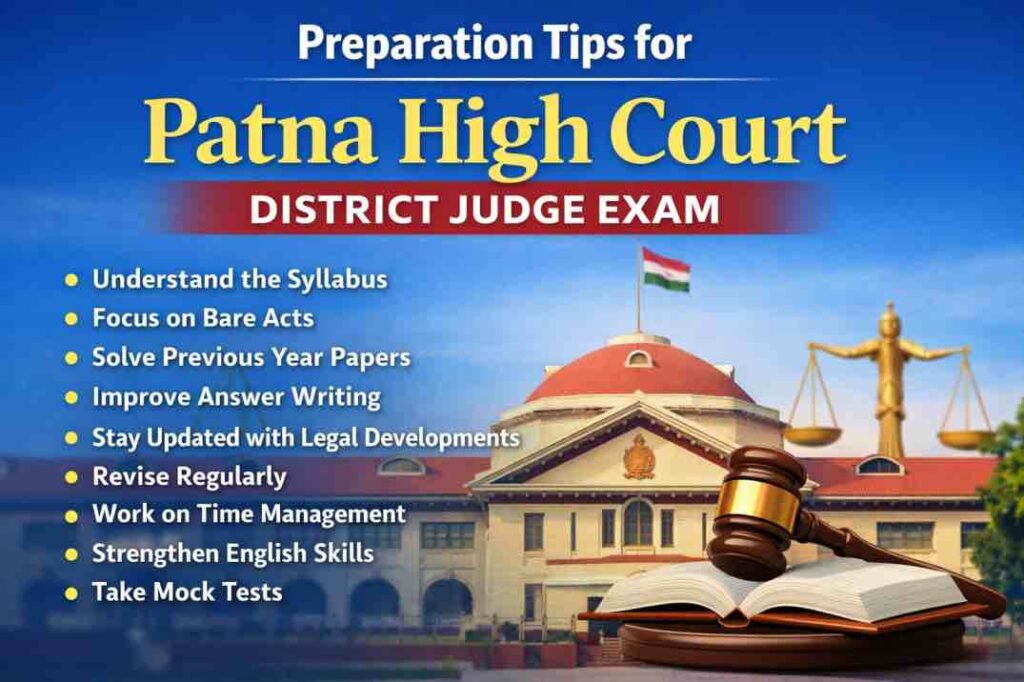
Table of Contents
TogglePatna High Court District Judge Previous Year Question Paper
The Patna High Court District Judge (Entry Level) examination is one of the most prestigious judicial recruitment exams in Bihar. Candidates preparing for this exam must rely heavily on previous year question papers (PYQs) to understand the exam pattern, difficulty level, and important topics.
In this detailed article, we will cover everything about Patna High Court District Judge previous year question papers, including exam pattern, sources for downloading papers, benefits of solving PYQs, and preparation strategies.
Connect with Us
Introduction
The Patna High Court District Judge exam is conducted to recruit experienced advocates into the higher judiciary. It is commonly known as the Bihar Higher Judicial Service (HJS) exam. The selection process generally includes:
- Preliminary Examination
- Main (Written) Examination
- Interview
Practicing previous year question papers of Patna High Court District Judge is one of the most effective ways to crack this exam. These papers give real insight into how questions are framed and what topics are frequently asked.
Availability of Previous Year Question Papers
Candidates can access official question papers from the High Court website. The court provides multiple years of both prelims and mains papers.
Key Years Available
- Preliminary Papers: 2013, 2015, 2016, 2019, 2020, 2021, 2023
- Mains Papers: 2013, 2015, 2016, 2019, 2020, 2021, 2023
These papers are extremely valuable for understanding exam trends.
Exam Pattern Overview
Understanding the exam pattern is crucial before analyzing previous year papers.
Preliminary Exam Pattern
| Particulars | Details |
|---|---|
| Total Questions | 100 |
| Total Marks | 300 |
| Marks per Question | 3 |
| Negative Marking | -1 |
| Subjects | Law, English, General Knowledge |
The preliminary exam is objective in nature and acts as a screening test.
Main Examination Overview
The mains exam is descriptive and includes multiple papers focusing on:
- Civil Law
- Criminal Law
- Constitutional Law
- Judgment Writing
- English
The number of papers and marks may vary depending on the notification, but the focus remains on analytical and writing skills.
Previous Year Question Papers of District Judge – Direct From Bar Exam
Preliminary Test Question Papers
| Exam | Download Link |
|---|---|
| PT EXAM 2013 | Download PDF |
| PT EXAM 2015 | Download PDF |
| PT EXAM 2016 | Download PDF |
| PT EXAM 2019 | Download PDF |
| PT EXAM 2020 | Download PDF |
Main Test Question Papers
| Exam | Download Link |
|---|---|
| 2013 MAIN QUESTION | Download PDF |
| 2015 MAIN QUESTION | Download PDF |
| 2016 MAIN QUESTION | Download PDF |
| 2019 QUESTION PAPER I | Download PDF |
| 2019 QUESTION PAPER II | Download PDF |
| 2020 MAIN QUESTION | Download PDF |
Importance of Previous Year Question Papers
1. Understanding Exam Pattern
Previous papers give a clear idea of how questions are structured and what level of difficulty to expect.
2. Identifying Important Topics
Repeated topics such as Evidence Act, CPC & CrPC, Constitution of India, and Contract Law are frequently observed in PYQs.
3. Time Management Practice
Solving papers within a time limit helps improve speed and accuracy.
4. Self-Assessment
You can evaluate your strengths and weaknesses effectively.
5. Familiarity with Question Style
Legal questions often involve case-based scenarios. PYQs help you get comfortable with such formats.
Types of Questions Asked
In Preliminary Exam
- Objective multiple-choice questions
- Concept-based law questions
- GK and English questions
In Mains Exam
- Descriptive answers
- Case law analysis
- Judgment writing
- Essay and translation
Analysis of Previous Year Question Papers
1. Law Section
The majority of questions are from core law subjects. Focus areas include:
- Indian Penal Code (IPC)
- Code of Civil Procedure (CPC)
- Code of Criminal Procedure (CrPC)
- Indian Evidence Act
2. English Language
- Comprehension
- Vocabulary
- Grammar
3. General Knowledge
- Current affairs
- Legal developments
- Static GK
Year-wise Insights
2013–2016 Papers
- Focused heavily on bare act knowledge
- Direct questions from legal provisions
2019–2021 Papers
- Increased emphasis on conceptual clarity
- More application-based questions
2023 Papers
- Balanced mix of theory and application
- More focus on recent legal developments
How to Download Patna High Court District Judge Previous Year Question Papers
- Visit the official website of the Patna High Court
- Go to the “Recruitment” or “Examination” section
- Click on District Judge (Entry Level) papers
- Download the required year PDF
Alternatively, educational platforms also provide compiled PDFs for easy access.
Common Mistakes to Avoid
- Ignoring previous year papers
- Memorizing without understanding concepts
- Not analyzing mistakes
- Skipping revision
- Poor time management
Best Books for Preparation
- Bare Acts (most important)
- Universal’s Guide to Judicial Service Exam
- Singhal’s Law Publications
- Previous Year Question Paper compilations
Advantages of Solving PYQs Regularly
- Boosts confidence
- Improves accuracy
- Enhances legal reasoning
- Helps predict important topics
- Builds exam temperament
Role of PYQs in Final Selection
Many toppers of judiciary exams emphasize that:
“Previous year papers are the backbone of preparation.”
They help in:
- Clearing prelims cut-off
- Improving answer writing for mains
- Performing better in interviews
Preparation Tips for Patna High Court District Judge Exam
1. Understand the Syllabus Thoroughly
Before starting your preparation, it is essential to have a clear understanding of the syllabus. The Patna High Court District Judge exam focuses mainly on core law subjects such as Civil Law, Criminal Law, and Constitutional Law. Carefully go through the official notification and identify all the topics included. This will help you avoid studying irrelevant topics and keep your preparation focused and structured.
2. Focus on Bare Acts
Bare Acts are the foundation of judiciary exams. Most questions are directly or indirectly based on the language of the law. Read Bare Acts like the Code of Civil Procedure (CPC), Code of Criminal Procedure (CrPC), Indian Penal Code (IPC), and Evidence Act multiple times. Try to understand the provisions instead of memorizing them blindly, and pay attention to important sections and illustrations.
3. Practice Previous Year Question Papers
Solving previous year question papers is one of the most effective strategies. It helps you understand the pattern, difficulty level, and frequently asked topics. Regular practice will also improve your speed, accuracy, and confidence. Make it a habit to solve papers in a time-bound manner to simulate real exam conditions.
4. Improve Answer Writing Skills
The mains examination is descriptive, so answer writing plays a crucial role. Practice writing structured answers with proper introduction, body, and conclusion. Use legal terminology, relevant case laws, and clear reasoning. Writing concise and well-organized answers can significantly improve your scores.
5. Stay Updated with Current Legal Developments
Keeping up with recent legal developments and landmark judgments is important. Read legal news, recent Supreme Court and High Court judgments, and important amendments. This will not only help in mains but also in the interview stage.
6. Revise Regularly
Revision is key to retaining what you have studied. Make short notes for quick revision, especially for important sections, case laws, and concepts. Regular revision will strengthen your understanding and help you recall information quickly during the exam.
7. Work on Time Management
Managing time effectively during preparation and in the exam is crucial. Divide your study time wisely among different subjects. During the exam, allocate time to each section and avoid spending too much time on a single question. Practicing mock tests can help you develop this skill.
8. Strengthen English Language Skills
The exam includes English language components such as comprehension, essay writing, and translation. Work on improving your grammar, vocabulary, and writing skills. Regular reading and writing practice will enhance your command over the language.
9. Take Mock Tests Seriously
Mock tests are essential for evaluating your preparation level. Attempt full-length mock tests regularly and analyze your performance. Identify your weak areas and work on improving them. Mock tests also help in building exam temperament and reducing anxiety.
Conclusion
The Patna High Court District Judge previous year question paper is an indispensable resource for every aspirant preparing for the Bihar Higher Judicial Service exam. These papers not only provide clarity on exam pattern and difficulty level but also act as a roadmap for effective preparation.
By consistently solving and analyzing PYQs, candidates can significantly enhance their chances of success. Combine them with strong conceptual understanding, regular revision, and answer writing practice to achieve the best results.
📚 Read More
Frequently Asked Questions (FAQs)
The Patna High Court District Judge exam is a recruitment process conducted to appoint eligible advocates to the higher judiciary under the Bihar Higher Judicial Service (HJS).
Previous year question papers help candidates understand the exam pattern, question types, difficulty level, and frequently asked topics, making preparation more effective.
You can download the papers from the official Patna High Court website under the recruitment or examination section, or from various educational platforms.
It is recommended to practice at least 5–10 years of previous year question papers to get a comprehensive understanding of the exam trend.
The preliminary exam consists of 100 objective-type questions carrying 300 marks, with negative marking of 1 mark for each incorrect answer.
The exam includes subjects such as Civil Law, Criminal Law, Constitutional Law, English, and General Knowledge.
Yes, they are extremely useful for mains as they help improve answer writing skills and understanding of legal concepts and case laws.
Yes, in the preliminary exam, 1 mark is deducted for every incorrect answer.
While exact questions may not repeat, similar concepts and topics are frequently asked, making previous year papers very important.