
📅 Published on: 20.04.2026
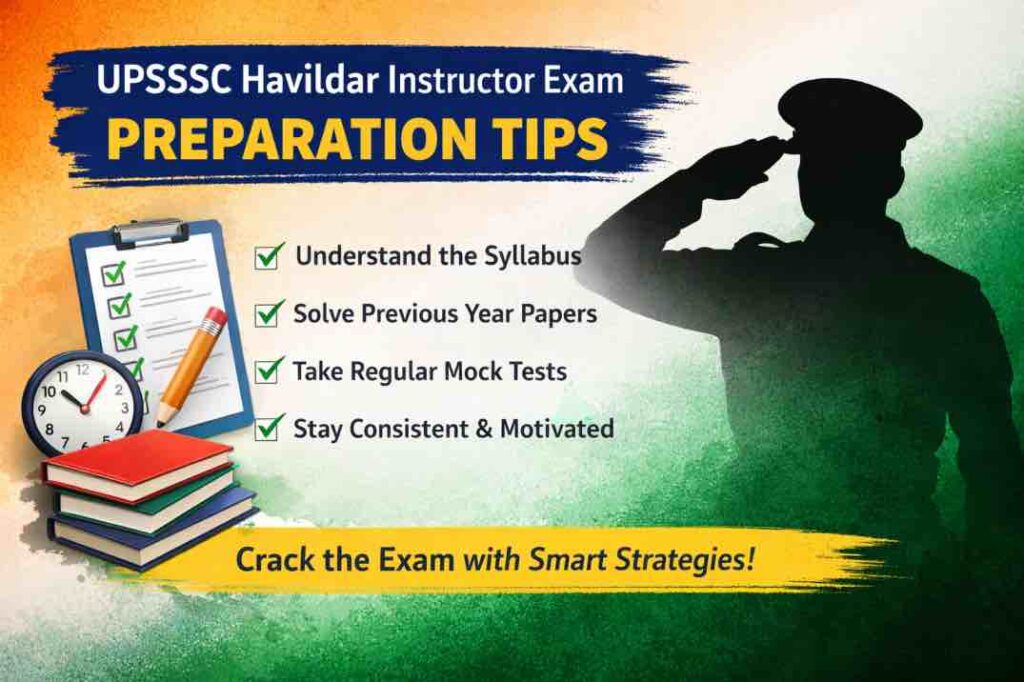
Table of Contents
ToggleUPSSSC Havaldar Instructor Previous Year Question Paper
The UPSSSC Havaldar Instructor Previous Year Question Paper is one of the most important resources for candidates preparing for this competitive exam. Conducted by the Uttar Pradesh Subordinate Services Selection Commission (UPSSSC), this recruitment offers a stable government job with responsibilities related to training, discipline, and physical instruction.
In recent years, the competition for this post has increased significantly due to limited vacancies and high demand. If you are serious about clearing this exam, solving previous year question papers (PYQs) is not optional—it is essential. This article will guide you through exam pattern, overview, PYQs, PDF downloads, best books, and preparation strategy.
Connect with Us
Exam Overview
| Particular | Details |
|---|---|
| Organization | Uttar Pradesh Subordinate Services Selection Commission (UPSSSC) |
| Post Name | Havildar Instructor |
| Total Vacancies | 200+ (Approx.) |
| Qualification | 12th Pass |
| Age Limit | 18–40 Years |
| Selection Process | PET Score → Written Exam → Physical Test → Document Verification |
| Job Location | Uttar Pradesh |
| Salary | ₹25,000 – ₹40,000 (Expected) |
The role of a Havildar Instructor involves maintaining discipline, conducting physical training, and supervising trainees in government institutions.
Exam Pattern Table
| Subject | No. of Questions | Marks | Level |
|---|---|---|---|
| General Knowledge | 25 | 25 | Moderate |
| General Hindi | 20 | 20 | Easy–Moderate |
| Reasoning Ability | 20 | 20 | Moderate |
| Mathematics | 20 | 20 | Moderate |
| Computer Knowledge | 15 | 15 | Basic |
| Total | 100 Questions | 100 Marks | — |
- Total Questions: 100
- Duration: Approx. 2 hours
- Type: Objective (MCQ)
- Negative Marking: Expected (as per UPSSSC pattern)
The written exam typically includes subjects like GK, Hindi, Reasoning, Maths, and Computer knowledge.
| Exam Name | Year | Shift | Download PDF |
|---|---|---|---|
| UPSSSC Havaldar Instructor Previous Year Question Paper | 2022 | Shift 1 | Download PDF |
| UPSSSC Havaldar Instructor Previous Year Question Paper | 2022 | Shift 2 | Download PDF |
UPSSSC Havildar Instructor Previous Year Question Paper
Practicing UPSSSC Havildar Instructor previous year question paper gives you a clear idea about:
- Question difficulty level
- Important topics
- Repeated questions
- Time management strategy
Benefits of Solving PYQs
- Exam Pattern Understanding
You get familiar with real exam format and marking scheme. - Important Topics Identification
Frequently asked topics like GK and Reasoning become clear. - Speed & Accuracy Improvement
Regular practice improves solving speed. - Confidence Boost
Solving actual exam papers reduces exam fear. - Self-Assessment
You can evaluate your preparation level easily.
UPSSSC Havildar Instructor Previous Year Question Paper PDF
Many candidates search for:
- upsssc havildar instructor previous year question paper pdf
- upsssc havildar instructor pyqs
These PDFs are extremely helpful because:
- They are downloadable and accessible offline
- You can practice anytime
- They simulate real exam conditions
UPSSSC Havildar Instructor Previous Year Question Paper Download with Solution
Downloading PYQs with solutions is even more beneficial because:
- You understand the correct approach
- You learn shortcuts and tricks
- You avoid repeating mistakes
Advantages of Solved Papers
- Concept clarity improves
- Helps in revision
- Builds strong fundamentals
Candidates should always prefer question papers with detailed solutions rather than just PDFs without answers.
📚 Read More
UPSSSC Havildar Instructor PYQs – Subject Wise Analysis
1. General Knowledge
- History, Geography, Polity
- Current Affairs
- Uttar Pradesh Special GK
2. General Hindi
- Grammar (Sandhi, Samas)
- Synonyms & Antonyms
- Sentence correction
3. Reasoning
- Coding-Decoding
- Series
- Blood Relation
- Puzzle
4. Mathematics
- Percentage
- Profit & Loss
- Time & Work
- Ratio & Proportion
5. Computer Knowledge
- MS Office basics
- Internet
- Hardware & Software
Best Books for UPSSSC Havildar Instructor Preparation
1. General Knowledge
- Lucent’s General Knowledge
- Arihant GK Book
2. Hindi
- Lucent Hindi
- Samanya Hindi by Arihant
3. Reasoning
- R.S. Aggarwal Reasoning
- Kiran Reasoning Book
4. Mathematics
- R.S. Aggarwal Quantitative Aptitude
- Fast Track Arithmetic
5. Computer
- Objective Computer Awareness by Arihant
Book Selection Tips
- Always choose latest editions
- Prefer books with practice questions
- Avoid too many books—stick to limited resources
Preparation Tips for UPSSSC Havildar Instructor Exam
Preparing for the UPSSSC Havildar Instructor exam requires a balanced approach that combines conceptual clarity, practice, and consistency. Below are detailed preparation tips explained through subheadings to help you structure your study effectively.
1. Understand the Syllabus Thoroughly
Before starting your preparation, it is essential to go through the complete syllabus. Knowing what to study—and what not to—saves time and effort. Break down each subject into smaller topics such as History, Polity, Arithmetic, and Grammar. This helps you create a focused study plan and prevents unnecessary confusion. When you clearly understand the syllabus, your preparation becomes more targeted and efficient.
2. Analyze Previous Year Question Papers
Previous year question papers (PYQs) are one of the most powerful tools in your preparation. They help you identify important topics, repeated questions, and the overall difficulty level of the exam. Solve at least 8–10 years of papers and observe patterns. For example, certain topics in GK or Reasoning are frequently repeated. This analysis allows you to prioritize high-weightage topics and prepare smartly rather than randomly.
3. Build Strong Fundamentals
Many candidates make the mistake of jumping directly to advanced questions without strengthening their basics. Subjects like Mathematics and Reasoning require clear concepts. Focus on understanding formulas, rules, and logic rather than memorizing solutions. A strong foundation ensures that you can solve even unfamiliar questions during the exam.
4. Create a Realistic Study Plan
A proper study plan helps you stay consistent and disciplined. Divide your daily schedule into subject-wise slots and allocate time according to your strengths and weaknesses. For example, if Mathematics is your weak area, give it more time. Ensure that your timetable includes revision and practice sessions as well. A realistic plan is one that you can follow consistently without burnout.
5. Practice Mock Tests Regularly
Mock tests simulate the real exam environment and help you improve time management. Attempt full-length tests at least once a week and gradually increase frequency. While attempting mocks, try to complete the paper within the given time limit. After each test, analyze your performance carefully—identify mistakes, weak areas, and time-consuming sections.
6. Focus on Accuracy Along with Speed
Speed is important, but accuracy matters more due to negative marking. Avoid guessing answers blindly. Instead, focus on solving questions correctly. With regular practice, your speed will automatically improve. Develop strategies such as skipping difficult questions and returning to them later to save time.
7. Revise Regularly
Revision is the key to long-term retention. No matter how much you study, without revision you will forget important concepts. Make short notes for formulas, facts, and important points. Revise these notes weekly. Subjects like GK and Computer Knowledge require frequent revision to keep information fresh in your memory.
8. Improve General Knowledge and Current Affairs
General Knowledge plays a crucial role in this exam. Focus on static GK as well as current affairs related to Uttar Pradesh and national events. Read newspapers, monthly current affairs magazines, or use reliable online sources. Make short notes of important events, schemes, and updates for quick revision.
9. Maintain Physical Fitness
Since the selection process may include a physical test, maintaining fitness is equally important. Regular exercise, running, and basic physical training should be part of your routine. This will not only help you clear the physical test but also improve your overall stamina and concentration during preparation.
10. Stay Consistent and Motivated
Consistency is more important than studying for long hours occasionally. Study daily with focus and dedication. Set small, achievable goals and track your progress. Staying motivated throughout the preparation journey is crucial, especially during challenging phases. Keep reminding yourself of your goal and the benefits of securing a government job.
Final Thought
A well-planned strategy combined with regular practice and revision can significantly increase your chances of success in the UPSSSC Havildar Instructor exam. Focus on understanding concepts, practicing PYQs, and maintaining consistency throughout your preparation journey.
Conclusion
The UPSSSC Havildar Instructor Previous Year Question Paper is a powerful tool that can significantly boost your preparation. From understanding the exam pattern to improving speed and accuracy, PYQs play a crucial role in success.
With proper strategy, regular practice, and the right study material, cracking this exam becomes much easier. Focus on consistency, revise regularly, and make PYQs a part of your daily routine.
If you are serious about selection, start solving previous year papers today—because smart preparation always beats hard preparation.
Frequently Asked Questions (FAQs)
The UPSSSC Havildar Instructor exam is a state-level recruitment exam conducted by the Uttar Pradesh Subordinate Services Selection Commission to select candidates for the Havildar Instructor post.
Previous year question papers help candidates understand the exam pattern, difficulty level, and important topics frequently asked in the exam.
You can download previous year question papers from official websites, exam preparation portals, or educational blogs that provide free PDF downloads.
Yes, many platforms provide previous year question papers with detailed solutions to help candidates understand the correct approach.
The written exam typically consists of 100 objective-type questions covering multiple subjects.
Negative marking is usually applicable as per UPSSSC exam pattern, but candidates should check the official notification for confirmation.
The exam includes General Knowledge, General Hindi, Reasoning, Mathematics, and Computer Knowledge.
You should solve previous papers regularly, analyze mistakes, and revise important topics to improve your performance.
Books like Lucent GK, R.S. Aggarwal for Reasoning and Maths, and Arihant Computer Awareness are commonly recommended for preparation.



Pingback: UP Home Guard Answer Key 2026 – Download -