📅 Published on: 29.08.2026
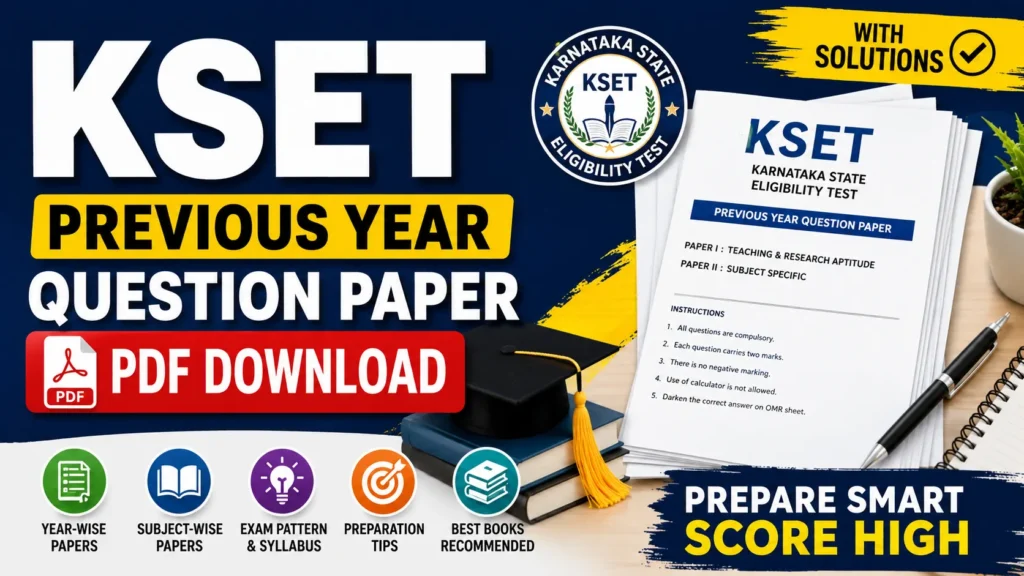
Table of Contents
ToggleKSET Previous Year Question Paper
Introduction
The KSET previous year question paper is one of the most useful resources for candidates preparing for the Karnataka State Eligibility Test (KSET). Solving previous papers helps candidates understand the actual level of the examination, the type of questions asked, important topics, and the distribution of questions between Paper I and Paper II.
KSET, or Karnataka State Eligibility Test, is conducted to determine the eligibility of candidates for Assistant Professor positions in universities and colleges across Karnataka. The examination includes two papers: Paper I, which tests teaching and research aptitude, and Paper II, which tests subject-specific knowledge.
🌐 Connect with Us
Candidates can use the KSET previous year question paper PDF for repeated practice, revision, mock-test preparation, and self-assessment. Previous papers are available for several subjects and years, making them valuable for both beginners and candidates who are revising the complete syllabus.
KSET Exam Overview
| Particulars | Details |
|---|---|
| Exam Name | Karnataka State Eligibility Test |
| Short Name | KSET |
| Conducting Authority | Karnataka Examinations Authority (KEA) |
| Purpose | Eligibility for Assistant Professor |
| Mode of Exam | Offline/OMR-based |
| Number of Papers | 2 |
| Paper I | Teaching & Research Aptitude |
| Paper II | Subject-specific |
| Total Questions | 150 |
| Total Marks | 300 |
| Question Type | Multiple Choice Questions |
| Negative Marking | No negative marking |
| Exam Duration | 3 hours |
The KSET examination is designed around the UGC-NET-style structure. Paper I is common to candidates and focuses on teaching and research aptitude, while Paper II is based on the subject selected by the candidate.
KSET Exam Pattern
Understanding the exam pattern before solving previous papers is important. The examination consists of two compulsory papers carrying a combined total of 300 marks.
| Paper | Subject | Questions | Marks | Duration |
|---|---|---|---|---|
| Paper I | Teaching & Research Aptitude | 50 | 100 | Included in 3 hours |
| Paper II | Selected Subject | 100 | 200 | Included in 3 hours |
| Total | — | 150 | 300 | 3 hours |
All questions are objective-type MCQs, and each correct answer carries two marks. There is no negative marking for incorrect answers.
Paper I
Paper I is common for all KSET candidates. It evaluates areas such as teaching aptitude, research aptitude, comprehension, communication, reasoning, data interpretation, ICT, people and environment, and higher education-related topics. Candidates should regularly solve Paper I questions to improve both accuracy and speed.
Paper II
Paper II is subject-specific and contains 100 compulsory questions. The paper tests the candidate's knowledge of the subject selected during the application process. Therefore, candidates should download the KSET previous year question paper for their particular subject and solve papers from multiple years.
KSET Previous Year Question Paper
The KSET previous year question paper gives candidates an opportunity to experience the examination before appearing for the actual test. Instead of relying only on theoretical study, candidates can use old question papers to identify how concepts are converted into objective questions.
Previous KSET papers are available for subjects such as Commerce, Kannada, Economics, English, Political Science, History, Sociology, Geography, Management, Education, Law, Computer Science, Physical Sciences, Mathematical Sciences, Chemical Sciences, Life Sciences, Environmental Science, Home Science, Electronic Science, Philosophy, Music, Performing Arts and several other subjects.
Candidates should preferably solve papers in chronological order. Start with an older paper to understand the general format and then move toward the latest available papers. This approach can help identify recurring concepts and changes in the difficulty level.
KSET General Question Paper PDF with Answer Key
KSET Question Paper 2020 PDF Download
| S.No. | Subject | KSET Question Paper 2020 PDF |
|---|---|---|
| 1 | Criminology | Download PDF |
| 2 | Mass Communication and Journalism | Download PDF |
| 3 | Tourism and Administration | Download PDF |
| 4 | Electronic Science | Download PDF |
| 5 | Physical Education | Download PDF |
| 6 | Anthropology | Download PDF |
| 7 | Economics | Download PDF |
| 8 | Music | Download PDF |
| 9 | Mathematical Sciences | Download PDF |
| 10 | Public Administration | Download PDF |
| 11 | Hindi | Download PDF |
| 12 | Environmental Science | Download PDF |
| 13 | History | Download PDF |
| 14 | Education | Download PDF |
| 15 | Psychology | Download PDF |
| 16 | Earth Science | Download PDF |
| 17 | Marathi | Download PDF |
| 18 | Law | Download PDF |
| 19 | Commerce | Download PDF |
| 20 | Visual Arts | Download PDF |
| 21 | Linguistics | Download PDF |
| 22 | Folk Literature | Download PDF |
| 23 | Sociology | Download PDF |
| 24 | Chemical Science | Download PDF |
| 25 | English | Download PDF |
| 26 | Management | Download PDF |
| 27 | Computer Science and Applications | Download PDF |
| 28 | Home Science | Download PDF |
| 29 | Social Work | Download PDF |
| 30 | Kannada | Download PDF |
| 31 | Sanskrit | Download PDF |
| 32 | Library and Information Science | Download PDF |
| 33 | Performing Arts | Download PDF |
| 34 | Urdu | Download PDF |
| 35 | Archaeology | Download PDF |
| 36 | Philosophy | Download PDF |
| 37 | Geography | Download PDF |
| 38 | Life Science | Download PDF |
| 39 | Political Science | Download PDF |
| 40 | Physical Sciences | Download PDF |
KSET Previous Year Question Paper PDF – Paper 2 & Paper 3
| Year | Paper | Question Paper PDF | Answer Key |
|---|---|---|---|
| 2017 | Paper 2 | Download Paper 2 | Answer Key |
| Paper 3 | Download Paper 3 | ||
| 2018 | Paper 2 | Download Paper 2 | Answer Key |
| Paper 3 | Download Paper 3 | ||
| 2016 | Paper 2 | Download Paper 2 | Answer Key |
| 2015 | Paper 2 | Download Paper 2 | Answer Key |
| Paper 3 | Download Paper 3 | ||
| 2014 | Paper 2 | Download Paper 2 | Answer Key |
| Paper 3 | Download Paper 3 | ||
| 2013 | Paper 2 | Download Paper 2 | — |
| Paper 3 | Download Paper 3 | — |
Note: The answer keys listed above are provided for the respective KSET examination years. Candidates should verify the paper year and subject before using an answer key.
KSET Previous Year Question Paper – PDF Download
Candidates searching for a KSET previous year question paper - PDF download should use reliable educational resources and official examination updates wherever available. Several online repositories provide year-wise KSET question papers, while some also provide answer keys.
A year-wise collection can help candidates compare papers from different examination cycles. Candidates should download papers relevant to their selected subject and use them as practice tests during preparation.
Follow these steps to use the PDFs effectively:
- Select the KSET subject in which you are appearing.
- Download the available previous year question paper PDF.
- Keep the latest syllabus beside you while solving it.
- Attempt the paper without referring to notes.
- Record the number of correct and incorrect answers.
- Analyse every incorrect question after completing the paper.
- Revise the topics where mistakes are repeated.
KSET Previous Year Question Paper – PDF Download with Solution
Practising a KSET previous year question paper - PDF download with solution is more beneficial than simply reading old questions. A solved paper allows candidates to understand why a particular option is correct and why other options are incorrect.
After completing a paper, calculate your score and classify mistakes into three categories:
- Conceptual mistakes: The topic needs to be studied again.
- Memory-based mistakes: Important facts, terms or definitions need revision.
- Careless mistakes: More attention is required while reading the question.
Candidates should maintain a mistake notebook. Write down difficult questions, incorrect concepts and important facts from each paper. Revisiting this notebook during the final revision can save considerable time.
Answer keys are particularly useful for objective examinations because they allow candidates to verify their responses immediately. However, candidates should check that the answer key corresponds to the correct subject, year and question-paper set.
Benefits of Solving KSET Previous Year Question Papers
- Understand the real exam pattern: Previous papers show how questions are actually framed.
- Identify important topics: Repeated questions and concepts can reveal high-priority areas.
- Improve time management: Full-length papers help candidates practise completing 150 questions within the prescribed time.
- Increase accuracy: Regular practice reduces careless errors.
- Understand difficulty level: Candidates can compare easy, moderate and difficult questions.
- Improve confidence: Familiarity with the question format can reduce examination anxiety.
- Test preparation level: Previous papers provide a practical measure of preparation.
- Strengthen revision: Solving questions helps reinforce concepts studied from books and notes.
- Identify weak areas: Mistakes indicate which units require additional preparation.
- Develop an attempt strategy: Since KSET has no negative marking, candidates can plan their attempts accordingly.
Preparation Tips for KSET
1. Understand the Complete Syllabus
Start preparation by downloading and reviewing the latest KSET syllabus. Divide Paper I and Paper II into individual units and identify the topics you already know and those requiring more attention. A syllabus-based approach prevents unnecessary study and keeps preparation focused.
2. Solve KSET Previous Year Question Papers
Make the KSET previous year question paper an important part of your preparation strategy. Begin with untimed practice and gradually move toward full-length timed tests. After every paper, analyse your mistakes instead of simply checking your score.
3. Prepare Paper I Regularly
Paper I is common to all candidates, so it should not be ignored while focusing on the subject paper. Study teaching aptitude, research aptitude, reasoning, comprehension, ICT, data interpretation and other prescribed areas. Practising a small number of Paper I questions every day can improve consistency.
4. Give More Time to Paper II
Paper II carries 200 marks and therefore requires extensive subject preparation. Divide the subject syllabus into manageable units and complete them systematically. After finishing each unit, solve related previous-year questions to determine whether you can apply the concepts.
5. Take Full-Length Mock Tests
Once you have completed a significant portion of the syllabus, start taking full-length mock tests. Try to recreate the examination environment and complete both papers within three hours. Analyse your score, speed and accuracy after every test.
6. Maintain a Revision Notebook
Prepare short notes for formulas, definitions, theories, important scholars, dates, concepts and frequently repeated facts. Add mistakes from previous papers to the same notebook. Revise these notes regularly, particularly during the final weeks before the examination.
7. Analyse Repeated Concepts
Do not merely count repeated questions. Identify the underlying concept behind them. A question may appear differently in another examination while testing the same concept. Understanding the concept gives you an advantage over memorising old questions.
Best Books for KSET Preparation
Candidates should select books according to their chosen KSET subject. For Paper I, standard UGC-NET/SET Teaching and Research Aptitude books can be useful because the syllabus and examination approach are closely aligned with the UGC framework.
For Paper II, candidates should prefer standard postgraduate-level textbooks recommended for their subject. Useful resources generally include:
- UGC NET/SET Paper I – Teaching & Research Aptitude books by established competitive-exam publishers.
- Previous Years' Solved Papers for UGC NET/SET for additional objective practice.
- Subject-specific UGC NET books covering the complete Paper II syllabus.
- Standard university-level textbooks for detailed conceptual understanding.
- KSET previous year question paper collections for realistic examination practice.
Rather than collecting too many books, candidates should select one comprehensive book for each paper and combine it with standard subject textbooks, notes, mock tests and previous papers.
How to Use Previous Papers During Revision
During the initial preparation stage, solve individual sections or units from old papers. In the middle stage, attempt complete Paper I and Paper II papers separately. During the final revision stage, solve complete papers under examination conditions.
Maintain a simple record containing the date, paper attempted, score, incorrect questions and weak topics. If the same topic repeatedly causes mistakes, revise it before attempting another paper. This converts previous papers from simple practice material into a structured preparation tool.
The availability of subject-wise previous papers makes it possible to practise according to the candidate's selected discipline.
Conclusion
The KSET previous year question paper - PDF download is an essential resource for candidates preparing for the Karnataka State Eligibility Test. Previous papers help candidates understand the question pattern, identify important topics, improve speed and accuracy, and evaluate their preparation.
Candidates should not wait until the final days to start solving previous papers. Include them from the early stages of preparation and gradually increase the difficulty by attempting complete papers within the actual time limit. Combine previous-year papers with the latest syllabus, standard books, revision notes and mock tests for a balanced strategy.
Most importantly, do not simply solve a paper and check the score. Analyse every mistake, revise the related concept and attempt the question again later. Consistent practice with the KSET previous year question paper can make preparation more focused, systematic and examination-oriented.
📚 Read More Articles
Frequently Asked Questions (FAQs) on KSET Previous Year Question Paper
Where can I download the KSET previous year question paper PDF?
Candidates can download KSET previous year question papers from reliable educational resources and official examination-related sources. It is recommended to select the paper according to the subject and year required for preparation.
Why should I solve the KSET previous year question paper?
Solving the KSET previous year question paper helps candidates understand the exam pattern, difficulty level, frequently tested topics and question style. It also improves speed, accuracy and confidence before the examination.
How many papers are there in the KSET examination?
The KSET examination consists of two papers. Paper I tests teaching and research aptitude, while Paper II evaluates knowledge of the subject selected by the candidate.
How many questions are asked in the KSET exam?
The KSET examination has a total of 150 questions. Paper I contains 50 questions, while Paper II contains 100 questions.
Is there negative marking in KSET?
No, there is generally no negative marking for incorrect answers in the KSET examination. Candidates should, however, always verify the marking scheme in the latest official examination notification.
Can I get KSET previous year question papers with solutions?
Yes, solved KSET previous year question papers and answer keys may be available for different subjects and examination years. Candidates should ensure that the solution or answer key corresponds to the correct paper and subject.
How should I use KSET previous year question papers for preparation?
Begin by solving individual sections or units without time pressure. Later, attempt complete papers within the prescribed examination duration. Analyse incorrect answers after every attempt and revise the topics responsible for repeated mistakes.
Which books are best for KSET preparation?
For Paper I, candidates can use standard Teaching and Research Aptitude books designed for UGC NET and SET examinations. For Paper II, standard subject-specific textbooks and reliable UGC NET/SET preparation books should be combined with previous year papers and mock tests.
How many KSET previous year papers should I solve?
Candidates should try to solve as many relevant previous year papers as possible, preferably from multiple examination cycles. Solving several papers helps identify recurring concepts, improve time management and assess preparation more effectively.