📅 Published on: 02.05.2026
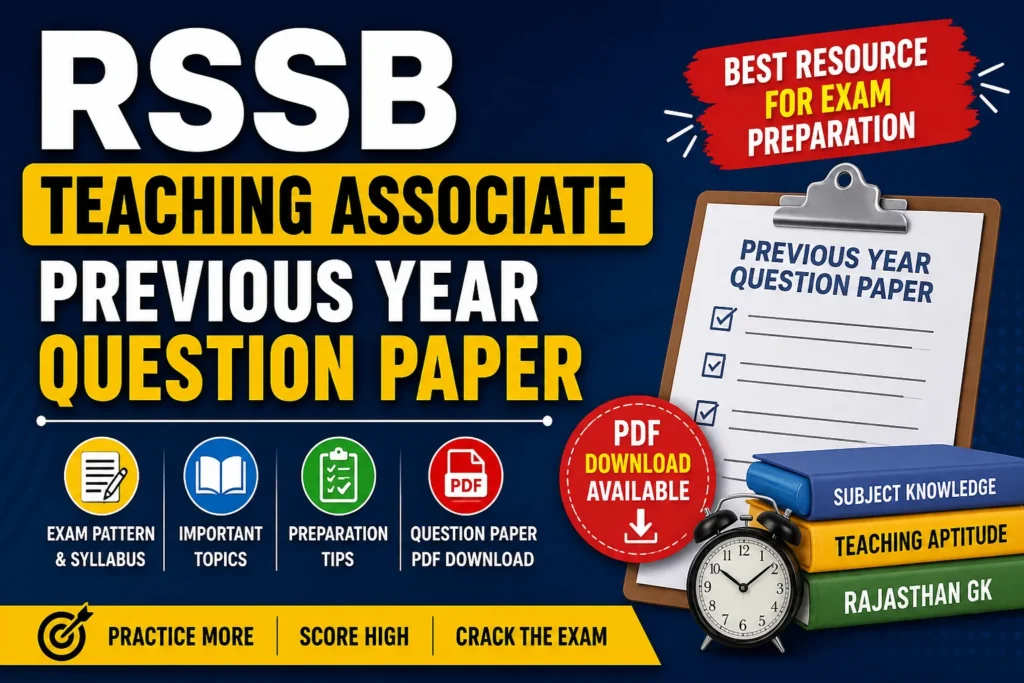
Table of Contents
ToggleRSSB Teaching Associate Previous Year Question Paper – Complete Guide
The rssb teaching associate previous year question paper is one of the most important resources for candidates preparing for the Rajasthan Teaching Associate exam. Conducted by the Rajasthan Staff Selection Board, this exam offers a great opportunity for aspirants aiming to build a career in teaching across Rajasthan. With the 2026 recruitment notification already released for thousands of vacancies, competition is expected to be intense.
Connect with Us
Introduction to RSSB Teaching Associate Exam
The RSSB Teaching Associate recruitment is a state-level examination conducted to select qualified candidates for teaching roles in various subjects. According to recent updates, the exam is expected to be conducted between August and October 2026.
Candidates applying for this post must typically have postgraduate qualifications along with eligibility tests like NET/SET/SLET or a Ph.D., making it a highly competitive exam.
To crack such an exam, solving rssb teaching associate previous year question paper is not optional—it is essential.
Importance of RSSB Teaching Associate Previous Year Question Paper
Practicing previous year papers gives you a real understanding of the exam. Here’s why they matter:
1. Understand Exam Pattern
Previous papers help you understand the structure of the exam, types of questions, and marking scheme.
2. Identify Important Topics
Repeated questions highlight high-weightage topics that you should prioritize.
3. Improve Speed and Accuracy
Regular practice improves time management and reduces mistakes.
4. Analyze Difficulty Level
You get a realistic idea of the exam difficulty, helping you plan your preparation accordingly.
5. Boost Confidence
Solving real exam papers increases confidence before the actual exam.
RSSB Teaching Associate Exam Pattern (Expected)
| Section | Topics | Marks |
|---|---|---|
| General Knowledge | Rajasthan GK, Current Affairs | 50 |
| Subject Knowledge | Relevant Subject (PG Level) | 150 |
| Teaching Aptitude | Pedagogy, Education Psychology | 50 |
| Language | Hindi & English | 50 |
| Total | — | 300 Marks |
Mode: Offline (OMR based)
Duration: 2–3 hours
Type: Objective (MCQs)
Types of Questions Asked in RSSB Teaching Associate Previous Year Question Paper
When you analyze the rssb teaching associate previous year question paper, you will notice these common question types:
1. Concept-Based Questions
Focused on subject fundamentals (e.g., History, Science, Literature).
2. Application-Based Questions
Require practical understanding rather than rote learning.
3. Pedagogy Questions
Based on teaching methods, child psychology, and classroom management.
4. Current Affairs
Especially related to Rajasthan state.
5. Language Questions
Grammar, comprehension, and vocabulary.
How to Download RSSB Teaching Associate Previous Year Question Paper PDF
You can download the rssb teaching associate previous year question paper by following these steps:
- Visit the official website of RSSB
- Go to the “Question Papers” or “Old Papers” section
- Select exam year and exam name
- Download the PDF
Preparation Tips for RSSB Teaching Associate Exam
1. Understand the Complete Syllabus Thoroughly
Before starting your preparation, carefully go through the official syllabus. Divide it into smaller topics and create a realistic study plan. Focus more on high-weightage areas such as subject knowledge, Rajasthan GK, and teaching aptitude. A clear understanding of the syllabus ensures that you do not waste time on irrelevant topics and stay focused on what actually matters in the exam.
2. Analyze RSSB Teaching Associate Previous Year Question Paper
One of the most effective strategies is to analyze the rssb teaching associate previous year question paper. This helps you understand the types of questions, difficulty level, and important topics that are frequently asked. Make notes of repeated questions and concepts, as they have a high probability of appearing again in the exam.
3. Build Strong Conceptual Clarity
Instead of rote learning, focus on understanding concepts deeply, especially in your core subject. Since the exam includes postgraduate-level questions, conceptual clarity is essential. Use standard textbooks and reference materials to strengthen your fundamentals and ensure long-term retention.
4. Practice Regular Mock Tests
Mock tests play a crucial role in exam preparation. Attempt full-length tests in a timed environment to simulate real exam conditions. This helps improve speed, accuracy, and time management. After each test, analyze your performance and work on weak areas.
5. Focus on Rajasthan General Knowledge
Rajasthan GK is an important section in the exam. Cover topics such as history, geography, culture, and current affairs related to Rajasthan. Regular reading of newspapers and monthly current affairs magazines will help you stay updated and score well in this section.
6. Strengthen Teaching Aptitude and Pedagogy
Questions related to teaching methods, classroom management, and child psychology are commonly asked. Refer to B.Ed level books and focus on practical teaching scenarios. Understanding how to handle real classroom situations will help you answer these questions more effectively.
7. Improve Time Management Skills
Time management is key to cracking the exam. Practice solving questions within a fixed time limit. Learn to prioritize easy questions first and avoid spending too much time on difficult ones. This strategy will help you attempt maximum questions accurately.
8. Revise Regularly
Revision is essential to retain what you have studied. Create short notes for important topics and revise them frequently. Weekly and monthly revision cycles will help you strengthen your memory and reduce last-minute stress.
9. Maintain Consistency and Stay Motivated
Consistency is more important than studying for long hours occasionally. Set daily goals and stick to your schedule. Stay motivated by tracking your progress and reminding yourself of your goal to become a teaching associate.
Common Mistakes to Avoid
- Ignoring previous year papers
- Not analyzing mistakes
- Focusing only on theory
- Skipping Rajasthan GK
- Lack of revision
Benefits of Solving RSSB Previous Papers Regularly
Consistent practice of rssb teaching associate previous year question paper provides long-term benefits:
- Better retention of concepts
- Improved problem-solving skills
- Familiarity with exam trends
- Increased chances of selection
RSSB Teaching Associate 2026 – Latest Updates
- Over 3500+ vacancies announced
- Exam expected in September–October 2026
- Huge opportunity for teaching aspirants
Conclusion
The rssb teaching associate previous year question paper is a powerful tool that can significantly improve your preparation. It not only helps you understand the exam pattern but also boosts confidence and accuracy.
If you are serious about cracking the RSSB Teaching Associate exam, make previous year papers a daily part of your study routine. Combine them with a proper study plan, revision strategy, and mock tests for the best results.
📚 Read More
FAQs – RSSB Teaching Associate Previous Year Question Paper
It refers to past exam papers conducted by the Rajasthan Staff Selection Board for the Teaching Associate recruitment, which help candidates understand exam trends and question patterns.
You can download the papers from the official RSSB website under the “Old Papers” or “Question Papers” section.
It is recommended to solve at least the last 5–10 years of question papers to get a clear understanding of the exam pattern.
Previous papers are essential for practice, but they should be combined with syllabus study, revision, and mock tests for best results.
The exam generally includes objective-type questions covering subject knowledge, Rajasthan GK, teaching aptitude, and language skills.
Yes, the exam can be challenging due to subject-level depth and high competition among candidates.
While exact questions may not repeat, similar concepts and patterns are frequently seen in multiple exams.
The exam is usually conducted in offline mode using OMR sheets with multiple-choice questions.
Practicing previous papers improves speed, accuracy, and confidence while helping you understand important topics and exam difficulty.