
📅 Published on: 22.04.2026
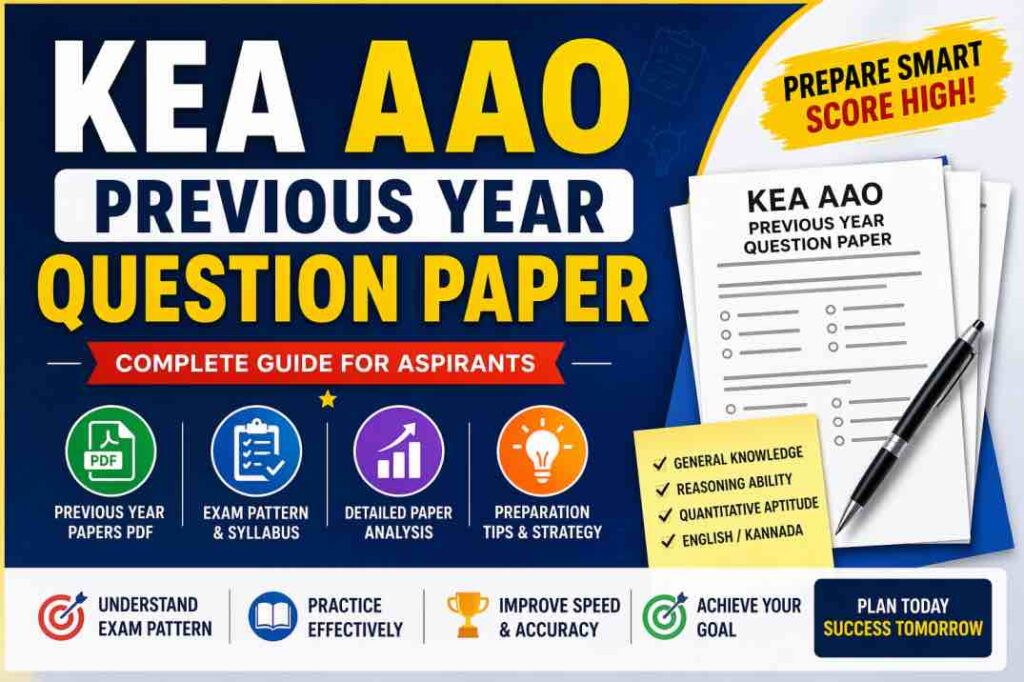
Table of Contents
ToggleKEA AAO Previous Year Question Paper
Preparing for competitive exams requires a smart strategy, and one of the most effective tools is solving previous year question papers. If you are aiming for the Assistant Administrative Officer (AAO) post conducted by Karnataka Examinations Authority (KEA), then understanding the KEA AAO previous year question paper is essential for success.
Connect with Us
Introduction
The KEA AAO exam is a highly competitive recruitment exam conducted to select candidates for administrative roles in Karnataka government departments. With thousands of applicants every year, cracking this exam requires not only conceptual clarity but also familiarity with the exam pattern and question trends.
This is where KEA AAO previous year question papers become a powerful resource. They help candidates understand the structure, difficulty level, and types of questions asked over the years.
Exam Overview
- Exam Conducting Body: Karnataka Examinations Authority (KEA)
- Post Name: Assistant Administrative Officer (AAO)
- Mode of Exam: Offline / Online
- Type of Questions: Objective (MCQs)
- Selection Process:
- Written Examination
- Document Verification
Exam Pattern
- General Knowledge
- Current Affairs
- Indian Polity
- History & Geography
- Karnataka GK
- Language (English/Kannada)
- Grammar
- Vocabulary
- Comprehension
- Reasoning Ability
- Logical Reasoning
- Analytical Problems
- Quantitative Aptitude
- Arithmetic
- Data Interpretation
Key Highlights: 100–150 questions | 2–3 hours duration | Negative marking may apply
KPSC AO / AAO Previous Year Question Paper
KEA AAO Previous Year Question Paper
The KEA AAO previous year question paper is a crucial resource that provides real insight into the exam. Practicing these papers helps candidates understand important topics, exam difficulty, and question trends.
Benefits of Solving KEA AAO Previous Year Question Papers
1. Understand Exam Trends
- Identify frequently asked topics
- Know important sections
2. Improve Time Management
- Enhance speed
- Learn time allocation
3. Self-Assessment
- Analyze strengths and weaknesses
- Improve accuracy
4. Real Exam Experience
Simulates actual exam conditions and reduces stress.
KEA AAO Previous Year Question Paper Analysis
- Difficulty Level: Moderate
- Important Topics: Current Affairs, Karnataka GK, Arithmetic, Reasoning
- Weightage: GK has higher importance
How to Use KEA AAO Previous Year Question Papers
Step 1: Topic-wise Practice
Start by solving questions subject-wise.
Step 2: Full-Length Papers
Solve complete papers with a timer.
Step 3: Analyze Mistakes
Review wrong answers and improve concepts.
Step 4: Revision
Maintain notes and revise regularly.
📚 Read More
KEA AAO Preparation Tips
Preparing effectively for the KEA AAO previous year question paper requires a structured strategy, consistency, and smart study techniques. Below are detailed preparation tips with proper subheadings to help you maximize your performance.
1. Understand the Exam Pattern and Syllabus Thoroughly
Before starting preparation, it is essential to clearly understand the exam pattern and syllabus. Go through all sections such as General Knowledge, Reasoning, Quantitative Aptitude, and Language.
- Identify the weightage of each section
- Focus on high-scoring topics
- Keep the syllabus handy for regular tracking
This step ensures that your preparation stays focused and aligned with the actual exam.
2. Analyze KEA AAO Previous Year Question Papers
The KEA AAO previous year question paper is your most valuable resource. Instead of just solving, deeply analyze each paper.
- Find frequently asked topics
- Understand question patterns
- Note difficulty level variations
This helps you predict important areas and avoid surprises in the exam.
3. Build Strong Conceptual Clarity
Do not rely on rote learning. Focus on understanding concepts, especially in Quantitative Aptitude and Reasoning.
- Clear basic mathematical formulas
- Practice logical reasoning techniques
- Strengthen grammar fundamentals
Strong concepts will help you solve even tricky and new questions easily.
4. Create a Realistic Study Plan
A proper study plan is essential for consistent preparation.
- Divide your day into subject-wise slots
- Allocate more time to weak areas
- Include revision and practice sessions
Example:
- General Knowledge – 2 hours
- Quantitative Aptitude – 1 hour
- Reasoning – 1 hour
- Language – 1 hour
5. Practice Daily with Time Management
Time management plays a crucial role in competitive exams.
- Solve questions with a timer
- Practice speed and accuracy together
- Avoid spending too much time on one question
Regular timed practice improves your efficiency during the actual exam.
6. Focus on Current Affairs and GK
General Knowledge is a scoring section if prepared well.
- Read newspapers daily
- Follow monthly current affairs PDFs
- Focus on Karnataka-specific GK
Revise current affairs regularly to retain information.
7. Take Mock Tests Regularly
Mock tests simulate the real exam environment and help evaluate your preparation.
- Attempt at least 1–2 mock tests per week
- Analyze performance after each test
- Track your progress over time
Mocks help in improving both speed and confidence.
8. Revise Consistently
Revision is the key to long-term retention.
- Maintain short notes for quick revision
- Revise formulas and important facts weekly
- Revisit difficult questions
Without revision, even well-prepared topics can be forgotten.
9. Work on Weak Areas
Identifying and improving weak areas is crucial.
- Analyze mistakes from previous papers
- Practice more questions from weak topics
- Seek help from books or online resources
Turning weak areas into strengths can significantly boost your score.
10. Maintain Consistency and Discipline
Consistency is more important than studying for long hours occasionally.
- Study daily with focus
- Avoid procrastination
- Stay motivated throughout preparation
Even 5–6 hours of focused daily study can yield excellent results over time.
11. Avoid Common Preparation Mistakes
- Skipping analysis of previous papers
- Ignoring revision
- Not practicing with time limits
- Overloading with too many resources
Stick to a limited number of quality resources and revise them thoroughly.
12. Stay Healthy and Positive
Your physical and mental health directly affect your performance.
- Take short breaks during study
- Get proper sleep
- Stay positive and confident
A healthy mind performs better in exams.
Preparation Tips
- Focus on repeated questions
- Practice daily
- Improve speed and accuracy
- Combine with mock tests
Common Mistakes to Avoid
- Skipping analysis
- Ignoring weak areas
- Not practicing with a timer
- Memorizing without understanding
Previous Papers vs Mock Tests
| Feature | Previous Papers | Mock Tests |
|---|---|---|
| Real Questions | Yes | No |
| Pattern Accuracy | High | Moderate |
| Variety | Limited | High |
| Tracking | Basic | Advanced |
Study Plan
- GK – 2 hours daily
- Reasoning – 1 hour
- Math – 1 hour
- Language – 1 hour
Conclusion
The KEA AAO previous year question paper is one of the most effective tools for exam preparation. It helps improve speed, accuracy, and confidence. Regular practice combined with smart strategy can significantly increase your chances of success.
FAQs
The KEA AAO previous year question paper refers to past exam papers of the Assistant Administrative Officer exam conducted by KEA. These papers help candidates understand the exam pattern, difficulty level, and important topics.
Practicing these papers improves time management, boosts confidence, and helps identify frequently asked questions and important topics for better preparation.
You can download KEA AAO previous year question papers from official KEA websites, exam preparation portals, and educational blogs that provide free PDFs.
The difficulty level of the KEA AAO exam is generally moderate, with some sections like reasoning being slightly tricky.
You should aim to solve at least the last 5–10 years of KEA AAO previous year question papers to understand trends and improve performance.
No, previous papers should be combined with mock tests, concept study, and revision for complete preparation.
While exact questions may not repeat, similar concepts and patterns are often asked again, making previous papers very useful.
After solving, check your answers, identify mistakes, note weak areas, and revise those topics regularly.
Yes, beginners can start with topic-wise questions and gradually move to full-length papers for better understanding and confidence.