📅 Published on: 16.05.2026
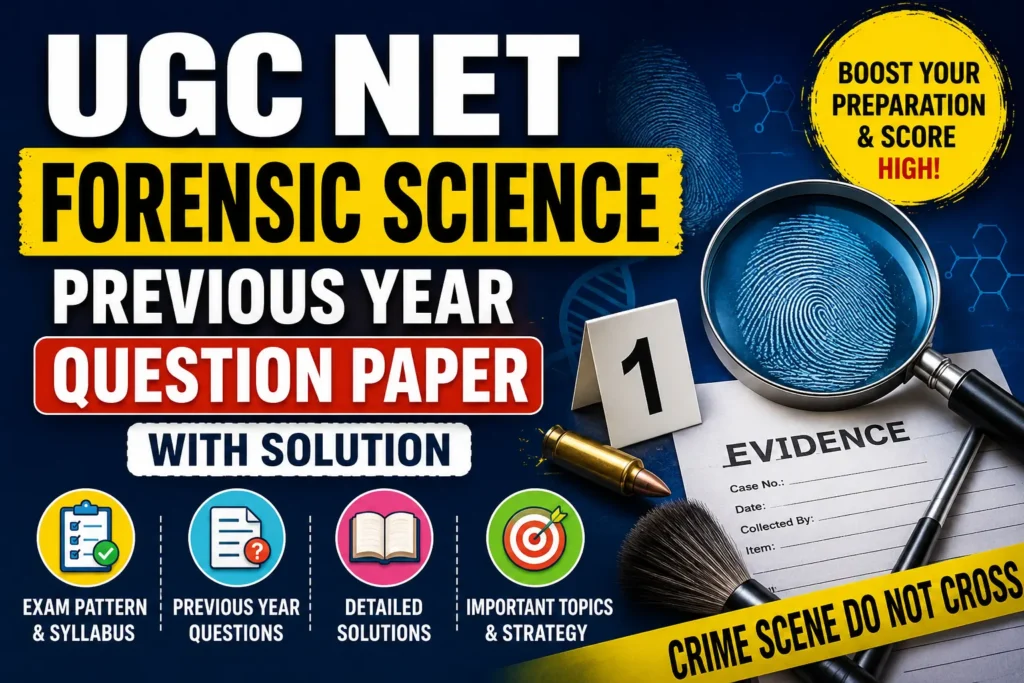
Table of Contents
ToggleUGC NET Forensic Science Previous Year Question Paper
The UGC NET Forensic Science Previous Year Question Paper is one of the most important study resources for candidates preparing for the UGC NET examination. Solving previous year papers helps aspirants understand the exam pattern, difficulty level, important topics, and question trends. It also improves time management and boosts confidence before the actual examination.
Connect with Us
The UGC NET examination is conducted by the National Testing Agency (NTA) to determine eligibility for Assistant Professor and Junior Research Fellowship (JRF) positions in Indian universities and colleges. Forensic Science is a highly specialized subject that requires conceptual clarity, analytical skills, and regular practice. Therefore, practicing the UGC NET Forensic Science Previous Year Question Paper regularly can significantly improve your performance.
UGC NET Forensic Science Exam Overview
| Particulars | Details |
|---|---|
| Exam Name | UGC NET Forensic Science |
| Conducting Body | National Testing Agency (NTA) |
| Exam Level | National Level |
| Purpose | Eligibility for Assistant Professor & JRF |
| Mode of Exam | Computer-Based Test (CBT) |
| Papers | Paper 1 and Paper 2 |
| Language | English & Hindi |
| Frequency | Twice a Year |
| Question Type | Multiple Choice Questions (MCQs) |
UGC NET Forensic Science Exam Pattern
Understanding the exam pattern is essential before solving the UGC NET Forensic Science Previous Year Question Paper.
| Paper | Subjects | Number of Questions | Marks | Duration |
|---|---|---|---|---|
| Paper 1 | Teaching & Research Aptitude | 50 | 100 | Combined 3 Hours |
| Paper 2 | Forensic Science | 100 | 200 | Combined 3 Hours |
| Total | — | 150 | 300 | 3 Hours |
Important Points
- All questions are compulsory.
- Each correct answer carries 2 marks.
- There is no negative marking.
- Paper 2 focuses entirely on Forensic Science concepts and applications.
UGC NET Forensic Science Previous Year Question Paper with Solution
Practicing the UGC NET Forensic Science Previous Year Question Paper with Solution is more effective than solving unsolved papers. Solutions help candidates understand the correct approach and improve conceptual clarity.
Advantages of Solved Papers
- Understand the logic behind answers
- Learn shortcut techniques
- Improve accuracy in MCQs
- Avoid repeating mistakes
- Analyze weak areas effectively
Many coaching institutes and online learning platforms provide solved papers with detailed explanations. Aspirants should compare their answers and evaluate performance after every mock practice session.
Download UGC NET Forensic Science Previous Year Question Paper with Solution PDF
| Year | Session/Paper | Download PDF |
|---|---|---|
| 2024 | UGC NET Forensic Science Question Paper | Download PDF |
| 2023 | UGC NET Forensic Science Question Paper | Download PDF |
| 2022 | UGC NET Forensic Science Question Paper | Download PDF |
| 2021 | UGC NET Forensic Science Question Paper | Download PDF |
| 2020 | UGC NET Forensic Science Question Paper | Download PDF |
| 2019 | UGC NET Forensic Science Question Paper | Download PDF |
| 2018 | UGC NET Forensic Science Question Paper | Download PDF |
| 2014 | Paper 1 | Download PDF |
| Paper 2 | Download PDF | |
| 2013 | June Session | Download PDF |
| December Session | Download PDF | |
| 2012 | June Session | Download PDF |
| December Session | Download PDF | |
| 2011 | June Session | Download PDF |
| 2010 | June Session | Download PDF |
| December Session | Download PDF | |
| 2009 | June Session | Download PDF |
| December Session | Download PDF |
Benefits of Solving UGC NET Forensic Science Previous Year Question Paper
Here are the major benefits of practicing the UGC NET Forensic Science Previous Year Question Paper regularly:
- Helps understand the actual exam structure
- Familiarizes candidates with question difficulty levels
- Improves time management skills
- Enhances speed and accuracy
- Builds exam confidence
- Strengthens conceptual understanding
- Identifies important and repeated topics
- Helps in revision and self-analysis
- Reduces exam anxiety
- Improves problem-solving abilities
Regular practice can significantly increase the chances of qualifying for both Assistant Professor and JRF positions.
Preparation Tips for UGC NET Forensic Science
Understand the Complete Syllabus
Before starting preparation, candidates must thoroughly understand the entire syllabus. Divide the syllabus into smaller sections and allocate sufficient time for each topic. A clear understanding of the syllabus helps avoid confusion and ensures systematic preparation.
Practice Previous Year Papers Regularly
Solving the UGC NET Forensic Science Previous Year Question Paper regularly is one of the best preparation strategies. It helps candidates become familiar with important topics and improves question-solving efficiency. Try solving papers within the actual exam duration to improve speed.
Make Short Notes
Preparing concise notes during study sessions helps in quick revision before the examination. Include formulas, definitions, forensic principles, and important concepts in your notes. These notes become extremely useful during the last phase of preparation.
Focus on Conceptual Clarity
Forensic Science involves practical applications and scientific analysis. Therefore, candidates should focus on understanding concepts rather than memorizing facts. Strong conceptual clarity improves accuracy and helps tackle difficult questions confidently.
Attempt Mock Tests
Mock tests simulate the real examination environment and help improve performance under pressure. After every mock test, analyze mistakes carefully and work on weak areas. Consistent mock practice improves confidence and exam temperament.
Revise Regularly
Revision is essential for retaining important concepts and facts. Candidates should revise topics weekly and dedicate the final month entirely to revision and practice. Consistent revision ensures better memory retention and minimizes confusion during the exam.
Best Books for UGC NET Forensic Science Preparation
| Book Name | Author |
|---|---|
| Textbook of Forensic Medicine and Toxicology | Nagesh Kumar Rao |
| Forensic Science in Criminal Investigation | B.R. Sharma |
| Criminalistics: An Introduction to Forensic Science | Richard Saferstein |
| Forensic Biology | K. Mathiharan |
| Objective Forensic Science | R.P. Yadav |
| UGC NET Paper 1 Guide | Trueman Publications |
Important Topics for UGC NET Forensic Science
While preparing for the UGC NET Forensic Science Previous Year Question Paper, candidates should focus more on high-weightage topics such as:
- DNA Fingerprinting
- Toxicology
- Cyber Forensics
- Fingerprint Analysis
- Ballistics
- Forensic Anthropology
- Bloodstain Pattern Analysis
- Questioned Documents
- Forensic Psychology
- Crime Scene Management
Time Management Strategy
A proper study plan is essential for success in the UGC NET examination.
Suggested Daily Study Routine
- 2 hours for core forensic science subjects
- 1 hour for Paper 1 preparation
- 1 hour for solving MCQs and previous year papers
- 30 minutes for revision
Consistency and disciplined preparation are the keys to cracking the examination.
Common Mistakes to Avoid
Candidates preparing for the UGC NET Forensic Science Previous Year Question Paper should avoid these common mistakes:
- Ignoring Paper 1 preparation
- Not revising regularly
- Depending only on theory
- Avoiding mock tests
- Poor time management
- Skipping previous year papers
- Studying without a schedule
Avoiding these mistakes can improve preparation quality and exam performance.
Conclusion
The UGC NET Forensic Science Previous Year Question Paper is an essential resource for every aspirant preparing for the UGC NET examination. It provides valuable insights into the exam pattern, important topics, and question trends. Regular practice of previous year papers with solutions helps improve accuracy, speed, confidence, and conceptual clarity.
Candidates should combine previous year paper practice with consistent revision, mock tests, and standard study materials to maximize their chances of success. With proper preparation, dedication, and smart study strategies, qualifying for UGC NET Forensic Science becomes much easier.
📘 JEE Physics Previous Year Questions (PYQ)
- 🔹 Units and Dimensions – JEE Mains PYQ
- 🔹 Motion in a Straight Line – JEE Mains PYQ
- 🔹 Laws of Motion – JEE Mains PYQ
- 🔹 Work, Power & Energy – JEE Mains PYQ
- 🔹 Rotational Motion – JEE PYQ
- 🔹 Gravitation – JEE Mains PYQ
- 🔹 Mechanical Properties of Solids – JEE Mains PYQ
- 🔹 Mechanical Properties of Fluids – JEE Mains PYQ
- 🔹 Oscillations – JEE Mains PYQ
- 🔹 Waves – JEE Mains PYQ
- 🔹 Kinetic Theory of Gases – JEE Mains PYQ
- 🔹 Electrostatic Potential & Capacitance – JEE Mains PYQ
- 🔹 Current Electricity – JEE Mains PYQ
- 🔹 Alternating Current – JEE Mains PYQ
- 🔹 Electromagnetic Induction – JEE Mains PYQ
- 🔹 Semiconductors – JEE Mains PYQ
- 🔹 Atoms – JEE Mains PYQ
- 🔹 Agniveer Vayu Previous Year Question Papers
Frequently Asked Questions (FAQs)
The UGC NET Forensic Science Previous Year Question Paper helps candidates understand the exam pattern, important topics, question trends, and difficulty level. It also improves speed, accuracy, and confidence.
The UGC NET Forensic Science exam consists of two papers: Paper 1 for Teaching and Research Aptitude and Paper 2 for the Forensic Science subject.
No, there is no negative marking in the UGC NET Forensic Science examination. Candidates receive marks only for correct answers.
Candidates should focus on understanding the syllabus, solving previous year papers, attempting mock tests, revising regularly, and studying standard forensic science books.
Previous year papers are highly useful, but candidates should also study the complete syllabus, revise concepts, and practice mock tests for comprehensive preparation.
Important topics include DNA Fingerprinting, Toxicology, Cyber Forensics, Ballistics, Fingerprint Analysis, Crime Scene Investigation, and Forensic Biology.
Paper 2 contains 100 multiple-choice questions, and each question carries 2 marks.
Some recommended books include Criminalistics by Richard Saferstein, Forensic Science in Criminal Investigation by B.R. Sharma, and Objective Forensic Science by R.P. Yadav.