📅 Published on: 25.06.2026
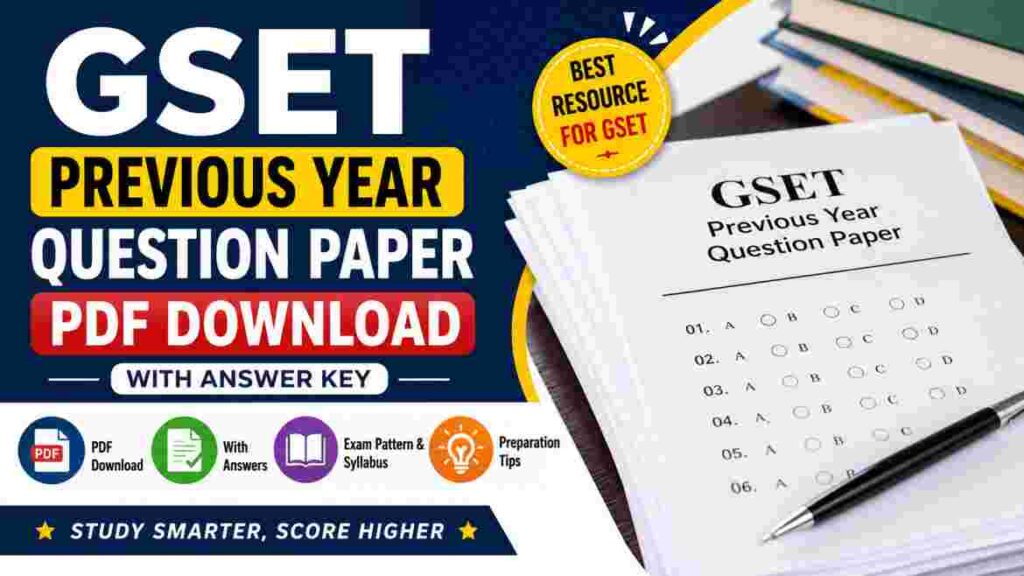
GSET Previous Year Question Paper - PDF Download
Preparing for the Gujarat State Eligibility Test (GSET) requires the right study materials and a smart strategy. One of the most useful resources for candidates is the GSET previous year question paper PDF download. Solving previous papers helps aspirants understand the exam pattern, difficulty level, important topics, and time management techniques.
If you are planning to appear for the GSET exam, downloading and practicing old papers can significantly improve your preparation. In this article, you will find complete information about GSET previous year question paper PDF, exam pattern, benefits, preparation tips, and recommended books.
About GSET Exam
The Gujarat State Eligibility Test (GSET) is conducted to determine the eligibility of candidates for the post of Assistant Professor in colleges and universities of Gujarat. The examination is conducted annually and covers multiple subjects.
GSET Exam Overview Table
| Particulars | Details |
|---|---|
| Exam Name | Gujarat State Eligibility Test (GSET) |
| Conducting Body | Maharaja Sayajirao University of Baroda |
| Exam Level | State Level |
| Purpose | Eligibility for Assistant Professor |
| Mode of Examination | Offline (OMR Based) |
| Number of Papers | 2 Papers |
| Question Type | Multiple Choice Questions |
| Official Website | www.gujaratset.ac.in |
| Negative Marking | No |



GSET Exam Pattern
Understanding the exam pattern is essential before starting preparation. The GSET examination consists of two papers conducted in a single session.
GSET Exam Pattern Table
| Paper | Number of Questions | Marks | Duration |
|---|---|---|---|
| Paper I | 50 Questions | 100 Marks | Combined Duration |
| Paper II | 100 Questions | 200 Marks | 3 Hours Total |
| Total | 150 Questions | 300 Marks | 180 Minutes |
Important Highlights
- All questions are objective type.
- Each question carries 2 marks.
- There is no negative marking.
- Paper I tests teaching and research aptitude.
- Paper II is based on the candidate's selected subject.
GSET Previous Year Question Paper PDF
Candidates should regularly practice the GSET previous year question paper PDF to become familiar with the structure of the examination. Previous papers provide a clear idea about frequently asked topics, weightage of various sections, difficulty level of questions, and time required to solve each paper.
By solving these papers, candidates can improve speed and accuracy, which are crucial for securing qualifying marks.
GSET Previous Year Question Paper 2024 – PDF Download
| S.No. | Subject | Download PDF |
|---|---|---|
| 1 | Mathematical Sciences | Not Available |
| 2 | Physical Sciences | Download PDF |
| 3 | Chemical Sciences | Download PDF |
| 4 | Life Sciences | Download PDF |
| 5 | Earth, Atmospheric, Ocean and Planetary Sciences | Download PDF |
| 6 | History | Download PDF |
| 7 | Geography | Download PDF |
| 8 | Sociology | Download PDF |
| 9 | Economics | Download PDF |
| 10 | Political Science | Download PDF |
| 11 | Philosophy | Download PDF |
| 12 | Psychology | Download PDF |
| 13 | Education | Download PDF |
| 14 | Library and Information Science | Download PDF |
| 15 | Law | Download PDF |
| 16 | Commerce | Download PDF |
| 17 | Management | Download PDF |
| 18 | Computer Science and Applications | Download PDF |
| 19 | Electronic Science | Not Available |
| 20 | Environmental Sciences | Download PDF |
| 21 | Hindi | Download PDF |
| 22 | English | Download PDF |
| 23 | Gujarati | Download PDF |
| 24 | Sanskrit | Download PDF |
| 25 | Urdu | Not Available |
| 26 | Marathi | Not Available |
| 27 | Linguistics | Not Available |
| 28 | Forensic Science | Download PDF |
| 29 | Mass Communication and Journalism | Not Available |
| 30 | Social Work | Download PDF |
| 31 | Home Science | Download PDF |
| 32 | Defence and Strategic Studies | Not Available |
| 33 | Public Administration | Download PDF |
| 34 | Music | Download PDF |
| 35 | Performing Arts (Dance, Drama, Theatre) | Download PDF |
| 36 | Visual Arts | Download PDF |
| 37 | Indian Knowledge System (IKS) | Download PDF |
GSET Previous Year Question Paper PDF Download
Many aspirants search for GSET previous year question paper PDF download to strengthen their preparation. These papers are available subject-wise and year-wise.
Candidates can download papers for subjects such as:
- Commerce
- English
- History
- Political Science
- Economics
- Geography
- Sociology
- Mathematics
- Hindi
- Gujarati
- Computer Science
- Management
Downloading and solving these papers enables candidates to evaluate their preparation level and identify weak areas.
Years Available for Download
- GSET 2025 Question Paper
- GSET 2024 Question Paper
- GSET 2023 Question Paper
- GSET 2022 Question Paper
- GSET 2021 Question Paper
- GSET 2020 Question Paper
GSET Previous Year Question Paper PDF with Answer
Another valuable resource is the GSET previous year question paper PDF with answer. Papers accompanied by answer keys help candidates verify their responses, analyze mistakes, understand the correct approach, improve conceptual clarity, and estimate probable scores.
Practicing papers with solutions gives a better understanding of question trends and enhances confidence before the actual examination.
Benefits of Solving GSET Previous Year Question Papers
- Helps understand the latest exam pattern.
- Improves speed and accuracy.
- Enhances time management skills.
- Builds confidence for the examination.
- Identifies strengths and weaknesses.
- Familiarizes candidates with important topics.
- Assists in self-assessment.
- Reduces exam stress and anxiety.
- Increases chances of qualifying the exam.
- Provides real exam experience.
Preparation Tips for GSET Exam
1. Understand the Syllabus Thoroughly
The first step in preparation is understanding the complete syllabus. Candidates should divide topics into smaller sections and prepare a study plan accordingly. Covering the syllabus systematically prevents confusion and ensures balanced preparation.
Before beginning any topic, candidates should compare it with previous year papers. This helps in identifying high-weightage areas. Prioritizing important topics can save time and improve efficiency.
Making short notes during preparation also helps in revision. Candidates should regularly update these notes with formulas, facts, and key concepts.
A clear understanding of the syllabus provides direction and prevents unnecessary study of irrelevant topics.
2. Solve Previous Year Question Papers Regularly
Practicing old papers is one of the most effective methods for success. Candidates should solve at least five to ten previous year papers before the exam.
Initially, aspirants can solve papers without time restrictions to understand the pattern. Later, they should practice under exam conditions to improve speed.
After solving each paper, candidates must analyze their mistakes carefully. This process helps in avoiding repeated errors and strengthening weak areas.
Regular practice improves confidence and develops familiarity with actual examination standards.
3. Focus on Paper I Preparation
Paper I is common for all candidates and tests teaching aptitude, reasoning ability, comprehension, and research aptitude.
Candidates should devote sufficient time to topics like logical reasoning, data interpretation, reading comprehension, communication, information and communication technology, and higher education systems.
Since Paper I contributes significantly to the overall score, proper preparation can improve qualifying chances.
Consistent practice and revision are essential to score well in this section.
4. Revise Important Topics Frequently
Revision is the key to retaining information. Candidates should reserve the final weeks before the exam exclusively for revision.
Preparing concise notes can make revision faster and more effective. Important formulas, concepts, and facts should be revised repeatedly.
Weekly revision schedules help candidates remember topics for a longer duration. Revisiting previously studied chapters also increases confidence.
Without revision, even well-prepared topics may be forgotten during the examination.
5. Attempt Mock Tests
Mock tests simulate real exam conditions and help candidates assess their preparation level.
By taking regular mock tests, aspirants can improve time management, increase accuracy, identify weak sections, and build confidence.
Performance analysis after each mock test is equally important. Candidates should focus on correcting mistakes and improving their strategy.
Mock tests also help in reducing examination pressure and improving overall performance.
Best Books for GSET Preparation
| Subject | Book Name | Author |
|---|---|---|
| Paper I | Trueman's UGC NET/SET Paper I | M. Gagan & Sajit Kumar |
| Teaching Aptitude | UGC NET Paper I Guide | Arihant Experts |
| Reasoning Ability | A Modern Approach to Verbal and Non-Verbal Reasoning | R.S. Aggarwal |
| Quantitative Aptitude | Quantitative Aptitude | R.S. Aggarwal |
| General Paper I | NTA UGC NET/JRF/SET Paper I | KVS Madaan |
| Subject Paper | Subject-Specific Books | Respective Authors |
| Practice Papers | Previous Year Solved Papers | Arihant Publications |
Importance of Time Management in GSET
Time management plays a vital role in qualifying for the examination. Candidates should allocate separate time slots for theory study, revision, previous year paper practice, and mock tests.
Maintaining a balanced schedule ensures comprehensive preparation and prevents last-minute stress.
Conclusion
The GSET previous year question paper PDF download is one of the most valuable resources for candidates preparing for the Gujarat State Eligibility Test. Practicing old papers helps understand the exam pattern, improve speed, and identify important topics.
Candidates should regularly solve the GSET previous year question paper PDF, use the GSET previous year question paper PDF with answer, and revise consistently for better results. Combined with quality books and mock tests, previous year papers can significantly increase the chances of success in the GSET examination.