
📅 Published on: 02.09.2026
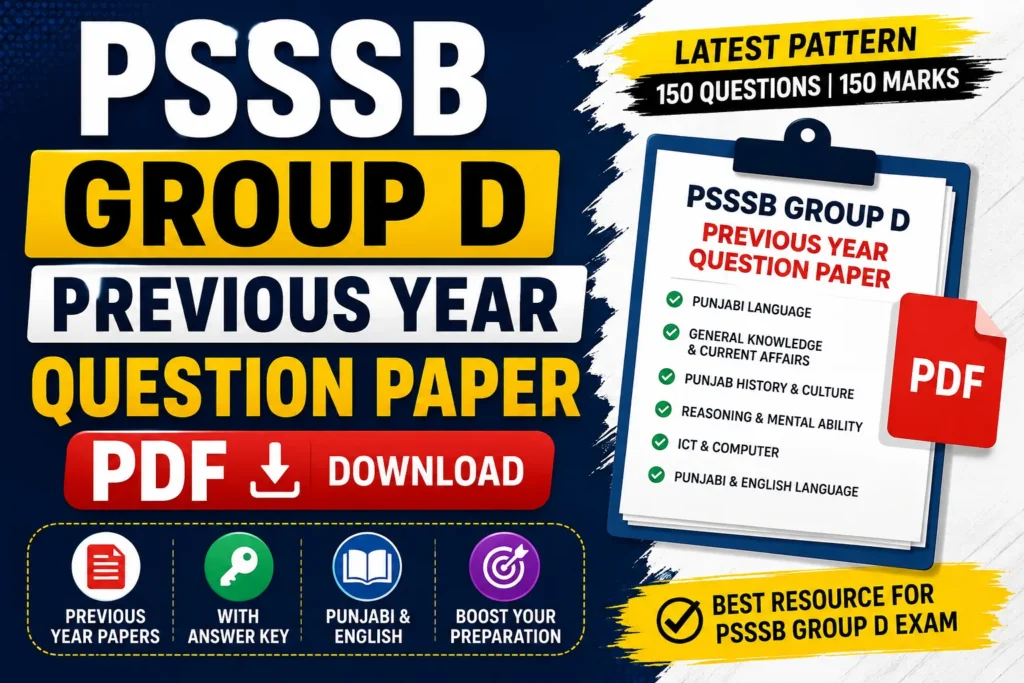
Table of Contents
TogglePSSSB Group D Previous Year Question Paper PDF
Introduction
The PSSSB Group D Previous Year Question Paper PDF is an important study resource for candidates preparing for Punjab Subordinate Services Selection Board (PSSSB) Group D recruitment. Previous year papers help aspirants understand the actual level of questions, important topics, section-wise weightage, and the style in which questions are asked.
🌐 Connect with Us
The PSSSB Group D examination covers subjects such as Punjabi language, General Knowledge and Current Affairs, Punjab History and Culture, Reasoning, Computer/ICT, and Punjabi and English language. The latest examination pattern includes a qualifying Punjabi Language test followed by the main written paper.
Candidates should solve the PSSSB Group D previous year question paper PDF regularly rather than relying only on books or mock tests. Practising actual papers can help candidates identify frequently tested topics and improve speed and accuracy.
PSSSB Group D Exam Overview
Before downloading the PSSSB Group D previous year question paper PDF, candidates should understand the basic details of the examination.
| Particulars | Details |
|---|---|
| Exam Name | PSSSB Group D Examination |
| Conducting Body | Punjab Subordinate Services Selection Board |
| Advertisement | Advt. No. 08/2025 |
| Posts | Various Group D/Class IV Posts |
| Selection Process | Written Examination & Document Verification |
| Exam Mode | Offline |
| Question Type | Multiple Choice Questions |
| Total Questions | 150 |
| Total Marks | 150 |
| Negative Marking | 0.25 mark in Part B |
| Main Exam Duration | 2 Hours |
| Official Website | PSSSB |
The examination pattern includes a qualifying Punjabi Language paper and a main written examination. Candidates should always check the latest official notification for the applicable recruitment details before beginning their preparation.
PSSSB Group D Exam Pattern
The latest PSSSB Group D examination pattern is divided into Part A and Part B. Part A tests Punjabi language ability and is qualifying in nature. Part B contains questions from General Knowledge, Current Affairs, Punjab History and Culture, Reasoning, ICT/Computer, Punjabi and English.
| Part | Subject | Questions | Marks | Duration |
|---|---|---|---|---|
| Part A | Punjabi Language – Qualifying | 50 | 50 | 30 Minutes |
| Part B | General Knowledge & Current Affairs | 25 | 25 | 2 Hours |
| Part B | Punjab History & Culture | 17 | 17 | |
| Part B | Reasoning & Mental Ability | 25 | 25 | |
| Part B | ICT & Computer | 8 | 8 | |
| Part B | Punjabi & English Language | 25 | 25 |
Part B carries negative marking of 0.25 marks for every incorrect answer, while the Punjabi qualifying test does not carry negative marking according to currently available examination-pattern information. Candidates should verify the marking scheme from the latest official notification before the examination.
PSSSB Group D Previous Year Question Paper PDF
PSSSB Group D Previous Year Question Paper 2026
Download the PSSSB Group D Previous Year Question Paper 2026 PDF for exam preparation and practice.
📥 Download PDFThe PSSSB Group D previous year question paper PDF can be used to understand the types of questions asked in the actual examination. The latest available Group D paper can provide a useful benchmark for understanding the current syllabus, question style and difficulty level.
Candidates can use the latest paper as a practice test and compare their performance with the prescribed examination pattern. Previous papers from related PSSSB recruitment examinations can also be useful for practising individual subjects, but candidates should ensure that the syllabus and difficulty level are relevant to Group D preparation.
While downloading any paper, candidates should check the year, post, paper or shift and language before using it for preparation. This is particularly important because PSSSB conducts recruitment for several different posts and their examination patterns can vary.
PSSSB Group D Previous Year Question Paper Download PDF
Candidates searching for PSSSB Group D previous year question paper download PDF should preferably use papers corresponding to the Group D or Class IV recruitment rather than downloading unrelated PSSSB papers.
A simple way to use previous papers is given below:
- Open a reliable previous-paper resource.
- Search for PSSSB Group D Previous Year Papers.
- Select the required year or examination paper.
- Download the PDF or attempt the paper online.
- Solve the complete paper without looking at the answers.
- Check your answers after completing the paper.
- Record incorrect and doubtful questions.
- Revise the topics responsible for mistakes.
Candidates can also use previous PSSSB papers for individual subjects such as Punjabi, Reasoning, English, Computer Knowledge and Punjab History and Culture to strengthen particular sections.
PSSSB Group D Previous Year Question Paper with Answer Key
Practising the PSSSB Group D previous year question paper with answer key is more beneficial than solving a paper without checking the answers. The answer key allows candidates to calculate their approximate score and identify weak areas.
A good practice method is to first attempt the entire paper under examination conditions. Do not check the solution after every question. Once the paper is completed, compare your answers with the answer key and calculate your score.
How to Analyse Your Paper
Correct Questions
Note the topics in which you consistently answer correctly. These areas should be revised periodically but need comparatively less preparation time.
Incorrect Questions
Make a separate list of incorrect answers. Check whether the mistake happened because of a conceptual gap, careless reading, calculation error or lack of knowledge.
Unattempted Questions
Review questions that you could not solve. These can reveal topics that require additional study and practice.
Time Taken
Record how much time you spent on each section. Gradually try to reduce unnecessary time without compromising accuracy.
PSSSB Group D Previous Year Question Paper in Punjabi
For Punjab government exam aspirants, the PSSSB Group D previous year question paper in Punjabi is especially useful because Punjabi is an important component of the examination. The qualifying Punjabi paper tests language knowledge, grammar and other prescribed areas.
The Punjabi syllabus includes areas such as Punjabi grammar, idioms, proverbs, word classification, prefixes and suffixes, singular and plural, gender, punctuation, correct and incorrect usage, Punjabi forms of English words, numbers, months and days, along with questions connected to Punjab-related topics.
Candidates should therefore practise Punjabi questions regularly instead of preparing this section only during the final weeks. Previous Punjabi questions can help students become familiar with the terminology and question style.
Candidates who prefer Punjabi-medium preparation should practise papers and study material in Punjabi wherever available. However, the language and format of the particular paper should always be checked before downloading.
Benefits of Solving PSSSB Group D Previous Year Papers
There are several advantages of including the PSSSB Group D previous year question paper PDF in your preparation strategy:
- Understand the actual exam pattern: Previous papers show how questions are distributed among different subjects.
- Identify important topics: Repeated concepts can help candidates decide which areas deserve greater attention.
- Improve speed: Regular timed practice makes it easier to complete the paper within the prescribed time.
- Increase accuracy: Repeated practice reduces careless mistakes.
- Understand difficulty level: Candidates get a realistic idea of easy, moderate and difficult questions.
- Improve time management: Solving full papers helps develop a practical section-wise strategy.
- Evaluate preparation: Your score gives an objective indication of your current preparation.
- Boost confidence: Familiarity with the paper format can reduce exam-day anxiety.
- Strengthen revision: Questions act as a practical revision tool for multiple subjects.
- Learn from mistakes: Answer-key analysis highlights weak concepts that need additional study.
Preparation Tips for PSSSB Group D Exam
1. Understand the Latest Syllabus
Start preparation by carefully checking the latest syllabus and examination pattern. Give separate attention to Punjabi, General Knowledge, Current Affairs, Punjab History and Culture, Reasoning, Computer, English and other prescribed topics. This prevents unnecessary study and helps you create a focused timetable.
2. Solve Previous Year Papers Regularly
Make the PSSSB Group D previous year question paper PDF a regular part of your preparation. Initially, solve papers without a time limit to understand the questions. Later, attempt complete papers under the actual examination time limit.
3. Focus on Punjabi Language
Punjabi is particularly important because the examination includes a separate qualifying Punjabi Language test. Revise grammar, idioms, proverbs, vocabulary and Punjab-related language topics regularly. Practising Punjabi previous year questions can improve both familiarity and accuracy.
4. Prepare Punjab History and Culture
Punjab History and Culture is an important component of Part B. Prepare major historical events, personalities, religious movements, cultural traditions and important facts related to Punjab. After studying each topic, solve relevant MCQs to test your retention.
5. Strengthen General Knowledge and Current Affairs
Read important national and international current affairs regularly along with static GK. Give special attention to Punjab-related current affairs, government schemes, awards, sports, important appointments and major events. Revise current affairs periodically because simply reading them once is not enough.
6. Practise Reasoning and Mental Ability
Reasoning requires practice rather than extensive memorisation. Solve questions on analogy, classification, series, coding-decoding, directions, relationships, ranking and other prescribed topics. Maintain a record of questions that take too long to solve and practise similar problems.
7. Improve Computer Knowledge
Revise fundamental computer concepts, operating systems, MS Word, MS Excel, MS PowerPoint, internet, networking and spreadsheets. The computer section may contain relatively direct questions, so a clear understanding of basic terminology can help candidates score efficiently.
8. Take Full-Length Mock Tests
After completing a significant portion of the syllabus, start taking full-length mock tests. Attempt them under realistic conditions and avoid checking answers while solving. Analyse the results afterwards and use your mistakes to decide what to revise next.
9. Maintain a Revision Notebook
Create short notes for formulas, vocabulary, Punjab GK, current affairs and frequently repeated facts. Revise these notes regularly instead of repeatedly studying entire chapters. A compact revision notebook becomes particularly useful during the final days before the examination.
10. Practise With a Timer
Speed and accuracy should be developed together. Set a timer whenever you solve a previous paper or sectional test. As your preparation improves, try to complete questions faster while maintaining a high accuracy rate.
Best Books for PSSSB Group D Preparation
Candidates should choose books that cover the latest syllabus and provide sufficient objective questions. The following books and study resources can be useful for PSSSB Group D preparation:
| Subject | Recommended Book/Material |
|---|---|
| Punjabi | Punjabi Grammar and Language Objective Books |
| General Knowledge | Lucent's General Knowledge |
| Reasoning | A Modern Approach to Verbal & Non-Verbal Reasoning by R.S. Aggarwal |
| English | Objective General English by S.P. Bakshi |
| Computer | Objective Computer Awareness by Arihant |
| Punjab GK | Punjab General Knowledge/General Knowledge of Punjab Preparation Books |
| Practice | PSSSB Group D Previous Year Papers and Mock Tests |
Along with books, candidates should use the latest official syllabus and PSSSB Group D previous year question paper PDF for exam-oriented practice. Books provide conceptual knowledge, while previous papers help candidates understand how that knowledge is tested in the examination.
Conclusion
The PSSSB Group D previous year question paper PDF is one of the most useful resources for candidates preparing for the Punjab Group D examination. It helps aspirants understand the examination structure, recognise frequently tested topics, improve speed and accuracy, and evaluate their preparation objectively.
Candidates should not simply download the papers and keep them for later. Instead, solve them systematically, check the answer key, analyse mistakes and revise the weak topics. Special attention should be given to Punjabi, Punjab History and Culture, General Knowledge, Reasoning, Computer and English.
For the best results, combine previous year papers with the latest syllabus, quality books, current affairs preparation and regular mock tests. Consistent practice of the PSSSB Group D previous year question paper PDF can make preparation more focused, structured and exam-oriented.
📚 Read More Articles
Frequently Asked Questions (FAQs) – PSSSB Group D Previous Year Question Paper
Where can I download the PSSSB Group D previous year question paper PDF?
Candidates can download or practise the PSSSB Group D previous year question paper PDF from reliable exam-preparation platforms and official PSSSB sources whenever the papers are made available. Always verify the year, post and examination pattern before using a paper for preparation.
Is the PSSSB Group D previous year question paper available in Punjabi?
Yes, PSSSB Group D preparation material and question papers may be available in Punjabi. Candidates preparing through Punjabi medium should practise Punjabi-language papers regularly, especially for the Punjabi Language section.
Can I get the PSSSB Group D previous year question paper with answer key?
Yes, previous year papers may be available with answer keys or solutions on exam-preparation platforms. Solving the paper first and checking the answer key afterwards is recommended for accurate self-assessment.
What is the benefit of solving PSSSB Group D previous year papers?
Previous year papers help candidates understand the exam pattern, question difficulty, frequently tested topics and time requirements. They also improve speed, accuracy, confidence and overall exam readiness.
How many times should I solve PSSSB Group D previous year papers?
Candidates should ideally solve each available paper at least twice. The first attempt should focus on understanding the questions, while subsequent attempts should be conducted under timed examination conditions to improve speed and accuracy.
Does PSSSB Group D exam have negative marking?
The currently available exam pattern indicates negative marking in Part B, with 0.25 marks deducted for each incorrect answer. Candidates should check the latest official notification because the marking scheme can be revised for a particular recruitment.
Which subjects should I prepare for the PSSSB Group D exam?
Preparation should cover Punjabi Language, General Knowledge and Current Affairs, Punjab History and Culture, Reasoning and Mental Ability, ICT and Computer, and Punjabi and English Language as prescribed in the applicable examination pattern.
How can I use the PSSSB Group D previous year question paper for preparation?
First solve the paper without checking the answers. Then calculate your score using the answer key, identify incorrect and unattempted questions, and revise the related topics. Repeating this process with multiple papers can significantly improve exam-oriented preparation.
Are previous year papers enough to qualify for the PSSSB Group D exam?
Previous year papers are highly useful but should not be the only preparation resource. Candidates should combine them with the latest syllabus, standard books, current affairs, subject-wise practice and mock tests for comprehensive preparation.
How should I improve my score using previous year papers?
Maintain a record of your scores and mistakes after every paper. Identify weak subjects, revise those topics and attempt another paper after revision. Focus on improving both accuracy and time management rather than simply increasing the number of questions attempted.



Pingback: PSSSB Stenographer Previous Year Question Paper – PDF Download -