📅 Published on: 02.09.2026
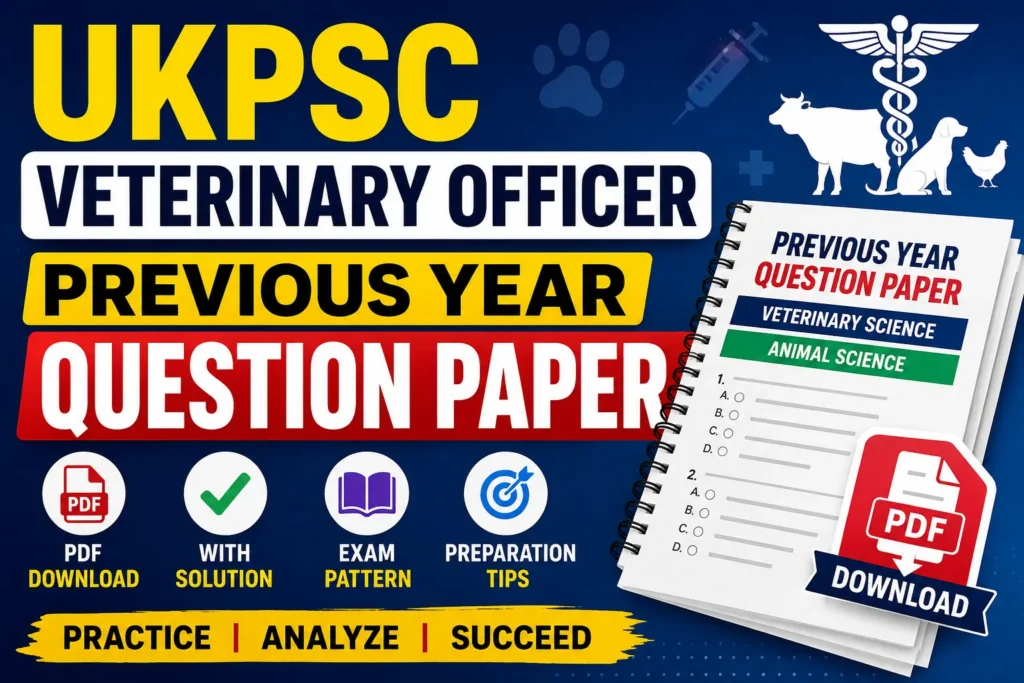
UKPSC Veterinary Officer Previous Year Question Paper – Download PDF
Preparing for the Uttarakhand Public Service Commission (UKPSC) Veterinary Officer examination requires a clear understanding of the syllabus, exam pattern and types of questions asked in previous examinations. The UKPSC Veterinary Officer previous year question paper is one of the most useful resources for candidates because it helps them understand the difficulty level, question style and important topics.
🌐 Connect with Us
The Veterinary Officer examination is conducted by the Uttarakhand Public Service Commission (UKPSC) for recruitment to Veterinary Officer posts. Candidates preparing for this examination should use previous year papers along with the latest syllabus, standard books, mock tests and revision notes.
In this article, candidates can find information about the UKPSC Veterinary Officer previous year question paper PDF, the PDF download process, question papers with solutions, benefits of solving previous papers, preparation tips and recommended books.
UKPSC Veterinary Officer Exam Overview
The UKPSC Veterinary Officer examination is a state-level recruitment examination. Candidates should carefully check the latest official notification before beginning their preparation because the commission may change the examination pattern, syllabus, eligibility requirements or selection procedure.
| Particulars | Details |
|---|---|
| Exam Name | UKPSC Veterinary Officer Examination |
| Conducting Body | Uttarakhand Public Service Commission |
| Post Name | Veterinary Officer |
| Exam Level | State Level |
| Job Location | Uttarakhand |
| Exam Mode | Offline/Written Examination |
| Question Type | Objective Type (MCQ) |
| Total Papers | 3 |
| Total Questions | 400 |
| Total Marks | 800 |
| Negative Marking | 1/4 mark of the marks assigned to the question |
| Selection Process | Written Examination, Interview, Document Verification and Medical Examination |
UKPSC Veterinary Officer Exam Pattern
Before solving the UKPSC Veterinary Officer previous year question paper, candidates should understand the examination structure. The written examination consists of three papers. Paper I covers General Studies and General Hindi, while Paper II and Paper III focus on professional subjects related to Veterinary Science and Animal Science.
| Paper | Subject | Questions | Marks | Duration |
|---|---|---|---|---|
| Paper I | General Studies & General Hindi | 100 | 200 | 2 Hours |
| Paper II | Veterinary Science | 150 | 300 | 3 Hours |
| Paper III | Animal Science | 150 | 300 | 3 Hours |
| Total | All Papers | 400 | 800 | 8 Hours |
Each question carries two marks according to the above structure. Candidates should also consider negative marking while practising previous papers. A proper attempt strategy is important because randomly attempting questions can reduce the final score.
🔥 Best Selling Notes
Handwritten Notes for Competitive Exams
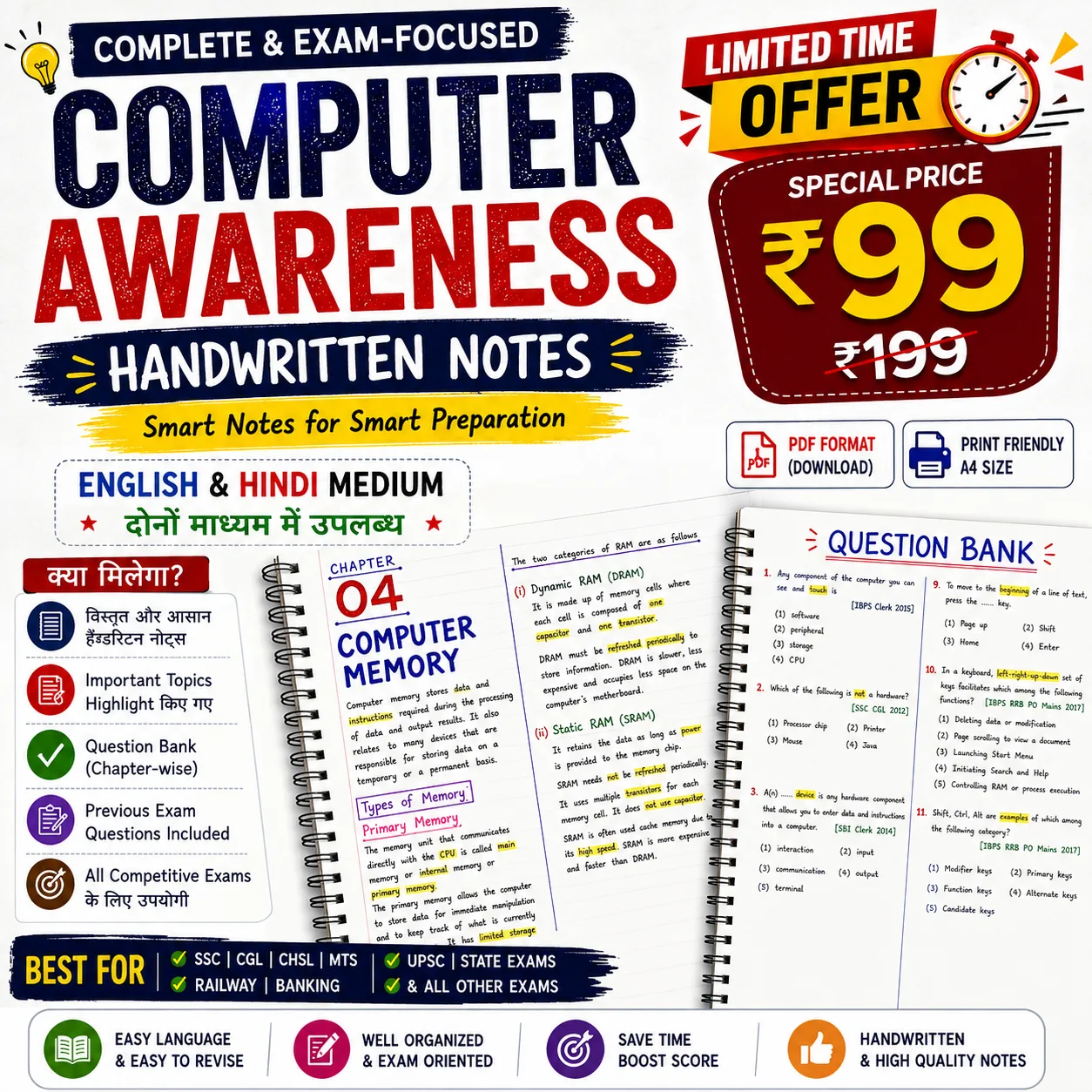
Computer Awareness Handwritten Notes
Hindi & English Medium • PDF • Practice Questions
SSC • Railway • Banking • UPSC • State Exams
₹99 Buy Now
General English Handwritten Notes
581 Pages • Practice Questions • PDF
SSC • Banking • Railway • Defence • Teaching
₹49 Buy Now
General Hindi Handwritten Notes
Complete Handwritten Notes • PDF • 2026
SSC • Railway • UPSC • UPSSSC • Police • Teaching
₹79 Buy NowUKPSC Veterinary Officer Previous Year Question Paper PDF
| Paper | Subject | Exam Date | Download PDF |
|---|---|---|---|
| Paper III | Animal Science | 22 February 2024 | Download PDF |
| Paper II | Veterinary Science | 22 February 2024 | Download PDF |
The UKPSC Veterinary Officer previous year question paper PDF is an important preparation resource for aspirants. By solving previous papers, candidates can become familiar with the type of questions asked in the examination and understand how different topics are represented in the paper.
Previous year papers should not be treated merely as practice tests. They can also be used to analyse the syllabus and identify frequently tested concepts. Candidates should first attempt the paper independently and then check the answers.
Available previous-paper resources include papers for Veterinary Science and Animal Science. Candidates should verify the authenticity of every PDF and prefer papers and answer keys released through official or reliable sources.
UKPSC Veterinary Officer Previous Year Question Paper PDF Download
Candidates looking for the UKPSC Veterinary Officer previous year question paper PDF download can follow a simple process. The official UKPSC website should be checked for old question papers, examination notices, answer keys and other relevant documents.
- Visit the official UKPSC website.
- Open the Candidate Corner or relevant examination section.
- Look for the Old Question Papers section.
- Search for the Veterinary Officer examination.
- Select the required examination year and paper.
- Open the available question paper PDF.
- Download and save the PDF on your device.
- Print the paper if you want to practise it offline.
Candidates should maintain separate folders for Paper I, Paper II and Paper III. This makes it easier to revise subject-wise and compare performance across different papers.
UKPSC Veterinary Officer Previous Year Question Paper PDF with Solution
The UKPSC Veterinary Officer previous year question paper PDF with solution can make preparation more effective because candidates can understand not only which option is correct but also why an answer is correct. Solved papers are especially useful when candidates are revising professional subjects.
Candidates should preferably use official answer keys whenever they are available. If an unofficial solution is being used, the answers should be cross-checked with standard textbooks or reliable academic resources.
A useful method for solving a paper with solutions is to attempt all questions first without looking at the answers. After completing the paper, calculate the score and then analyse every incorrect or doubtful question. Mark the topic associated with each mistake and revise it before attempting the paper again.
Benefits of Solving UKPSC Veterinary Officer Previous Year Papers
Regular practice with the UKPSC Veterinary Officer previous year question paper offers several advantages:
- Understand the Exam Pattern: Previous papers help candidates become familiar with the structure and style of questions.
- Identify Important Topics: Candidates can identify concepts and subjects that receive greater attention.
- Improve Speed: Timed practice helps candidates increase their question-solving speed.
- Improve Accuracy: Reviewing mistakes helps reduce repeated errors.
- Understand Difficulty Level: Previous papers provide a realistic idea of the level of questions.
- Develop Time Management: Full-length papers help candidates decide how much time to spend on each section.
- Build Examination Confidence: Regular practice makes the actual examination format more familiar.
- Evaluate Preparation: Scores from previous papers can be used to measure progress.
Preparation Tips for UKPSC Veterinary Officer Exam
1. Understand the Complete Syllabus
Begin preparation by carefully studying the latest UKPSC Veterinary Officer syllabus. Divide the syllabus into General Studies, General Hindi, Veterinary Science and Animal Science. Creating a topic-wise checklist will help you monitor your progress and ensure that important portions are not skipped.
2. Solve Previous Year Papers Regularly
Make the UKPSC Veterinary Officer previous year question paper a regular part of your preparation. Initially, solve questions topic-wise without focusing heavily on time. After completing the syllabus, start solving complete papers under examination-like conditions.
3. Give Special Attention to Veterinary Science
Veterinary Science is an important part of the examination and requires thorough preparation. Focus on subjects such as anatomy, physiology, pathology, pharmacology, microbiology, veterinary medicine, surgery, reproduction and veterinary public health according to the prescribed syllabus.
4. Prepare Animal Science Thoroughly
Animal Science is another major component of the examination. Important areas include animal nutrition, genetics and breeding, livestock production management, animal husbandry, extension education and livestock products technology. Prepare short notes for factual topics and revise them frequently.
5. Strengthen General Studies and Hindi
Paper I should not be ignored because it contributes 200 marks. Prepare Indian history, geography, polity, economy, general science, current affairs and Uttarakhand-specific general knowledge. For General Hindi, revise grammar, vocabulary, sentence correction and other topics mentioned in the syllabus.
6. Analyse Every Mock Test
Simply taking tests is not sufficient. After completing each paper, classify your mistakes into conceptual errors, factual errors, careless mistakes and questions where you were unsure. Maintain a mistake notebook and revise these areas regularly to prevent the same errors from occurring again.
7. Practise With Negative Marking
Since incorrect answers can result in negative marks, candidates should develop a careful attempt strategy. During mock tests, practise eliminating clearly incorrect options before choosing an answer. Avoid making random guesses when you have no reasonable basis for selecting an option.
8. Follow a Revision Schedule
Revision is essential because the Veterinary Officer syllabus contains a large number of factual and conceptual topics. Create weekly and monthly revision targets. Frequently revise important diseases, drugs, animal breeds, nutrition facts, terminology and other high-priority areas.
Best Books for UKPSC Veterinary Officer Preparation
Candidates should choose books according to the prescribed syllabus instead of collecting too many study materials. Standard textbooks combined with previous year papers and mock tests can provide a strong preparation strategy.
Veterinary Science Books
Use standard veterinary textbooks for core subjects such as Veterinary Anatomy, Veterinary Physiology, Pathology, Pharmacology, Microbiology, Veterinary Medicine, Surgery, Reproduction and Veterinary Public Health. Standard academic books are useful for developing conceptual clarity and solving professional questions.
Animal Science Books
For Animal Science, select comprehensive study material covering Animal Nutrition, Genetics and Breeding, Livestock Production Management, Animal Husbandry, Extension Education and Livestock Products Technology. Focus on books that follow the latest syllabus.
General Studies Books
A standard General Knowledge book can be used along with dedicated books for Indian Polity, History and Geography. Candidates should also use a reliable Uttarakhand General Knowledge source for state-specific preparation and regularly revise current affairs.
General Hindi Book
Select a competitive-examination Hindi grammar book covering topics such as संधि, समास, उपसर्ग, प्रत्यय, पर्यायवाची, विलोम शब्द, मुहावरे, वाक्य शुद्धि and other syllabus-based topics. Regular practice is more important than reading multiple books.
Previous Year Question Papers
A collection of UKPSC Veterinary Officer previous year question papers should be kept alongside your books. Previous papers help candidates connect textbook concepts with competitive-examination questions and identify areas that require additional revision.
How Many Previous Year Papers Should You Solve?
There is no fixed number of papers that guarantees success. Candidates should focus on solving every authentic Veterinary Officer paper available to them and supplement these papers with quality mock tests.
For each paper, record your score, accuracy, time taken, weak subjects and frequently repeated mistakes. After a few tests, compare your performance to determine whether your speed and accuracy are improving. The main objective should be to learn from every paper rather than simply increasing the number of tests attempted.
How to Make the Best Use of UKPSC Veterinary Officer PYQs?
Start by solving previous papers after completing the relevant topics. In the initial stage, focus on understanding questions and concepts rather than speed. Once you become comfortable with the syllabus, solve the complete paper within the prescribed time.
After each test, prepare a performance analysis. Note the questions you answered incorrectly, questions you left unanswered and questions where you spent too much time. Revise the associated concepts and reattempt difficult questions after a few days.
This process turns the UKPSC Veterinary Officer previous year question paper into a revision and assessment tool rather than simply another practice worksheet.
Conclusion
The UKPSC Veterinary Officer previous year question paper PDF is an important preparation resource for candidates targeting the Veterinary Officer examination. Previous papers help aspirants understand the question pattern, identify important topics, improve speed and accuracy and develop an effective examination strategy.
The examination structure includes three objective papers covering General Studies and General Hindi, Veterinary Science and Animal Science. Candidates should combine previous year papers with standard veterinary textbooks, syllabus-based preparation, regular mock tests and systematic revision.
For authentic and updated information, candidates should regularly check the official UKPSC website for recruitment notifications, syllabus updates, answer keys, results and old question papers. Candidates should always follow the latest official notification if there is any change in the examination pattern or selection process.