
📅 Published on: 03.09.2026
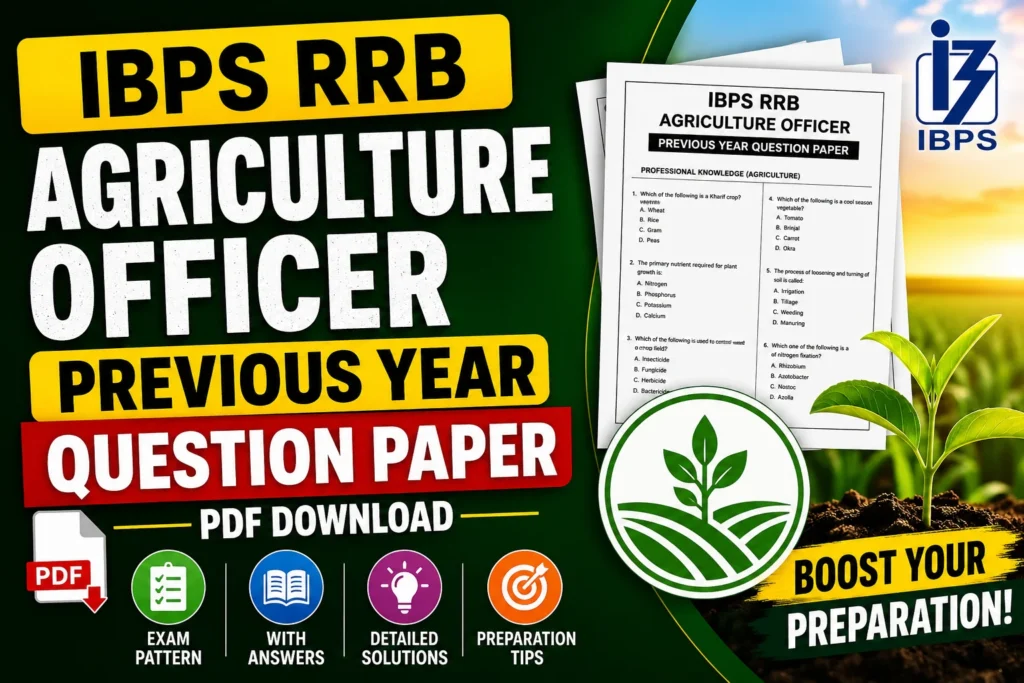
Table of Contents
ToggleIBPS RRB Agriculture Officer Previous Year Question Paper – PDF Download
Introduction
The IBPS RRB Agriculture Officer Previous Year Question Paper is one of the most useful resources for candidates preparing for the Agriculture Officer post under the Regional Rural Banks recruitment. Solving previous year papers helps aspirants understand the actual difficulty level, frequently asked topics, question format, and time pressure of the examination.
The Agriculture Officer post is generally recruited under Officer Scale-II Specialist Cadre. Candidates applying for the Agriculture Officer position appear for an online examination followed by an interview. The specialist examination includes Professional Knowledge along with Reasoning, Financial Awareness, Language, Computer Knowledge, and Quantitative Aptitude & Data Interpretation.
Candidates should therefore make IBPS RRB Agriculture Officer previous year question paper PDF practice an important part of their preparation strategy. Previous papers can be used for understanding the structure of the examination, practising questions, improving accuracy, and identifying weak areas.
🌐 Connect with Us
IBPS RRB Agriculture Officer Exam Overview
| Particulars | Details |
|---|---|
| Exam Name | IBPS RRB Agriculture Officer |
| Post | Officer Scale-II – Specialist Cadre |
| Conducting Body | Institute of Banking Personnel Selection (IBPS) |
| Recruitment | Common Recruitment Process for RRBs |
| Exam Mode | Online Computer-Based Examination |
| Selection Process | Online Examination + Interview |
| Main Focus | Agriculture/Professional Knowledge |
| Total Questions | 240 |
| Maximum Marks | 200 |
| Exam Duration | 150 minutes |
| Negative Marking | 1/4 mark for an incorrect answer |
| Professional Knowledge | 40 Questions, 40 Marks |
IBPS RRB Previous Year Question Paper PDF
| Question Paper | PDF Download |
|---|---|
| IBPS RRB Previous Year Question Paper | Download PDF |
| IBPS RRB Office Scale 3 Senior Manager Question Paper | Download PDF |
| IBPS RRB Officer Scale 1 Question Paper 2017 | Download PDF |
| IBPS RRB Officer Scale 1 Question Paper 2018 | Download PDF |
| IBPS RRB Officer Scale 1 Question Paper 2020 | Download PDF |
| IBPS RRB Officer Scale 1 Question Paper 2021 | Download PDF |
| IBPS RRB Officer Scale 1 Question Paper 2023 | Download PDF |
| IBPS RRB Officer Scale 1 Question Paper 2024 | Download PDF |
| IBPS RRB Agriculture Officer Question Paper | Download PDF |
| IBPS RRB IT Officer Question Paper | Download PDF |
| IBPS RRB GBO Question Paper | Download PDF |
IBPS RRB Agriculture Officer Exam Pattern
Understanding the exam pattern before solving the IBPS RRB Agriculture Officer previous year question paper with solution is essential. It allows candidates to identify the importance of each section and plan their time effectively.
| Section | Questions | Marks | Duration |
|---|---|---|---|
| Professional Knowledge | 40 | 40 | 30 minutes |
| Reasoning | 40 | 40 | 30 minutes |
| Financial Awareness | 40 | 40 | 15 minutes |
| English/Hindi Language | 40 | 20 | 30 minutes |
| Computer Knowledge | 40 | 20 | 15 minutes |
| Quantitative Aptitude & Data Interpretation | 40 | 40 | 30 minutes |
| Total | 240 | 200 | 150 minutes |
The specialist-cadre examination has a separate Professional Knowledge section, which is particularly important for Agriculture Officer aspirants. Candidates can choose English or Hindi for the applicable language test. An incorrect objective answer attracts a penalty of one-fourth of the marks assigned to that question.
IBPS RRB Agriculture Officer Previous Year Question Papers with Answers PDF
Candidates searching for IBPS RRB Agriculture Officer previous year question papers with answers PDF should preferably use memory-based papers, officially released material where available, and reliable preparation sources. IBPS does not consistently provide a public archive containing every previous-year specialist paper as a downloadable PDF.
A previous-year paper with answers can nevertheless be extremely useful because it enables candidates to check their responses immediately after completing a practice session. While downloading any paper, candidates should verify that it is specifically for RRB Officer Scale-II Agriculture Officer/Specialist Cadre, rather than an Officer Scale-I paper.
For the latest recruitment information, application details, and official notifications, candidates should refer to the official IBPS RRB recruitment portal.
What to Check in a Previous Year Paper
Before using an IBPS RRB Agriculture Officer previous year question paper PDF, check the following:
- Whether the paper belongs to Agriculture Officer/Specialist Cadre.
- Whether the Professional Knowledge section is included.
- Whether answers or explanations are provided.
- Whether the paper follows the relevant examination pattern.
- Whether questions are arranged according to individual sections.
- Whether the source clearly mentions the examination year or shift.
IBPS RRB Agriculture Officer Previous Year Question Paper with Solution
An IBPS RRB Agriculture Officer previous year question paper with solution is more useful than a question-only paper because candidates can understand the reasoning behind each answer. Detailed solutions help aspirants identify the exact concept behind a question and avoid repeating similar mistakes.
The Professional Knowledge section should receive special attention. Important agriculture areas may include agronomy, soil science, horticulture, agricultural economics, animal husbandry, plant pathology, entomology, irrigation, agricultural schemes, crop production, seed technology, agricultural marketing, and allied agricultural activities.
Candidates should not simply mark the correct answer and move on. Instead, they should maintain a mistake notebook containing questions they answered incorrectly, topics they guessed, and concepts they could not solve. Regularly revising this notebook can improve accuracy over time.
IBPS RRB Agriculture Officer Previous Year Question Paper PDF
The IBPS RRB Agriculture Officer previous year question paper PDF should be treated as a practice and analysis resource rather than simply a collection of questions.
Try to solve each paper in a simulated examination environment. Keep the same section-wise time limits as the actual examination and avoid checking answers during the test.
After completing the paper, calculate your score after applying the applicable negative marking. Then compare your performance section by section. This will help you identify whether your main weakness is Agriculture, Reasoning, Quantitative Aptitude, Financial Awareness, Computer Knowledge, or Language.
IBPS RRB Agriculture Officer Previous Year Paper PDF – Benefits
Solving an IBPS RRB Agriculture Officer previous year paper PDF provides several advantages:
- Understand the Exam Level: Previous papers help candidates estimate whether questions are easy, moderate, or difficult.
- Identify Important Topics: Repeated concepts can be identified through regular paper analysis.
- Improve Time Management: Practising complete papers teaches candidates how to distribute the available examination time.
- Increase Accuracy: Repeated practice reduces careless mistakes and improves familiarity with question formats.
- Build Confidence: Familiarity with the question format can reduce exam-day anxiety.
- Analyse Weak Areas: Candidates can identify subjects requiring additional revision.
- Improve Question Selection: Previous papers teach candidates which questions should be attempted first.
- Measure Preparation: Regular paper scores provide a measurable indication of preparation progress.
Preparation Tips for IBPS RRB Agriculture Officer
1. Give Priority to Professional Knowledge
Professional Knowledge is one of the most important sections for Agriculture Officer aspirants. Build strong fundamentals in agronomy, soil science, horticulture, agricultural economics, plant pathology, entomology, animal husbandry, irrigation, and allied subjects.
After studying each topic, solve topic-wise questions and then revise the concepts through the IBPS RRB Agriculture Officer previous year question paper with solution. This approach helps connect theoretical concepts with objective-type questions.
2. Practise Previous Year Papers Regularly
Do not wait until the final weeks to start solving previous papers. Begin with one paper every week and gradually increase the frequency as the examination approaches.
After every test, analyse incorrect and unattempted questions. The analysis is often more valuable than simply taking another test because it shows exactly where your preparation needs improvement.
3. Prepare Agriculture Current Affairs
Agriculture-related government schemes, rural development initiatives, agricultural institutions, crop-related developments, banking schemes for farmers, and recent agricultural policies should be revised regularly.
Make short notes and revise them frequently. This will also help candidates prepare for Financial Awareness and the interview stage.
4. Strengthen Reasoning and Quantitative Aptitude
Although Professional Knowledge is crucial, candidates cannot ignore the other sections. Practise puzzles, seating arrangements, syllogism, inequalities, coding-decoding, data interpretation, simplification, percentages, averages, ratios, and arithmetic problems.
Set a timer while practising so that calculation speed and accuracy improve simultaneously. Regular sectional practice can also help candidates become comfortable with the prescribed section-wise time limits.
5. Revise Financial Awareness
Financial Awareness has a dedicated section in the Specialist Cadre examination. Focus on banking terminology, RBI-related developments, financial institutions, government financial schemes, rural banking, priority-sector lending, and current banking affairs.
Regular revision is essential because financial and banking awareness questions can cover both static and current topics. Keep concise notes for important terms, schemes, institutions, and recent developments.
6. Take Full-Length Mock Tests
Once the syllabus is substantially complete, start taking full-length mock tests. Follow the actual section timings instead of treating the test as an ordinary practice session.
Use your mock-test analysis to improve accuracy, speed, and question selection. Your objective should be consistent improvement rather than merely attempting a large number of tests.
Best Books for IBPS RRB Agriculture Officer
Choosing the right books can make preparation more structured. Candidates may consider the following resources:
| Book/Resource | Recommended Use |
|---|---|
| Objective Agriculture by S.R. Kantwa | Agriculture fundamentals and objective questions |
| Agriculture at a Glance by R.K. Sharma | Comprehensive agriculture revision |
| Arihant Agriculture Exams Books | Topic-wise agriculture practice |
| Lucent’s General Knowledge | Static awareness |
| A Modern Approach to Verbal & Non-Verbal Reasoning by R.S. Aggarwal | Reasoning practice |
| Quantitative Aptitude by R.S. Aggarwal | Basic quantitative practice |
| Computer Awareness by Arihant | Computer fundamentals |
| Banking & Financial Awareness Study Material | Banking and financial current affairs |
Candidates should avoid collecting too many books. It is generally better to complete one reliable source thoroughly and revise it multiple times than to read several books only once.
How to Use IBPS RRB Agriculture Officer Previous Year Papers Effectively
A three-step approach can make previous papers more productive.
Step 1 – Attempt
Solve the complete paper without looking at the answers. Try to replicate the actual examination environment and follow the prescribed section timings.
Step 2 – Analyse
Check every incorrect, guessed, and unattempted question. Identify the reason for the mistake, such as lack of knowledge, calculation error, misunderstanding of the question, or insufficient time.
Step 3 – Revise
Return to the relevant topic and revise the underlying concept. Then attempt similar questions again. This converts previous papers from simple practice material into a structured learning tool.
Maintain a simple record of your scores. For example, if your Professional Knowledge score improves across successive tests, you can clearly measure your progress and identify areas that still require additional work.
Conclusion
The IBPS RRB Agriculture Officer Previous Year Question Paper is an important preparation resource for candidates targeting the Agriculture Officer post under Officer Scale-II Specialist Cadre. Previous papers help aspirants understand the question style, practise important concepts, improve speed, and identify weak areas.
The specialist-cadre examination includes 240 questions carrying 200 marks with a total examination duration of 150 minutes. The Professional Knowledge section is particularly important for Agriculture Officer candidates. Therefore, aspirants should give special attention to agriculture-related concepts while maintaining balanced preparation for Reasoning, Financial Awareness, Language, Computer Knowledge, and Quantitative Aptitude & Data Interpretation.
For the best results, combine IBPS RRB Agriculture Officer previous year paper PDF practice with standard books, current affairs revision, sectional tests, and full-length mock tests. Consistent practice and detailed analysis of every paper can significantly improve both accuracy and examination confidence.
📚 Read More Articles
FAQs on IBPS RRB Agriculture Officer Previous Year Question Paper
Where can I download the IBPS RRB Agriculture Officer previous year question paper PDF?
Candidates can find IBPS RRB Agriculture Officer previous year question paper PDFs through reliable exam preparation platforms and educational resources. Always verify that the paper is for the Agriculture Officer/Officer Scale-II Specialist Cadre examination before downloading it.
Are IBPS RRB Agriculture Officer previous year papers available with answers?
Yes, memory-based and practice versions of IBPS RRB Agriculture Officer previous year question papers are available with answers and solutions. Solving papers with solutions helps candidates understand the correct approach and revise difficult concepts.
Why should I solve IBPS RRB Agriculture Officer previous year question papers?
Previous year papers help candidates understand the exam pattern, difficulty level, important topics, question types, and time requirements. They also help improve speed, accuracy, question selection, and overall examination confidence.
Which subjects should I focus on for the Agriculture Officer exam?
Candidates should give special attention to Professional Knowledge, including agronomy, soil science, horticulture, agricultural economics, plant pathology, entomology, animal husbandry, irrigation, agricultural schemes, crop production, and allied agriculture topics. Reasoning, Financial Awareness, Language, Computer Knowledge, and Quantitative Aptitude should also be prepared.
Is the IBPS RRB Agriculture Officer exam conducted online?
Yes, the IBPS RRB Agriculture Officer examination is conducted in online computer-based mode. Candidates should practise mock tests and previous year papers in an online-test environment to become familiar with the examination format.
What is the importance of Professional Knowledge in the Agriculture Officer exam?
Professional Knowledge is a major section of the Agriculture Officer examination. Questions test candidates on their understanding of agriculture and allied subjects, making strong conceptual preparation and regular practice essential.
How many questions are asked in the IBPS RRB Agriculture Officer exam?
The Specialist Cadre examination pattern consists of 240 questions carrying a total of 200 marks. The paper includes Professional Knowledge, Reasoning, Financial Awareness, Language, Computer Knowledge, and Quantitative Aptitude & Data Interpretation.
Does IBPS RRB Agriculture Officer exam have negative marking?
Yes. There is a penalty for incorrect answers in the objective examination. Generally, one-fourth of the marks assigned to a question is deducted for an incorrect response. Candidates should therefore focus on accuracy and avoid unnecessary guessing.
How should I prepare using the IBPS RRB Agriculture Officer previous year paper PDF?
First, attempt the paper within the prescribed time without checking the answers. Next, analyse incorrect and unattempted questions. Finally, revise the relevant concepts and solve similar questions. Maintaining a record of scores can help track preparation progress.
How many previous year papers should I solve for IBPS RRB Agriculture Officer preparation?
There is no fixed number of papers that guarantees success. Candidates should solve as many reliable papers as available while ensuring proper analysis after each test. Quality of practice and revision is more important than simply increasing the number of papers attempted.




Pingback: RRB Health and Malaria Inspector Previous Papers - PDF Download -
Pingback: Railway Lab Assistant Previous Year Question Paper – PDF Download -
Pingback: RRB Paramedical Staff Previous Year Question Paper – PDF Download -