📅 Published on: 20.01.2026
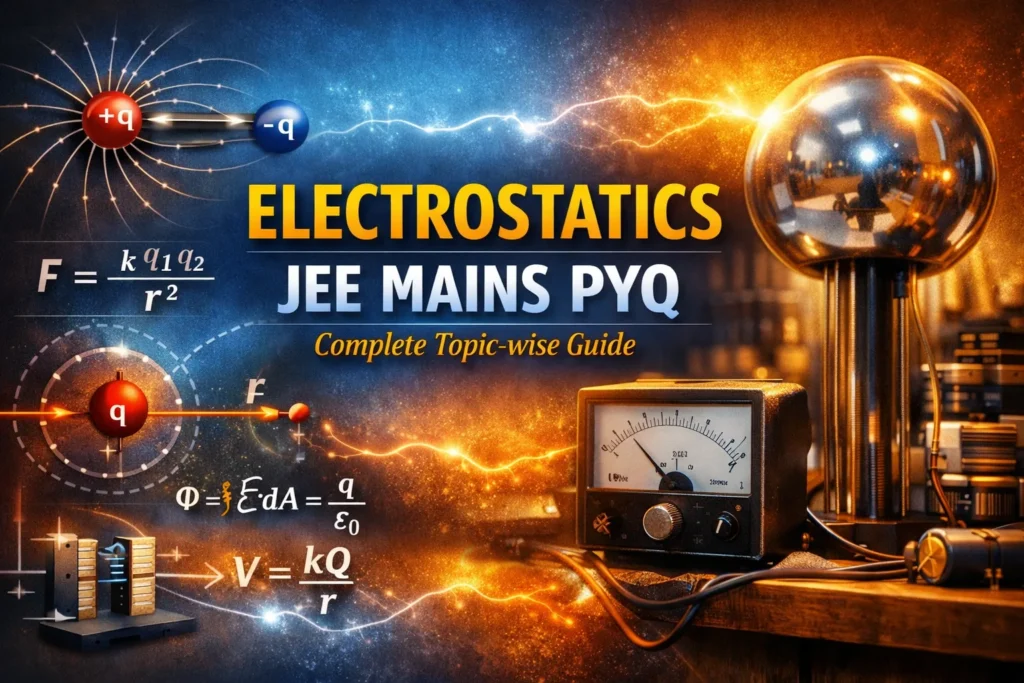
Table of Contents
ToggleElectrostatics JEE Mains PYQ – Complete Topic-wise Guide
Electrostatics JEE Mains PYQ questions are among the most important and scoring parts of the Physics syllabus. Every year, multiple questions are asked from electrostatics, making it essential for aspirants to practice previous year questions thoroughly. Solving electrostatics JEE PYQ helps students understand the exam pattern, difficulty level, and frequently repeated concepts.
📘 Electrostatics JEE Mains PYQ PDF
Download chapter-wise Electrostatics Previous Year Questions (JEE Main & Advanced)
Electric Charge and Field JEE Mains PYQ
Questions from electric charge and field JEE Mains PYQ mainly test conceptual understanding and vector analysis. Most problems are based on Coulomb’s law, superposition principle, and electric field due to point charges and dipoles.
- Coulomb’s law based numericals
- Electric field due to multiple charges
- Electric dipole (axial and equatorial points)
- Direction and magnitude of electric field
Electrostatic PYQ JEE Main – Gauss’s Law
Electrostatic PYQ JEE Main questions from Gauss’s law are highly scoring and mostly formula-based. Direct applications of Gauss’s theorem are frequently asked in the exam.
- Electric field due to infinite line charge
- Uniformly charged plane sheet
- Spherical shell and solid sphere
- Electric flux and Gaussian surface concepts
Electrostatics JEE PYQ – Electric Potential & Energy
This section of electrostatics JEE PYQ focuses on scalar quantities such as electric potential and potential energy. Questions often test the relationship between electric field and potential.
- Electric potential due to point charge
- Relation between electric field and potential
- Potential energy of two-charge system
- Motion of charged particles in electric field
Electrostatic PYQ JEE Mains – Capacitors
Capacitors are one of the most repeated topics in electrostatic PYQ JEE Mains. Numerical problems are usually straightforward and scoring.
- Parallel plate capacitor
- Dielectric slab insertion
- Series and parallel combination of capacitors
- Energy stored in a capacitor
Electrostatics JEE Advanced PYQ
Electrostatics JEE Advanced PYQ questions are comparatively complex and multi-concept based. Practicing these problems improves analytical thinking and strengthens fundamentals.
- Multi-step numerical problems
- Graph-based questions
- Combination of electrostatics with mechanics
- Advanced-level electric field and potential problems
Important Topics for Electrostatics JEE Mains PYQ
- Coulomb’s Law and Superposition Principle
- Electric Field and Field Lines
- Electric Flux and Gauss’s Law
- Electric Potential and Potential Difference
- Relation between E and V
- Capacitors and Dielectrics
- Energy density of electric field
Conclusion
Electrostatics JEE Mains PYQ practice is essential for scoring high marks in Physics. Most questions are concept-based and often repeated with slight variations. By regularly solving electrostatics JEE PYQ and revising formulas, students can build strong fundamentals and gain confidence for both JEE Main and JEE Advanced.
📘 JEE Physics Previous Year Questions (PYQ)
- 🔹 Magnetism and Matter – JEE Main PYQ
- 🔹 Units and Dimensions – JEE Mains PYQ
- 🔹 Motion in a Straight Line – JEE Mains PYQ
- 🔹 Laws of Motion – JEE Mains PYQ
- 🔹 Work, Power & Energy – JEE Mains PYQ
- 🔹 Rotational Motion – JEE PYQ
- 🔹 Gravitation – JEE Mains PYQ
- 🔹 Mechanical Properties of Solids – JEE Mains PYQ
- 🔹 Mechanical Properties of Fluids – JEE Mains PYQ
- 🔹 Oscillations – JEE Mains PYQ
- 🔹 Waves – JEE Mains PYQ
- 🔹 Agniveer Vayu Previous Year Question Papers
Frequently Asked Questions (FAQs)
What is Electrostatics in JEE Mains syllabus?
Electrostatics in JEE Mains includes electric charges, Coulomb’s law, electric field, electric flux, Gauss’s law, electric potential, capacitors, and dielectrics. It forms a core part of Class 12 Physics.
How many questions are asked from Electrostatics in JEE Main?
Usually 2–3 questions are asked every year from electrostatics in JEE Main, making it a high-weightage and scoring chapter.
Are Electrostatics PYQs enough for JEE Main preparation?
Electrostatics PYQs cover most question patterns, but students should also practice NCERT-based numericals and conceptual questions for complete preparation.
Which topic of Electrostatics is most important for JEE Mains?
Gauss’s Law, electric potential, and capacitors are the most frequently asked and highest scoring topics in electrostatics JEE Mains PYQ.
What is the difference between Electrostatics JEE Main and JEE Advanced PYQs?
JEE Main PYQs are mostly formula-based and direct, while JEE Advanced PYQs are multi-concept, analytical, and require deeper understanding.
How should I revise Electrostatics before the JEE Main exam?
Revise all formulas, practice previous year questions, focus on common traps, and solve mock tests to strengthen your electrostatics preparation.
Is NCERT enough for Electrostatics JEE Mains?
NCERT is essential for theory and definitions, but solving electrostatics JEE Mains PYQ and additional numerical problems is necessary for scoring high marks.