📅 Published on: 25.05.2026
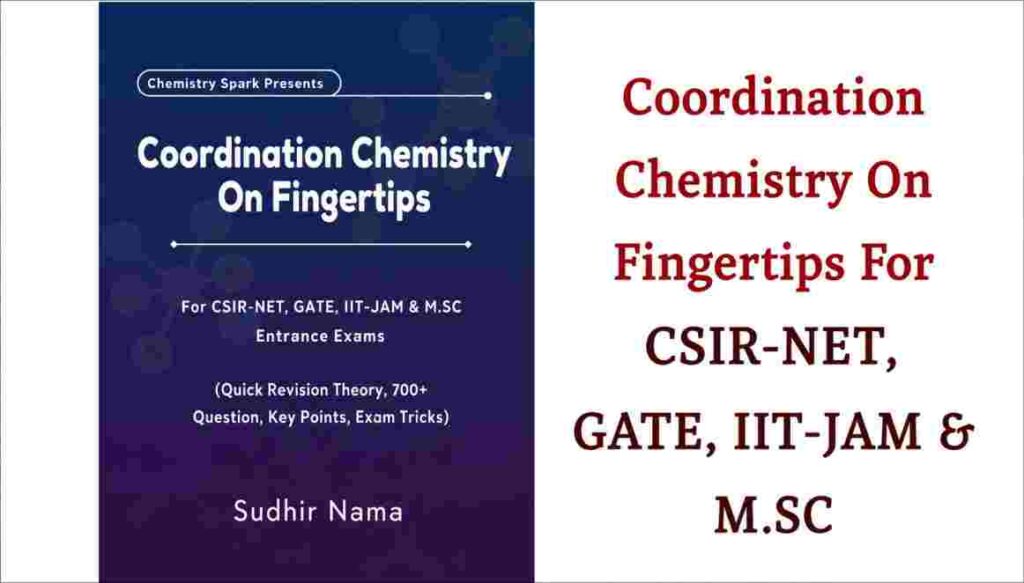
Book Review: Coordination Chemistry on Fingertips
Introduction
Coordination Chemistry on Fingertips is a highly useful and exam-oriented chemistry book written by Sudhir Nama for students preparing for competitive examinations such as CSIR-NET, GATE, IIT-JAM, and M.Sc. entrance tests. The book is specially designed to simplify the difficult concepts of coordination chemistry and present them in an easy, concise, and practical manner.



Coordination chemistry is considered one of the most important and scoring units in inorganic chemistry, yet many students find it difficult because of its theoretical concepts, magnetic properties, crystal field theory, and reaction mechanisms. This book attempts to solve these problems through short notes, conceptual explanations, solved examples, shortcut techniques, and previous year questions.
The book has become popular among chemistry aspirants because of its student-friendly language and exam-focused presentation style. It acts as a quick revision guide as well as a practice book for competitive examinations.
About the Author
Sudhir Nama is a well-known chemistry educator and author who has written several books for competitive chemistry examinations. He is recognized for his simple teaching methodology and his ability to explain difficult chemistry concepts in an understandable way.
His books are especially popular among students preparing for CSIR-NET, IIT-JAM, GATE, and postgraduate entrance examinations. His writing style focuses on conceptual clarity, quick revision methods, and problem-solving techniques.
Book Details
| Feature | Details |
|---|---|
| Book Title | Coordination Chemistry on Fingertips |
| Author | Sudhir Nama |
| Subject | Coordination Chemistry |
| Language | English |
| Publisher | Chemistry Spark |
| Target Exams | CSIR-NET, GATE, IIT-JAM, M.Sc Entrance |
| Book Type | Competitive Exam Guide |
| Special Features | PYQs, Shortcut Tricks, Quick Revision Notes |
| ISBN | 9789334453881 |
Main Features of the Book
- Concise and exam-oriented theory
- Simple explanation of difficult concepts
- 700+ previous year solved questions
- Quick memory tricks and revision notes
- Useful shortcut methods for exams
- Practice exercises for self-evaluation
- Student-friendly language and presentation
- Coverage of important competitive exams
Topics Covered in the Book
The book covers almost all important concepts of coordination chemistry required for competitive examinations. The chapters are arranged systematically for better understanding and quick revision.
| Chapter No. | Topics Covered |
|---|---|
| 1 | Introduction to Coordination Chemistry |
| 2 | Werner’s Theory |
| 3 | Nomenclature of Coordination Compounds |
| 4 | Isomerism in Coordination Compounds |
| 5 | Valence Bond Theory |
| 6 | Crystal Field Theory |
| 7 | Molecular Orbital Theory |
| 8 | Electronic Spectra |
| 9 | Magnetic Properties |
| 10 | Stability of Coordination Compounds |
| 11 | Organometallic Concepts |
| 12 | Previous Year Questions and Practice Sets |
Coordination Chemistry Resources
Read Book Online
Open and read the Coordination Chemistry book directly online.
Read Book Download FreeStrengths of the Book
1. Exam-Oriented Content
The biggest strength of this book is its exam-focused approach. The author has included only the most important and relevant concepts that are frequently asked in competitive examinations.
2. Large Collection of PYQs
The inclusion of more than 700 previous year questions helps students understand exam patterns and improves their problem-solving skills.
3. Quick Revision Notes
The book provides quick revision tables, important formulas, and shortcut tricks that are highly useful during final exam preparation.
4. Easy Language
The language used in the book is simple and understandable. Even difficult topics like crystal field splitting and electronic transitions are explained clearly.
5. Time-Saving Approach
Students preparing for multiple exams can save time because the book presents concise theory without unnecessary lengthy discussions.
Weaknesses of the Book
| Strengths | Weaknesses |
|---|---|
| Concise and practical theory | Limited detailed explanations |
| Excellent previous year questions | Advanced research-level topics are less covered |
| Quick revision support | Not a substitute for standard textbooks |
| Simple language | Mainly designed for competitive exams |
| Helpful shortcut methods | Less focus on theoretical depth |
Presentation and Writing Style
The presentation style of the book is attractive and student-friendly. Important points are highlighted using tables, bullet points, and memory tricks. The organized structure of the chapters helps students revise quickly before examinations.
The writing style resembles classroom teaching, making the book more interactive and engaging for self-study students.
Usefulness for Students
This book is extremely useful for:
- B.Sc Chemistry students
- M.Sc Chemistry students
- CSIR-NET aspirants
- IIT-JAM candidates
- GATE Chemistry students
- Students preparing for postgraduate entrance examinations
Students who find coordination chemistry difficult can use this book as a quick revision guide and practice workbook.
Critical Evaluation
From an academic perspective, Coordination Chemistry on Fingertips successfully fulfills its purpose as a competitive examination guide. The book simplifies complex concepts without losing their core meaning. It provides a balanced combination of theory and practice questions.
Although the book may not completely replace standard inorganic chemistry textbooks for detailed university-level study, it serves as an excellent revision companion for examination preparation.
The greatest achievement of the author is converting a difficult and feared topic into a simple and scoring section through practical explanations and shortcut methods.
Conclusion
Coordination Chemistry on Fingertips by Sudhir Nama is an excellent resource for chemistry students preparing for competitive examinations. The book provides concise theory, solved examples, shortcut methods, previous year questions, and revision tools in a simple and organized manner.
The book is highly recommended for students who want quick preparation and effective revision in coordination chemistry. While advanced learners may still need detailed reference textbooks, this book remains one of the best practical guides for competitive chemistry preparation.
Overall, the book is a valuable companion for students aiming to score well in coordination chemistry and succeed in competitive examinations.