
📅 Published on: 19.01.2026
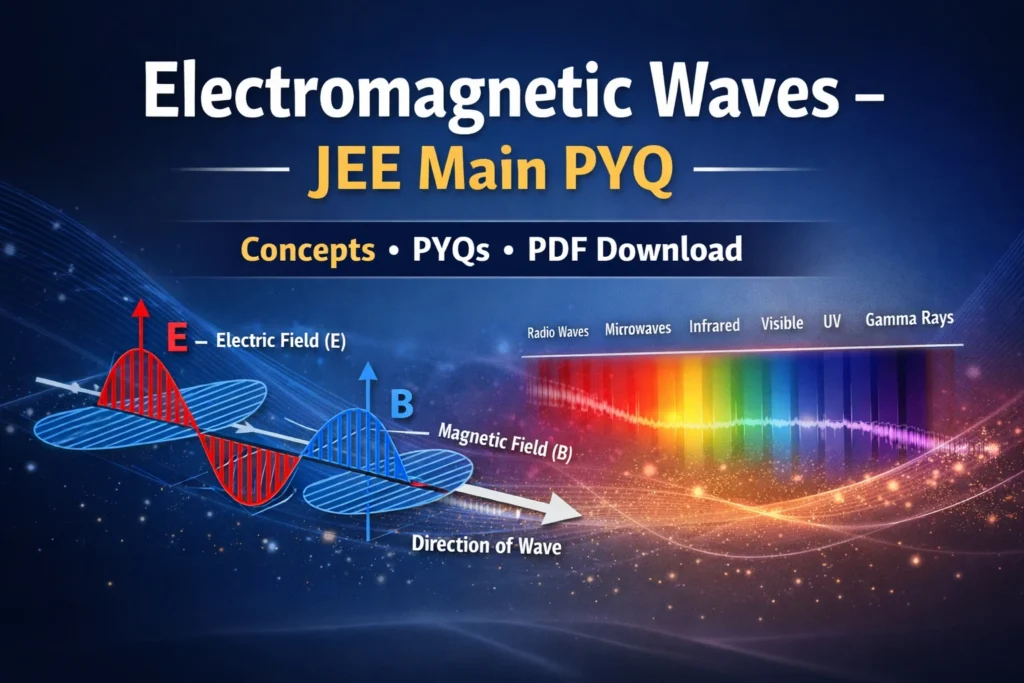
Table of Contents
ToggleElectromagnetic Waves JEE Main PYQ – Pdf Download
Electromagnetic Waves is an important chapter in Class 12 Physics and a regular contributor to JEE Main Previous Year Questions (PYQs). Although the number of questions from this chapter is usually limited, it is considered a high-scoring topic due to its direct formulas, conceptual clarity, and predictable question pattern. With proper understanding of electromagnetic wave properties, students can secure easy marks in JEE Main.
📘 Electromagnetic Waves JEE Main PYQ PDF
Download the carefully compiled PDF containing JEE Main previous year questions from the Electromagnetic Waves chapter along with exam-oriented practice problems.
Download PDFWhat Are Electromagnetic Waves?
Electromagnetic waves are waves formed by oscillating electric and magnetic fields that propagate through space without requiring any material medium. These waves were theoretically predicted by James Clerk Maxwell and later experimentally verified by Heinrich Hertz. The electric field and magnetic field in an electromagnetic wave oscillate perpendicular to each other and also perpendicular to the direction of propagation.
In vacuum, electromagnetic waves travel with the speed of light, which is approximately 3 × 10⁸ m/s. This speed depends on the permittivity and permeability of the medium through which the wave travels.
Mathematical Representation of EM Waves
A plane electromagnetic wave traveling along the x-axis can be represented using sinusoidal functions. The electric field and magnetic field vary harmonically with time and position. The ratio of the magnitudes of the electric field to the magnetic field is constant and equal to the speed of light in that medium.
Speed of EM wave (c) = Electric field (E) / Magnetic field (B)
Properties of Electromagnetic Waves
- They are transverse in nature.
- They do not require a material medium to propagate.
- They carry energy and momentum.
- They travel with the same speed in vacuum regardless of frequency.
- They obey the principle of superposition.
Electromagnetic Spectrum
The electromagnetic spectrum is the complete range of electromagnetic waves arranged according to increasing frequency or decreasing wavelength. It includes radio waves, microwaves, infrared rays, visible light, ultraviolet rays, X-rays, and gamma rays. JEE Main PYQs often ask students to identify regions of the spectrum or compare their properties.
JEE Main Previous Year Question Trends
Questions from electromagnetic waves in JEE Main are mostly formula-based or concept-oriented. Some of the most common PYQ patterns include:
| Topic | Question Type |
|---|---|
| Field relationship | Finding E or B using wave speed |
| Wavelength & frequency | Numerical problems |
| EM spectrum | Conceptual identification |
| Intensity of wave | Energy flow calculations |
Weightage of Electromagnetic Waves in JEE Main
On average, one question from electromagnetic waves appears in JEE Main Physics paper. This corresponds to nearly 3–4% weightage. Due to its predictable nature, this chapter is considered highly scoring when prepared properly.
Preparation Strategy for JEE Main
- Study NCERT thoroughly as most concepts are directly derived from it.
- Memorize key formulas and field relations.
- Practice previous year questions regularly.
- Focus on conceptual clarity rather than lengthy derivations.
- Revise electromagnetic spectrum and its applications.
Conclusion
Electromagnetic Waves is a concise yet powerful chapter for JEE Main aspirants. With limited theory and high conceptual clarity, it offers an excellent opportunity to score guaranteed marks. Solving JEE Main PYQs and revising important formulas can significantly boost confidence and exam performance. Consistent practice and smart revision are the keys to mastering this chapter.
📘 JEE Physics Previous Year Questions (PYQ)
- 🔹 Units and Dimensions – JEE Mains PYQ
- 🔹 Motion in a Straight Line – JEE Mains PYQ
- 🔹 Laws of Motion – JEE Mains PYQ
- 🔹 Work, Power & Energy – JEE Mains PYQ
- 🔹 Rotational Motion – JEE PYQ
- 🔹 Gravitation – JEE Mains PYQ
- 🔹 Mechanical Properties of Solids – JEE Mains PYQ
- 🔹 Mechanical Properties of Fluids – JEE Mains PYQ
- 🔹 Oscillations – JEE Mains PYQ
- 🔹 Waves – JEE Mains PYQ
- 🔹 Kinetic Theory of Gases – JEE Mains PYQ
- 🔹 Electrostatic Potential & Capacitance – JEE Mains PYQ
- 🔹 Current Electricity – JEE Mains PYQ
- 🔹 Alternating Current – JEE Mains PYQ
- 🔹 Electromagnetic Induction – JEE Mains PYQ
- 🔹 Semiconductors – JEE Mains PYQ
- 🔹 Atoms – JEE Mains PYQ
- 🔹 Agniveer Vayu Previous Year Question Papers
Frequently Asked Questions – Electromagnetic Waves JEE Main
Electromagnetic waves are transverse waves consisting of oscillating electric and magnetic fields that propagate through space without requiring a material medium.
Yes, Electromagnetic Waves is an important chapter for JEE Main as it regularly contributes 1 question and is considered easy and scoring.
On average, 1 question appears from Electromagnetic Waves in JEE Main, carrying about 4 marks.
No, electromagnetic waves do not require any medium and can travel through vacuum with the speed of light.
The ratio of the electric field to the magnetic field in an electromagnetic wave is equal to the speed of light in that medium.
The electromagnetic spectrum is the complete range of electromagnetic waves arranged according to frequency or wavelength, from radio waves to gamma rays.
Visible light is the only part of the electromagnetic spectrum that can be detected by the human eye.
Electromagnetic waves are transverse waves, where electric and magnetic fields oscillate perpendicular to the direction of propagation.
JEE Main PYQs from electromagnetic waves are mostly formula-based, conceptual, or related to the electromagnetic spectrum.
Yes, NCERT is more than sufficient for Electromagnetic Waves. Most JEE Main questions are directly based on NCERT theory and examples.


Pinoytime, my go-to for all things Filipino entertainment! Always reliable and easy to use. Check it out pinoytime!