
📅 Published on: 27.12.2025
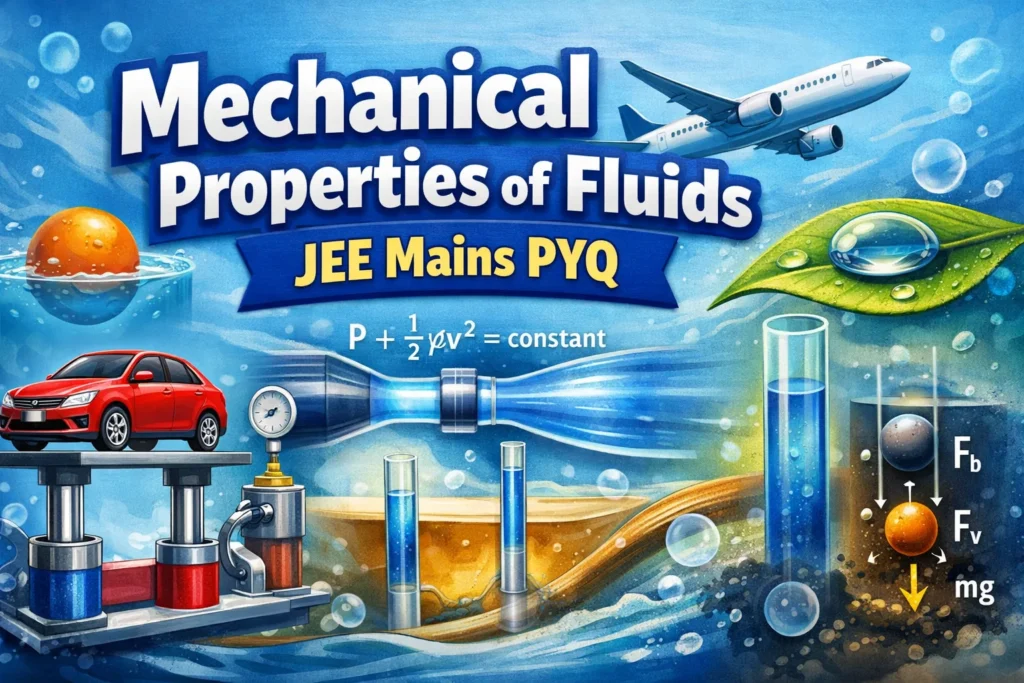
Table of Contents
ToggleMechanical Properties of Fluids – JEE Mains PYQ
Download PDF:
👉 Mechanical Properties of Fluids PYQ Compilation
Click Here to Download
Introduction
Mechanical properties of fluids is one of the scoring chapters in JEE Mains Physics, consistently contributing 2–3 questions every year. This topic deals with how liquids and gases behave under forces, pressure, and flow conditions. Questions are mostly formula-driven and numerical-based, making PYQ practice essential.
What Are Fluids?
Fluids are substances that can flow and do not have a fixed shape, such as liquids and gases. Key characteristic: They deform continuously under external shear stress.
Examples: water, air, oil, kerosene, carbon dioxide.
Key Mechanical Properties of Fluids for JEE Mains
1️⃣ Density (ρ)
Mass per unit volume:
ρ = m / V
Unit: kg/m³
JEE PYQ often asks ratio-based density problems.
2️⃣ Pressure in Fluids (P)
P = F / A
Unit: Pascal (Pa)
Fluids exert pressure in all directions, which increases with depth.
3️⃣ Pascal’s Law
Pressure applied at any point in a confined fluid is transmitted equally throughout.
Applications:
🔹 Hydraulic lift
🔹 Hydraulic brakes
JEE Question Type: Find force needed to lift a vehicle using hydraulic systems.
4️⃣ Buoyancy & Archimedes’ Principle
A body immersed in fluid experiences an upward buoyant force equal to the weight of displaced fluid.
Fb = ρ · g · V
Used in: ships, submarines, lactometers, hydrometers.
Common PYQ: Density of a floating body, apparent weight in fluid.
5️⃣ Surface Tension (T)
Force per unit length on the surface of a liquid.
T = F / l
Effects:
✔ Capillarity
✔ Water droplets spherical
✔ Razor blade floating on water
JEE Trend: Problems on rise/fall in capillary tube.
6️⃣ Viscosity (η)
Internal friction between layers of fluid.
F = η · A · (dv/dx)
Examples: honey > oil > water > air (in decreasing viscosity)
Important: Terminal velocity, Stoke’s law
vt = 2(ρs − ρf)gr² / 9η
7️⃣ Bernoulli’s Theorem
P + (1/2)ρv² + ρgh = constant
Explains:
✈ Lift of airplanes
💧 Water sprays
🎈 Cricket swing
🌀 Bunsen burner working
JEE Special: Venturimeter, Torricelli’s theorem
v = √(2gh)
Mechanical Properties of Fluids – JEE Mains PYQ Analysis
| Year | No. of Questions | Focus Areas |
|---|---|---|
| 2024 | 2 | Bernoulli, Capillarity |
| 2023 | 3 | Surface tension, Buoyancy |
| 2022 | 2 | Pascal’s law, Viscosity |
| 2021 | 3 | Terminal velocity, Pressure-depth |
Most repeated concepts: Bernoulli > Viscosity > Buoyancy > Capillarity
High-Frequency JEE Mains Formula List
| Concept | Formula |
|---|---|
| Pressure at depth | P = P₀ + ρgh |
| Buoyant force | Fb = ρgV |
| Surface tension | T = F / l |
| Excess pressure (soap bubble) | ΔP = 4T/R |
| Excess pressure (liquid drop) | ΔP = 2T/R |
| Bernoulli’s equation | P + ½ρv² + ρgh = constant |
| Terminal velocity | vt = 2(ρs − ρf)gr² / 9η |
Why Solve PYQ for Mechanical Properties of Fluids?
✔ Repeated question patterns
✔ Strengthens formula memory
✔ Improves conceptual understanding
✔ Direct numerical applications score full marks
✔ Develops time-saving shortcuts
JEE Mains PYQ Practice Strategy
1️⃣ Revise formulas daily
2️⃣ Practice capillarity + Bernoulli problems
3️⃣ Solve previous year questions repeatedly
4️⃣ Mark tricky conceptual questions
5️⃣ Give 20-minute topic-wise tests
Mechanical Properties of Fluids – Sample JEE-type Question
Q: A ball of density 600 kg/m³ is floating in a liquid of density 800 kg/m³. What fraction of its volume remains above the surface?
Solution:Vabove / V = 1 − (ρs / ρf) = 1 − 600/800 = 1/4
Answer: 25%
Download PDF and Practice PYQ
👉 Mechanical Properties of Fluids PYQ PDF
Download Now
Conclusion
Mechanical properties of fluids is a high-yield, formula-based chapter in JEE Mains. With strong conceptual clarity, formula memorization, and PYQ practice, you can secure 8–12 easy marks from this topic alone.
Target:
Revise + Practice + PYQ = Full marks 🚀

FAQs – Mechanical Properties of Fluids (JEE Mains)
1. What is the weight of displaced fluid called?
It is equal to the buoyant force acting on the body according to Archimedes’ principle.
2. Which concepts are most repeated from mechanical properties of fluids in JEE Mains?
Bernoulli’s theorem, capillarity, pressure in fluids, viscosity and terminal velocity are asked frequently.
3. What happens to pressure as depth increases in a fluid?
Pressure increases with depth according to P = P0 + ρgh.
4. Why does a steel ship float but a steel ball sinks?
The ship displaces enough water to produce buoyant force equal to its weight, but the ball displaces less water.
5. What is the cause of viscosity in fluids?
Viscosity is caused by internal friction between fluid layers due to intermolecular forces.
6. Why are raindrops spherical?
Surface tension minimizes surface area, giving drops a spherical shape.
7. What principle does a hydraulic lift work on?
Hydraulic lift works on Pascal’s law which states pressure is transmitted equally in all directions in a closed fluid.
8. What is terminal velocity?
It is the maximum constant velocity reached by a falling object when viscous and buoyant forces balance its weight.
9. Can Bernoulli’s theorem be applied to all fluid flows?
No. It applies only to incompressible, non-viscous and steady streamlined flow.
10. Why does water rise in a capillary tube?
Capillary rise occurs due to adhesive force between liquid and tube walls and surface tension of liquid.