📅 Published on: 01.09.2026
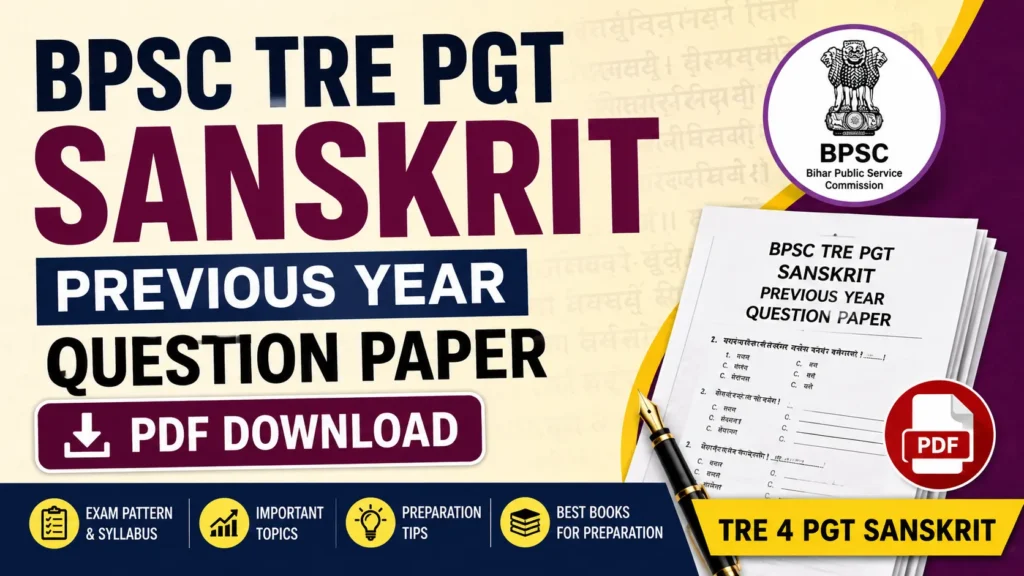
Table of Contents
ToggleBPSC TRE PGT Sanskrit Previous Year Question Paper – PDF Download
Introduction
Candidates preparing for the Bihar Public Service Commission Teacher Recruitment Examination (BPSC TRE) for the Post Graduate Teacher (PGT) Sanskrit post should include previous year question papers in their preparation strategy. The BPSC TRE PGT Sanskrit Previous Year Question Paper PDF helps aspirants understand the type of questions asked, important topics, difficulty level, and overall examination structure.
Practising BPSC TRE PGT Sanskrit Previous Year Question Paper PDF Download resources regularly can also improve time management and accuracy. Candidates preparing for TRE 4 should additionally solve available earlier papers and practice questions according to the latest syllabus and official examination pattern.
BPSC TRE PGT Sanskrit Exam Overview
| Particulars | Details |
|---|---|
| Exam Name | BPSC Teacher Recruitment Examination (TRE) |
| Post | Post Graduate Teacher (PGT) – Sanskrit |
| Conducting Body | Bihar Public Service Commission (BPSC) |
| Subject | Sanskrit |
| Level | Post Graduate Teacher |
| Question Type | Objective/Multiple Choice Questions |
| Previous Papers | Useful for understanding question trends |
| Mode | As prescribed in the official notification |
| Selection Process | As per the latest BPSC TRE notification |
Note: Candidates should verify the latest notification for the current vacancies, syllabus, exam duration, marking scheme and other examination details because these can change between recruitment cycles.
🌐 Connect with Us
BPSC TRE PGT Sanskrit Exam Pattern
The exam pattern is an important part of preparation because it helps candidates decide how much time should be devoted to each section. Before solving the BPSC TRE PGT Sanskrit Previous Year Question Paper, candidates should understand the latest pattern applicable to their recruitment cycle.
| Exam Component | Details |
|---|---|
| Examination | BPSC TRE PGT |
| Subject Paper | Sanskrit |
| Question Format | Objective-type questions |
| Questions | As per the latest official notification |
| Marks | As per the notified pattern |
| Negative Marking | Check the current official notification |
| Duration | As prescribed by BPSC |
| Difficulty | Subject-specific PGT level |
Candidates should not depend solely on an old exam pattern. The official BPSC notification should always be treated as the final source for the current examination.
BPSC TRE PGT Sanskrit Previous Year Question Paper PDF
The BPSC TRE PGT Sanskrit Previous Year Question Paper PDF is useful for identifying recurring concepts and understanding the standard expected from PGT-level candidates. Aspirants should solve each available paper in a proper exam-like environment rather than simply reading the questions.
While solving a paper, note down questions that are difficult or unfamiliar. After completing the paper, analyse the mistakes and revise the relevant Sanskrit topics. Maintaining a separate error notebook can make revision more focused.
BPSC TRE PGT Sanskrit Previous Year Question Paper PDF Download
Candidates searching for BPSC TRE PGT Sanskrit Previous Year Question Paper PDF Download should collect papers from reliable and authentic sources. Whenever possible, candidates should verify the paper against the official BPSC information or the examination details available for the relevant recruitment cycle.
A good practice is to organise the PDFs year-wise or examination-cycle-wise. This makes it easier to practise papers systematically and compare changes in question style over different recruitment cycles.
BPSC TRE 4 PGT Sanskrit Previous Question Paper PDF
For candidates preparing for TRE 4, the BPSC TRE 4 PGT Sanskrit Previous Question Paper PDF can be used as a practice resource alongside the latest syllabus. If the official TRE 4 paper is not yet available, candidates can use previous TRE PGT Sanskrit papers and similar PGT-level Sanskrit questions for preparation.
Focus particularly on Sanskrit grammar, literature, language-related concepts, important authors and works, and other topics included in the prescribed syllabus. Previous papers should be treated as a tool for understanding trends rather than as a guarantee that the same questions will be repeated.
Benefits of Solving BPSC TRE PGT Sanskrit Previous Year Papers
- Understanding the question pattern: Previous papers provide practical exposure to the type and level of questions asked in the examination.
- Identifying important topics: Repeated concepts can help candidates identify areas that deserve greater attention during revision.
- Improving time management: Solving complete papers within the expected time helps develop an effective exam strategy.
- Finding weak areas: Mistakes made during practice reveal topics that require additional study.
- Increasing confidence: Regular practice reduces exam anxiety and improves familiarity with objective-type questions.
- Improving accuracy: Repeated practice helps candidates avoid common mistakes and select answers more confidently.
- Evaluating preparation: Mock attempts based on previous papers provide a realistic measure of preparation progress.
Preparation Tips for BPSC TRE PGT Sanskrit
1. Understand the Sanskrit Syllabus
Begin preparation by dividing the complete Sanskrit syllabus into manageable sections. Give separate attention to grammar, literature, language and other prescribed areas. This prevents important topics from being overlooked.
2. Solve Previous Papers Regularly
Do not wait until the final weeks to practise previous papers. Solve them throughout your preparation and analyse every incorrect answer. This will help you understand which concepts repeatedly create difficulty.
3. Strengthen Sanskrit Grammar
Grammar can become a scoring area when concepts are studied systematically. Revise important grammatical rules and practise objective questions after completing each topic. Regular revision is more effective than studying grammar only once.
4. Revise Sanskrit Literature
Prepare important authors, works, literary traditions and prescribed literature topics according to the syllabus. Create short revision notes containing important facts and concepts so that they can be reviewed quickly before the examination.
5. Maintain an Error Notebook
Record questions that you answer incorrectly while solving previous papers and mock tests. Write the correct concept beside each mistake and revise the notebook frequently. This turns mistakes into targeted revision material.
6. Practise With a Timer
Attempt complete question papers under time constraints. Avoid spending excessive time on a single difficult question during practice. Gradually develop a strategy for answering easy, moderate and difficult questions efficiently.
7. Take Regular Mock Tests
Mock tests provide additional practice after completing previous year papers. Analyse your score after every test and identify whether lost marks resulted from conceptual gaps, careless errors or poor time management.
8. Revise Frequently
Revision should continue alongside new-topic preparation. Use short notes, important facts and previously attempted questions for quick revision. In the final stage, concentrate more on revision and practice than on starting completely new topics.
Best Books for BPSC TRE PGT Sanskrit Preparation
Candidates should select books according to the official syllabus and their existing level of preparation. Standard Sanskrit grammar and literature textbooks can help strengthen fundamentals, while objective-question books can provide additional practice.
For Sanskrit preparation, candidates can consider:
- NCERT and standard Sanskrit textbooks: Useful for strengthening basic concepts where relevant.
- Sanskrit Grammar books: Helpful for systematic practice of grammatical concepts.
- Sanskrit Literature reference books: Useful for major authors, works and literary concepts.
- BPSC TRE PGT Sanskrit previous year papers and solved papers: Helpful for exam-oriented practice.
- Objective Sanskrit practice books: Useful for increasing speed and accuracy.
Instead of collecting too many books, it is better to select a few reliable resources and revise them multiple times.
Conclusion
The BPSC TRE PGT Sanskrit Previous Year Question Paper PDF is an important preparation resource for aspirants targeting the PGT Sanskrit examination. Previous papers help candidates understand question trends, identify important areas, improve time management and assess their preparation level.
Candidates preparing for TRE 4 should combine previous year papers with the latest syllabus, standard Sanskrit study material, mock tests and regular revision. Most importantly, candidates should verify the latest BPSC notification before relying on any examination pattern or recruitment detail. Consistent practice and systematic analysis of previous papers can make Sanskrit preparation more focused and effective.
📚 Read More Articles
Frequently Asked Questions (FAQs) – BPSC TRE PGT Sanskrit Previous Year Question Paper
Candidates can download the BPSC TRE PGT Sanskrit Previous Year Question Paper PDF from reliable educational sources and verify the paper details with the latest information released by BPSC. Previous papers should be used along with the current syllabus and examination pattern.
Yes. Previous year papers are useful for TRE 4 preparation because they help candidates understand the level and style of questions. However, candidates should also follow the latest TRE 4 syllabus and official notification.
Solving previous papers helps candidates understand question trends, identify important Sanskrit topics, improve speed and accuracy, practise time management and discover their weak areas. It also provides useful exam-oriented practice.
First, attempt the paper without referring to study material. After completing it, check your answers and analyse every mistake. Revise the related Sanskrit topic and then attempt the questions again after some time.
Candidates should prepare the topics mentioned in the latest official syllabus. Depending on the prescribed syllabus, preparation may include Sanskrit grammar, literature, language-related concepts, authors, works and other subject-specific areas.
Exact questions should not be expected to repeat. However, similar concepts, topics and question patterns may appear again. Therefore, candidates should focus on understanding the concepts instead of memorising previous papers.
Candidates should solve as many relevant and authentic previous papers as are available. Quality of analysis is more important than simply counting papers. After every attempt, review incorrect and doubtful questions carefully.
Candidates should use standard Sanskrit grammar and literature books along with prescribed textbooks, objective-question practice books and previous year papers. The latest official syllabus should be used to select study material.
Yes. Candidates can solve selected questions during preparation to understand the exam trend. Full-length previous papers are particularly useful after completing most of the syllabus because they allow candidates to evaluate their overall preparation.