📅 Published on: 19.06.2026
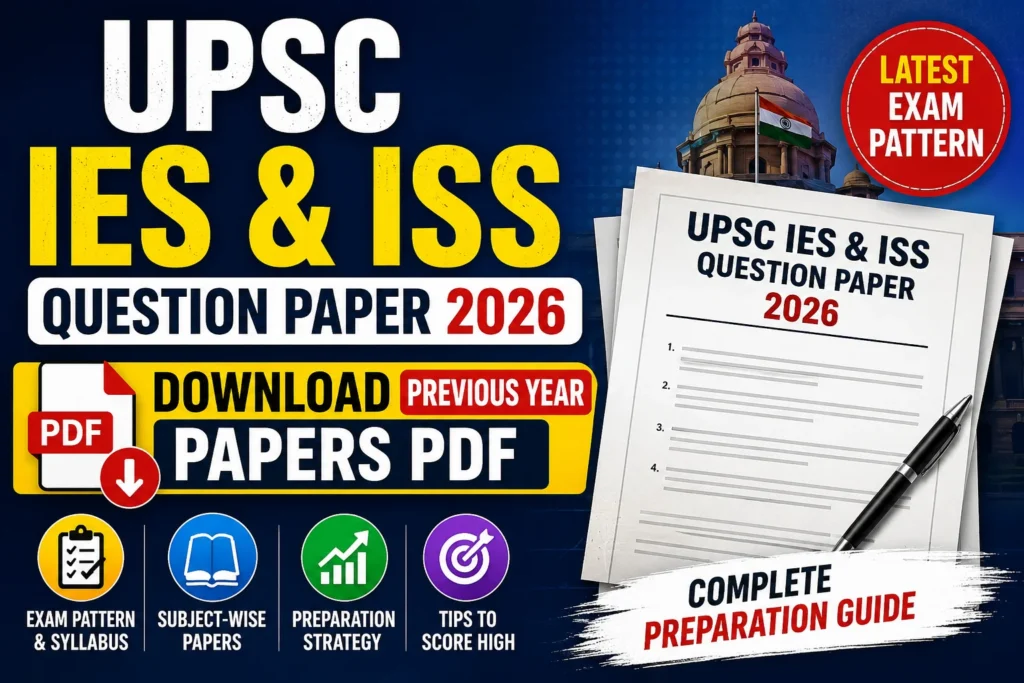
Table of Contents
ToggleUPSC IES and ISS Question Paper 2026
The UPSC IES and ISS Question Paper 2026 is one of the most valuable resources for candidates preparing for the Union Public Service Commission's Indian Economic Service (IES) and Indian Statistical Service (ISS) Examination. Solving previous year question papers helps aspirants understand the exam pattern, difficulty level, important topics, and the types of questions frequently asked in the examination.
Connect with Us
The UPSC IES and ISS examination is conducted annually to recruit qualified candidates for prestigious positions in various government departments dealing with economics and statistics. Candidates preparing for the examination should incorporate previous year papers into their study strategy to maximize their chances of success.
UPSC IES and ISS Exam 2026 Overview
| Particulars | Details |
|---|---|
| Exam Name | UPSC Indian Economic Service (IES) and Indian Statistical Service (ISS) Examination 2026 |
| Conducting Body | Union Public Service Commission (UPSC) |
| Examination Level | National Level |
| Mode of Examination | Offline (Pen and Paper Based) |
| Selection Process | Written Examination and Interview |
| Official Website | upsc.gov.in |
| Frequency of Exam | Once a Year |
| Job Location | Across India |
| Category | Previous Year Question Papers |
Why Should You Solve UPSC IES and ISS Question Paper 2026?
Previous year question papers play a crucial role in competitive exam preparation. They provide insights into the examination structure and help candidates develop effective strategies.
Benefits of Solving Previous Year Papers
- Understand the latest exam pattern and marking scheme.
- Identify important topics that carry significant weightage.
- Improve time management skills during the examination.
- Enhance accuracy and speed in solving questions.
- Assess strengths and weaknesses in different subjects.
- Build confidence before appearing in the actual examination.
- Familiarize yourself with the level of difficulty expected in the exam.
- Reduce examination anxiety through regular practice.
UPSC IES and ISS Exam Pattern 2026
Indian Economic Service (IES) Exam Pattern
| Subject | Maximum Marks | Duration |
|---|---|---|
| General English | 100 Marks | 3 Hours |
| General Studies | 100 Marks | 3 Hours |
| General Economics-I | 200 Marks | 3 Hours |
| General Economics-II | 200 Marks | 3 Hours |
| General Economics-III | 200 Marks | 3 Hours |
| Indian Economics | 200 Marks | 3 Hours |
| Viva Voce | 200 Marks | - |
Indian Statistical Service (ISS) Exam Pattern
| Subject | Maximum Marks | Duration |
|---|---|---|
| General English | 100 Marks | 3 Hours |
| General Studies | 100 Marks | 3 Hours |
| Statistics-I (Objective) | 200 Marks | 2 Hours |
| Statistics-II (Objective) | 200 Marks | 2 Hours |
| Statistics-III (Descriptive) | 200 Marks | 3 Hours |
| Statistics-IV (Descriptive) | 200 Marks | 3 Hours |
| Viva Voce | 200 Marks | - |
UPSC IES and ISS Question Paper 2026 PDF
Candidates looking for the UPSC IES and ISS Question Paper 2026 should regularly visit the official UPSC website after the examination. Along with the latest papers, aspirants are advised to practice previous year question papers from the last 5–10 years.
The previous year papers generally include:
- General English Question Papers
- General Studies Question Papers
- General Economics Papers I, II, and III
- Indian Economics Papers
- Statistics Papers I, II, III, and IV
- Answer keys and detailed solutions (where available)
How to Download UPSC IES and ISS Previous Year Question Papers?
- Visit the official UPSC website.
- Navigate to the "Examinations" section.
- Click on "Previous Question Papers."
- Select "IES/ISS Examination."
- Choose the desired year and subject paper.
- Download the PDF file for offline practice.
Preparation Strategy for UPSC IES and ISS Examination
Focus on Core Concepts
IES candidates should strengthen their understanding of microeconomics, macroeconomics, econometrics, public finance, and international economics. ISS aspirants must master probability, statistical inference, sampling theory, and operations research.
Create a Structured Study Plan
Develop a realistic study timetable that covers all subjects systematically. Allocate adequate time for revision and practice tests.
Practice Previous Year Papers Regularly
Attempting previous year question papers helps improve speed, accuracy, and familiarity with the examination pattern.
Revise Important Concepts Frequently
Maintain concise notes and formula sheets to facilitate quick revisions during the final stages of preparation.
Take Mock Tests
Mock tests simulate actual exam conditions and help identify areas that require additional attention.
Best Books for UPSC IES Preparation
| Subject | Recommended Books |
|---|---|
| Microeconomics | Microeconomic Theory by H.L. Ahuja |
| Macroeconomics | Macroeconomics by Dornbusch and Fischer |
| Indian Economy | Indian Economy by Mishra and Puri |
| Econometrics | Basic Econometrics by Damodar Gujarati |
Best Books for UPSC ISS Preparation
| Subject | Recommended Books |
|---|---|
| Probability | Fundamentals of Mathematical Statistics by Gupta and Kapoor |
| Statistical Inference | Statistical Inference by Casella and Berger |
| Sampling Theory | Sampling Theory and Methods by Sukhatme |
| Operations Research | Operations Research by Hamdy Taha |
Tips to Score High in UPSC IES and ISS Examination
- Understand the complete syllabus thoroughly.
- Solve at least 10 years of previous year question papers.
- Focus on conceptual clarity.
- Revise regularly using short notes.
- Practice answer writing for descriptive papers.
- Take mock tests consistently.
- Analyze mistakes and improve weak areas.
Conclusion
The UPSC IES and ISS Question Paper 2026 is an essential preparation tool for aspirants aiming to secure success in this prestigious examination. Regular practice with previous year papers, combined with a strategic study plan and quality resources, significantly enhances performance. Candidates should utilize these papers to understand the exam pattern, improve time management, and boost confidence before appearing for the final examination.
📚 Read More Articles
Frequently Asked Questions (FAQs) – UPSC IES and ISS Question Paper 2026
You can download the UPSC IES and ISS Question Paper 2026 PDF from the official UPSC website under the "Previous Question Papers" section once the examination is conducted.
Yes, solving previous year question papers helps candidates understand the exam pattern, difficulty level, important topics, and improves time management skills.
Experts recommend practicing at least the last 5 to 10 years of UPSC IES and ISS question papers to identify recurring topics and enhance preparation.
The UPSC IES and ISS Examination 2026 is conducted in an offline (pen-and-paper) mode.
Yes, candidates who qualify in the written examination are called for the Viva Voce (Interview) round, which carries 200 marks.
The IES examination includes General English, General Studies, General Economics-I, General Economics-II, General Economics-III, and Indian Economics.
The ISS examination consists of General English, General Studies, Statistics-I, Statistics-II, Statistics-III, and Statistics-IV papers.
Yes, several educational platforms provide UPSC IES and ISS previous year question papers with detailed solutions and answer explanations for better understanding.