📅 Published on: 08.04.2026
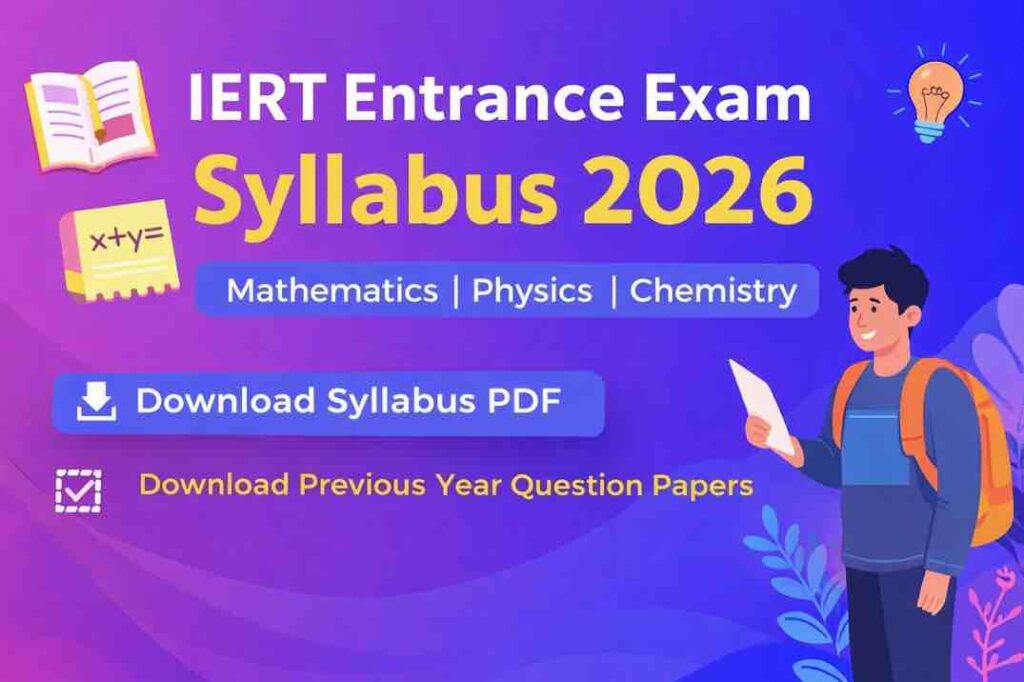
Table of Contents
ToggleIERT Entrance Exam Syllabus 2026
Introduction
The IERT Entrance Exam Syllabus 2026 is essential for candidates preparing for admission into diploma courses offered by the Institute of Engineering and Rural Technology (IERT), Prayagraj. This entrance exam is conducted for students who want to pursue engineering and technology diploma programs after completing high school.
Connect with Us
Understanding the complete IERT Entrance Exam Syllabus 2026 helps students prepare effectively and focus on important topics. The syllabus mainly includes Mathematics, Physics, and Chemistry based on Class 10 level concepts.
Exam Pattern
- Mode of Exam: Offline (Pen & Paper)
- Type of Questions: Objective (MCQs)
- Subjects: Mathematics, Physics, Chemistry
- Exam Duration: Around 3 Hours
- Negative Marking: Generally No
The exam evaluates basic concepts, logical thinking, and problem-solving ability of students based on the IERT Entrance Exam Syllabus 2026.
IERT Entrance Exam Syllabus 2026
General Information
Three year (6-Semester) Engineering/Technology Diploma
- (A) Diploma in Plastic Technology
- (B) Diploma in Electrical Engineering
- (C) Diploma in Electronics Engineering
- (D) Diploma in Instrumentation & Control Engg.
- (E) Diploma in Civil Engg. with Specialisation in:
- (i) Architecture & Town-Planning
- (ii) Construction Technology
- (iii) Public Health Engg.
- (F) Diploma in Mechanical Engg. with Specialisation in:
- (i) Power Plant Engg.
- (ii) Production Engineering
- (iii) Automobile Engg.
- (iv) Tool Engg.
- (v) Refrigeration and Air Conditioning Engg.
- (vi) Tube-well Engg.
Eligibility
The candidate must be High School from Madhyamik Shiksha Parishad U.P. with Science & Maths or its equivalent. The appearing candidates in above mentioned examination are also eligible for I.E.R.T. Entrance Examination, but they will have to produce pass marksheet at the time of admission, otherwise their admission will be treated as cancelled.
There is no minimum or maximum age limit for three year (6-Semester) Engineering/Technology Diploma Courses.
The stipulation of minimum qualification is criteria of eligibility only. The right of selection of contents of syllabus is reserved with the institute. For the guidance of candidates illustrative contents of syllabus are being given.
Any wrong disclosure/declaration by the candidate or pursuation for admission in any form/manner will disqualify the candidature outrightly.
Syllabus for Entrance Examination
NOTE: Calculator, Log Table, Slide Rule Paper & Mobile are NOT ALLOWED.
Mathematics
(A) Arithmetic
- Compound interest
- Work-time and time speed
- Bank deposit (Saving Accounts, Current Accounts, Time deposit accounts, knowledge of Cheques and payments in instalments)
(B) Statistics
- Importance of Statistics and its usefulness
- Classification of data, frequency distribution, cumulative frequency, graphical representation of statistical data
- Measures of Central tendency—Arithmetic mean, median, mode and standard deviation
(C) Algebra
- Number system—positive integers, rational and irrational numbers
- Laws of indices and applications
- Logarithms—Definition, laws and applications
- Factors—difference of two squares, trinomial expression, factorisation
- L.C.M. and H.C.F.
- Quadratic equations
- Simultaneous equations
- Trigonometric ratios
- Height and distance
- Set theory
- Mappings
(D) Trigonometry
- Circular measures (radian and degree)
- Trigonometric ratios of 0°, 30°, 45°, 60°, 90° and 180°
- Ratios of 90 + θ, 180 + θ
- Sum and difference formulas
- Product of sines and cosines
(E) Geometry
- Pythagoras theorem and its extension
- Apollonius theorem
- Circle related theorems
(F) Mensuration
- Surface area and volume of cube, prism, cylinder, cone and sphere
(G) Coordinate Geometry
- Distance between two points
- Equation of straight line
- Area of triangle
Physics
(A) Measurements
- Fundamental units and SI system
- Vernier calipers and Screw Gauge
(B) Kinematics
- Vectors
- Velocity and acceleration
(C) Mechanics
- Newton’s laws of motion
- Momentum and equilibrium
(D) Work, Power & Energy
- Work and energy
- Kinetic and potential energy
(E) Hydrostatics
- Pressure and Archimedes principle
(F) Vibration & Waves
- Simple harmonic motion
- Wave motion and sound
(G) Heat
- Kinetic theory
- Thermal expansion
(H) Light
- Reflection and refraction
- Lenses
(I) Electrostatics
- Charge and induction
(J) Electricity
- Ohm’s law
- Electric circuits
Chemistry
(A) General and Physical Chemistry
- Scientific method
- States of matter
- Atomic structure
- Valency
- Chemical equations
- Gas laws
- Avogadro’s hypothesis
- Atomic weight
- Electrolysis
- Chemical reactions
- Solutions
(B) Inorganic Chemistry
- Periodic table
(C) Organic Chemistry
- Introduction of organic chemistry
- Classification of compounds
- Hydrocarbons
- Plastics and fibres
(D) Numerical Problems
- Based on chemical laws and equations
Mathematics
- Arithmetic (Compound Interest, Time & Work, Speed & Distance)
- Statistics (Mean, Median, Mode, Graphs)
- Algebra (Number System, Quadratic Equations, Logarithms)
- Trigonometry (Ratios and Identities)
- Geometry (Pythagoras Theorem, Circles)
- Mensuration (Surface Area & Volume)
- Coordinate Geometry
Physics
- Measurements and Units
- Motion and Laws of Motion
- Work, Power, and Energy
- Heat and Thermodynamics
- Light (Reflection & Refraction)
- Electricity
- Sound and Waves
Chemistry
- Atomic Structure
- Chemical Reactions
- Acids, Bases and Salts
- Gas Laws
- Periodic Table
- Organic Chemistry Basics
- Solutions and Electrolysis
Download IERT Entrance Exam Syllabus 2026
Download Syllabus PDFDownload Previous Year Question Paper
Download Previous PapersConclusion
The IERT Entrance Exam Syllabus 2026 provides a clear roadmap for preparation. Candidates should focus on understanding concepts, practicing regularly, and solving previous year question papers.
By following the syllabus and exam pattern, students can improve their performance and increase their chances of success in the IERT entrance exam.
IERT Entrance Exam Syllabus 2026 – FAQs
The IERT Entrance Exam Syllabus 2026 includes three main subjects: Mathematics, Physics, and Chemistry based on the Class 10 level.
The exam consists of Mathematics, Physics, and Chemistry. These subjects form the core of the IERT Entrance Exam Syllabus 2026.
Generally, there is no negative marking in the IERT entrance exam, but candidates should confirm from the official notification.
The syllabus is based on the High School (Class 10) level, making it accessible for students who have completed or are appearing in Class 10.
You can download the syllabus PDF from the official link provided in the article.
Studying the syllabus helps candidates focus on important topics and prepare effectively for the exam.
Yes, solving previous year question papers helps understand exam pattern, improve speed, and boost confidence.
The exam duration is approximately 3 hours.
Yes, with proper study materials, syllabus understanding, and regular practice, candidates can prepare at home.
Focus on the syllabus, revise regularly, practice mock tests, and solve previous year papers to perform well.