📅 Published on: 24.12.2025
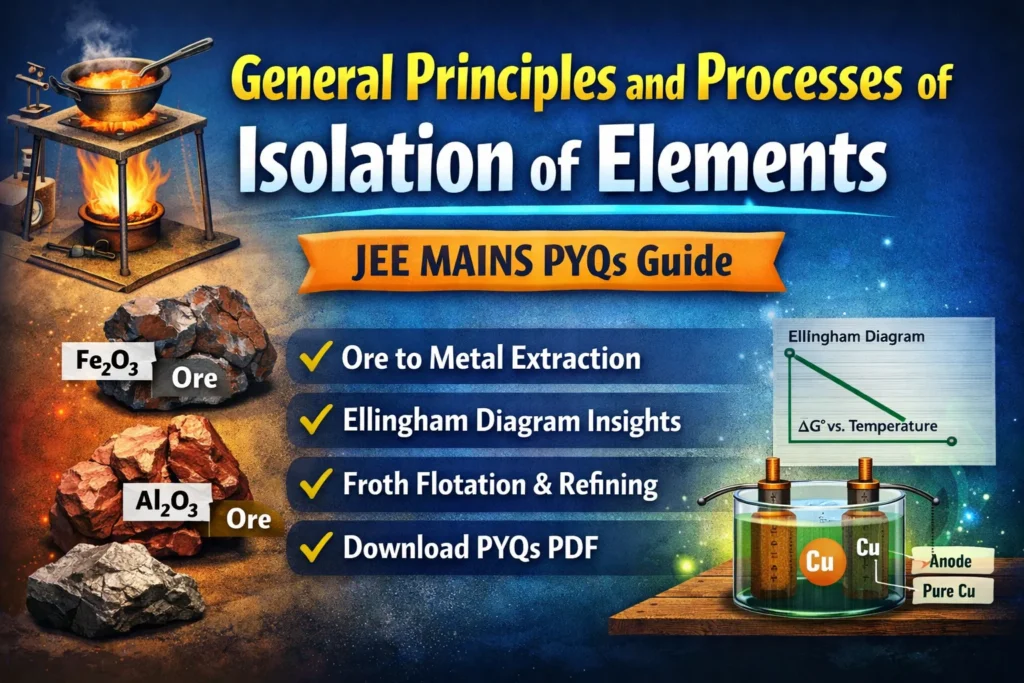
Table of Contents
ToggleGeneral Principles and Processes of Isolation of Elements – JEE Mains PYQs
The chapter General Principles and Processes of Isolation of Elements plays an important role in JEE Mains previous year questions (PYQs). It explains the fundamental methods used to extract metals from their ores and refine them for practical use. Questions from this topic are mostly concept-based and directly linked with NCERT, making it a high-scoring chapter when prepared properly.
What is Isolation of Elements?
Isolation of elements refers to the complete process of obtaining metals from their naturally occurring compounds. Since most elements are found in combined form, they are extracted through a series of physical and chemical processes.
- Minerals – Naturally occurring chemical compounds
- Ores – Minerals from which metals can be extracted economically
Major Steps in Isolation of Metals
1. Concentration of Ore
The ore is first concentrated to remove impurities known as gangue. The commonly used methods are:
- Froth flotation (for sulphide ores)
- Magnetic separation
- Leaching
Questions related to froth flotation, collectors, and depressants are frequently seen in JEE Mains PYQs.
2. Conversion of Ore into Oxide
Concentrated ores are converted into oxides because metals are easier to reduce from oxides.
- Calcination – Heating in absence of air
- Roasting – Heating in presence of excess air
3. Reduction of Metal Oxide
Metal oxides are reduced to metals using suitable reducing agents such as carbon, carbon monoxide, aluminium, or by electrolytic reduction.
The selection of a reducing agent is explained using the Ellingham diagram, which shows the variation of Gibbs free energy with temperature.
4. Refining of Metals
The crude metal obtained is purified using refining methods such as:
- Electrolytic refining
- Zone refining
- Distillation
- Liquation
JEE Mains questions often ask to match metals with their respective refining techniques.
Important PYQ Topics from This Chapter
- Froth flotation process
- Roasting vs calcination
- Ellingham diagram interpretation
- Flux and slag formation
- Electrolytic refining
Preparation Strategy for JEE Mains PYQs
- Read NCERT line by line
- Understand extraction steps with examples
- Practice Ellingham diagram questions
- Solve PYQs topic-wise
- Revise important definitions regularly
Download General Principles and Processes of Isolation of Elements – JEE Mains PYQs PDF
⬇ Download JEE Mains PYQs PDFConclusion
General Principles and Processes of Isolation of Elements is a conceptually strong and scoring chapter for JEE Mains PYQs. Most questions are direct, NCERT-based, and predictable. With proper understanding of extraction steps, Ellingham diagrams, and regular PYQ practice, students can easily secure marks from this chapter.