📅 Published on: 04.04.2026
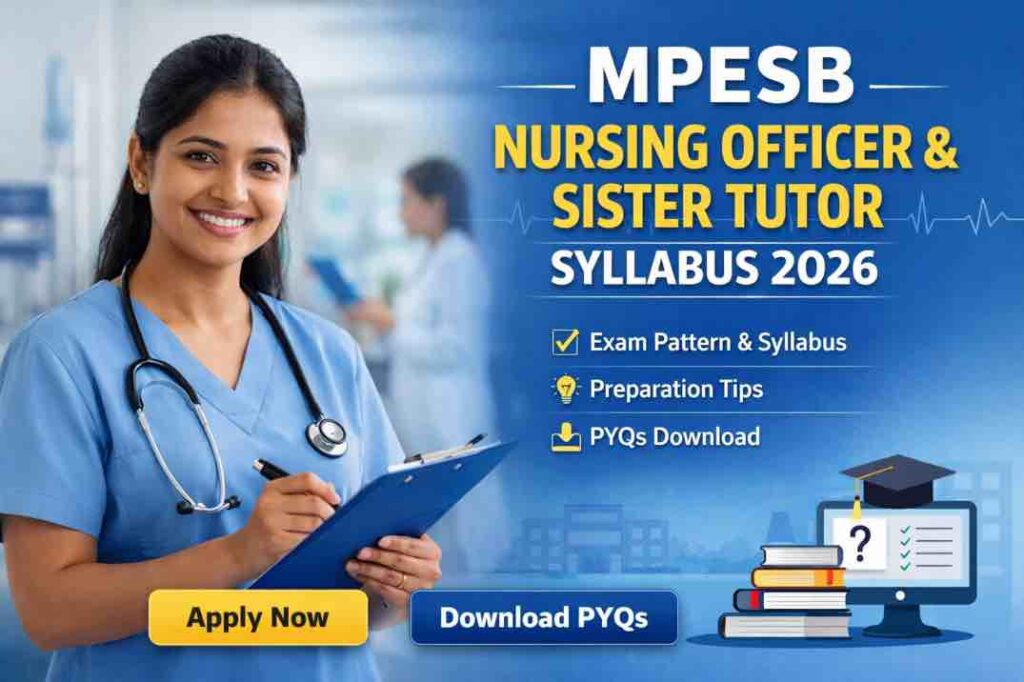
Table of Contents
ToggleMPESB Nursing Officer and Sister Tutor Syllabus 2026
Introduction
The MPESB Nursing Officer and Sister Tutor Recruitment 2026 is a great opportunity for candidates who want to build a career in the healthcare and teaching sector. Conducted by the Madhya Pradesh Employees Selection Board (MPESB), this recruitment includes posts like Nursing Officer, Staff Nurse, and Sister Tutor.
Connect with Us
Understanding the syllabus and exam pattern is essential for effective preparation. The exam mainly focuses on nursing subjects, general aptitude, and teaching-related topics.
Download Previous Year Papers Apply OnlineExam Overview
| Particulars | Details |
|---|---|
| Conducting Body | MPESB |
| Exam Name | Group-5 & Group-1 Subgroup-2 Recruitment |
| Posts | Nursing Officer, Staff Nurse, Sister Tutor |
| Mode of Exam | Computer-Based Test (CBT) |
| Total Questions | 100 MCQs |
| Total Marks | 100 Marks |
| Duration | 2 Hours |
| Negative Marking | No (Expected) |
Exam Pattern
Nursing Officer (Staff Nurse) Exam Pattern
The Nursing Officer exam consists of objective-type questions focusing on nursing subjects and general aptitude.
| Section | Questions | Marks |
|---|---|---|
| General Knowledge, Reasoning, Computer | 25 | 25 |
| Nursing Subject (Technical) | 75 | 75 |
- 100 MCQs
- Duration: 120 minutes
- No negative marking (expected)
Sister Tutor Exam Pattern
The Sister Tutor exam includes nursing knowledge along with teaching aptitude and general subjects.
- General English (Grammar, Vocabulary, Comprehension)
- Reasoning Ability
- Teaching Methodology
- Nursing Subjects
MPESB Nursing Officer Syllabus 2026
पाठ्यक्रम – सभी पदों हेतु
(अ) सामान्य ज्ञान, सामान्य हिन्दी, सामान्य अंग्रेजी, सामान्य गणित, सामान्य विज्ञान, सामान्य अभिक्षमता — 25 अंक
(ब) संबंधित विषय पर आधारित प्रश्न — 75 अंक
B.Sc. Curriculum
Semester I
Communicative English
- Communication
- Introduction to LSRGW (Listening, Speaking, Reading, Grammar, Writing simple)
- Attentive Listening
- Speaking-Effective
- Conversation
- Reading
- Writing Skills
- LSRW Skills
Applied Anatomy & Applied Physiology
Applied Anatomy
- Introduction to anatomical terms and organization of the human body
- The Respiratory system
- The Digestive system
- The Circulatory and lymphatic system
- The Endocrine system
- The Sensory organs
- The Musculoskeletal system
- The Muscular System
- The skeletal system
- The Renal System
- The Reproductive System
- The Nervous system
Applied Physiology
- General Physiology – Basic concept
- Respiratory system
- Digestive system
- Circulatory and lymphatic system
- Blood
- The endocrine system
- The sensory organs
- Musculo-skeletal system
- Renal system
- The Reproductive System
- Nervous system
Semester II
Applied Sociology & Applied Psychology
Applied Sociology
- Introduction
- Social structure
- Culture
- Family and Marriage
- Social stratification, social organization and disorganization
- Clinical sociology
Applied Psychology
- Introduction
- Biological basis of behaviour
- Mental health and mental hygiene
- Developmental psychology
- Personality
- Cognitive process
- Motivation and emotional processes
- Psychological assessment and tests
- Application of soft skill
- Self-empowerment
Applied Biochemistry and Applied Nutrition & Dietetics
Applied Biochemistry
- Carbohydrates
- Lipids
- Proteins
- Clinical Enzymology
- Acid base maintenance
- Heme catabolism
- Organ function tests
- Immunochemistry
Applied Nutrition & Dietetics
- Introduction to Nutrition
- Carbohydrates
- Energy
- Proteins
- Fats
- Vitamins
- Minerals
- Balanced diet
- Nutritional deficiency disorders
- Therapeutic diets
- Cookery rules and preservation of nutrients
- Nutrition assessment and nutrition education
- National Nutritional Programmes and role of nurse
Semester III
Nursing Foundation I & II
Nursing Foundation 1
- Introduction to Health and Illness
- Health Care Delivery Systems
- History and Scope of Nursing
- Communication and Nurse-Patient Relationship
- Documentation and Reporting
- Vital Signs
- Health Assessment
- Equipment and Linen Management
- Infection Control and Waste Management
- Comfort, Rest & Sleep, and Pain Management
- Safety in Health Care Environment
- Admission, Transfer, and Discharge of Patients
- Mobility and Immobility
- Patient Education
Nursing Foundation 2
- Nursing Concepts and Skills
- Nursing Procedures
- Basic Nursing Care
- Health Promotion and Disease Prevention
- Emergency Care
- Medical-Surgical Nursing
- Pharmacology
- Mental Health Nursing
Health/Nursing Informatics & Technology
- Introduction to Computer Applications for Patient Care
- Delivery System and Nursing Practice
- Principles of Health Informatics
- Information Systems in Healthcare
- Shared Care & Electronic Health Records
- Patient Safety & Clinical Risk
- Clinical Knowledge & Decision Making
- eHealth: Patients and the Internet
- Using Information in Healthcare Management
- Information Law & Governance in Clinical Practice
- Healthcare Quality & Evidence-Based Practice
Applied Microbiology and Infection Control including Safety
- Introduction
- General Characteristics of Microbes
- Pathogenic Organisms
- Immunity
- Hospital Acquired Infections (HAI)
- Isolation Precautions and Use of PPE
- Hand Hygiene
- Disinfection and Sterilization
- Specimen Collection (Review)
- Biomedical Waste Management & Laundry Management
- Antibiotic Stewardship
- Patient Safety Indicators
- Incidents and Adverse Events
- International Patient Safety Goals (IPSG)
- Safety Protocols
- Employee Safety Indicators
- Healthcare Worker Immunization Program and Occupational Exposure Management
Semester VI
Adult Health Nursing I (with Integrated Pathophysiology including BCLS module)
- Introduction
- Intraoperative Care
- Nursing Management of Patients with Respiratory Problems
- Gastrointestinal Disorders
- Cardiovascular Problems
- Hematological Disorders
- Endocrine Disorders
- Integumentary Disorders
- Musculoskeletal Disorders
- Communicable Diseases
Pharmacology (I & II) & Pathology (I & II)
Pharmacology I
- Introduction to Pharmacology
- Antiseptics and Disinfectants
- Gastrointestinal Drugs
- Respiratory Drugs
- Cardiovascular Drugs
- Endocrine Drugs
- Dermatological Drugs
- Antimicrobials and Chemotherapy
Pharmacology II
- Drugs for Ear, Nose, Throat, and Eye
- Urinary System Drugs
- Nervous System Drugs
- Hormonal Disorders & Contraception
- Drugs for Pregnant Women
- Drugs for Deaddiction, Emergency, Poisoning, Vitamins, Minerals
Semester V
Adult Health Nursing II (with Integrated Pathophysiology including Geriatric Nursing & Palliative Care)
- ENT Disorders
- Eye Disorders
- Kidney and Urinary Disorders
- Male Reproductive Disorders
- Burns and Cosmetic Surgeries
- Neurological Disorders
- Immunological Disorders
- Oncological Conditions
- Emergency and Disaster Management
- Nursing Care of Elderly
- Critical Care Units
- Occupational and Industrial Health Disorders
Professionalism, Professional Values and Ethics including Bioethics & Human Values
Semester IV
Community Health Nursing I (including Environmental Science & Epidemiology)
- Community Health Nursing Concepts, Roles, Responsibilities
- Health Promotion
- Epidemiology
- Communicable & Non-Communicable Diseases
- First Aid and Emergencies
- Maternal, Child, Adolescent Health
- School Health Services
- Demography & Data Interpretation
- Population Control
Environmental Science
- Environmental Health & Sanitation
- Nutrition Assessment and Education
- Communication Management and Health Education
Educational Technology / Nursing Education
- Introduction and Theoretical Foundations
- Assessment and Planning
- Implementation
- Teaching in Clinical Setting
- Educational Media
- Evaluation Methods
- Counseling and Discipline
- Ethics and Evidence-Based Teaching
- Emerging Trends
Introduction to Forensic Nursing
Child Health Nursing (I & II)
Child Health Nursing I
- Child Care Concepts
- Healthy Child
- Neonatal Care
- IMNCI
- Childhood Diseases
- Emergencies & CPR
Child Health Nursing II
- Orthopedic, Eye, Ear, Skin Disorders
- Communicable Diseases
- Behavioral and Social Problems
- Challenged Children Care
- Parent Counseling
- Pediatric Medical & Surgical Ward
- NICU & PICU
Mental Health Nursing (I & II)
Mental Health I
- Introduction
- Principles and Concepts
- Mental Health Assessment
- Therapeutic Communication
- Treatment Modalities
- Schizophrenia & Psychotic Disorders
- Mood Disorders
- Neurotic & Stress Disorders
- Substance Use Disorders
- Personality & Eating Disorders
- Childhood Behavioral Disorders
Mental Health II
- Organic Brain Disorders
- Psychiatric Emergencies
- Legal Issues
- Community Mental Health
Midwifery / Obstetrics and Gynaecology (OBG)
OBG Nursing I
- History of Midwifery
- RMNCH Programs
- Midwifery Trends
- RMNC, MLCU
- Birthing Centers
- Ethical & Legal Issues
- Women Rights
- Roles of Midwife
OBG Nursing II
- Pregnancy Problems
- Labour Management
- Postnatal Problems
- High-Risk Newborns
- Gynecological Disorders
- Family Planning
Competency Assessment
- Community Health Nursing
- Adult Health Nursing
- Child Health Nursing
- Mental Health Nursing
- Midwifery/OBG Nursing
Nursing Subjects
- Anatomy & Physiology
- Microbiology
- Medical-Surgical Nursing
- Community Health Nursing
- Pediatric Nursing
- Psychiatric Nursing
- Obstetrics & Gynecology Nursing
- Pharmacology
- Nutrition
General Section
- General Knowledge
- Basic Computer Knowledge
- Reasoning Ability
- Quantitative Aptitude
MPESB Sister Tutor Syllabus 2026
Nursing Subjects
- Advanced Nursing Concepts
- Nursing Education
- Research & Statistics
- Clinical Specialties
Teaching & Education
- Teaching Methods
- Educational Psychology
- Classroom Management
- Evaluation Techniques
General Subjects
- English (Grammar, Vocabulary, Comprehension)
- Reasoning (Analogy, Coding-Decoding, Series)
- General Awareness
Conclusion
The MPESB Nursing Officer and Sister Tutor Syllabus 2026 is designed to test both technical nursing knowledge and general aptitude. While the Nursing Officer exam focuses on clinical expertise, the Sister Tutor exam emphasizes teaching skills along with nursing knowledge.
Candidates should focus on core subjects, practice previous year papers, and improve their aptitude skills to crack the exam successfully.
Download PYQs Apply NowFrequently Asked Questions (FAQs)
Download MPESB Nursing Officer Previous Year Papers
Apply Online for MPESB Recruitment 2026