📅 Published on: 20.01.2026
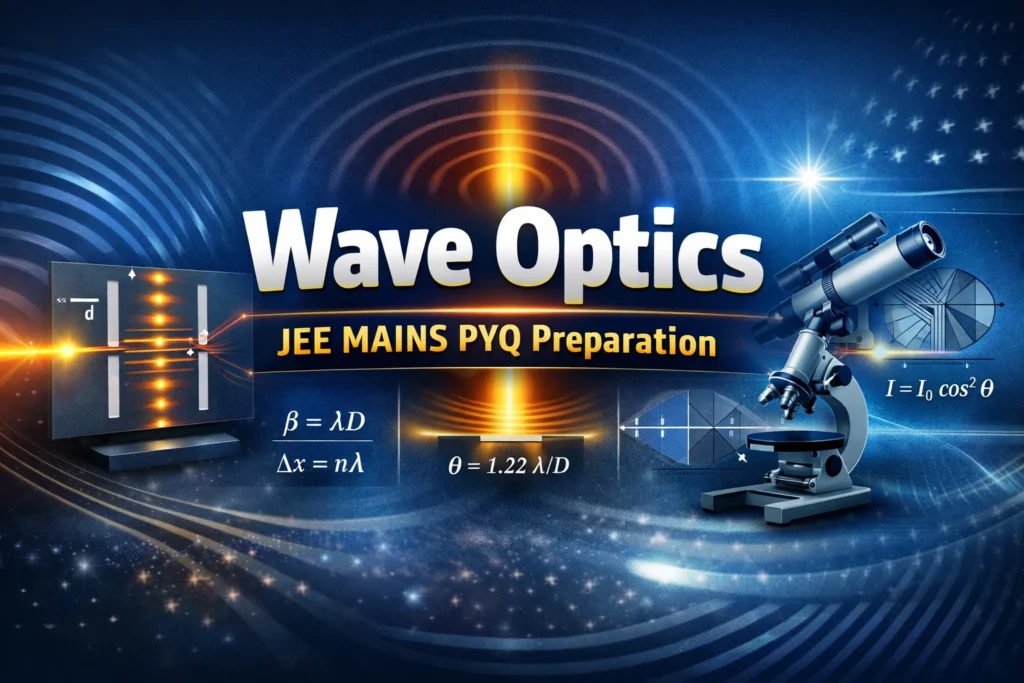
Table of Contents
ToggleWave Optics JEE Mains PYQ – Pdf Download
Wave Optics is a crucial chapter in the JEE Mains Physics syllabus that explains the wave nature of light. Unlike ray optics, which treats light as straight-line rays, wave optics focuses on phenomena such as interference, diffraction, and polarization. Questions from wave optics JEE mains PYQ appear almost every year, making this topic extremely important for aspirants aiming for a high Physics score.
📥 Wave Optics JEE Mains PYQ PDF
Download complete previous year questions with exam-level problems.
Download PDFWave Optics JEE Mains PYQ
The wave optics JEE mains PYQ section mainly includes questions from Young’s Double Slit Experiment, diffraction due to single slit, polarization of light, and resolving power of optical instruments. These questions are often numerical and concept-based, testing a student’s understanding rather than rote memorization.
Most JEE Mains questions from wave optics are moderate in difficulty. If concepts are clear and formulas are remembered properly, this chapter can become a scoring area. The exam frequently tests how changes in wavelength, slit separation, or screen distance affect the interference pattern.
JEE Mains Wave Optics PYQ – Important Trends
Analyzing jee mains wave optics PYQ shows that Young’s Double Slit Experiment dominates the chapter. Students are expected to apply the fringe width formula and interpret physical changes logically.
Diffraction-based questions usually focus on the angular width of the central maximum and resolving power. Polarization questions are often straightforward and rely on Malus’ Law.
Wave Optics PYQ JEE Mains – Topic-wise Analysis
1. Interference (YDSE)
This is the most important part of wave optics pyq jee mains. Questions commonly ask about fringe width, path difference, phase difference, and conditions for constructive or destructive interference.
2. Diffraction
Diffraction questions usually involve the position of minima and the width of the central maximum. Understanding the physical meaning of diffraction patterns is essential for solving such PYQs.
3. Polarization
Polarization questions are conceptually simple and scoring. PYQs often involve calculating transmitted intensity using Malus’ Law or identifying the nature of polarized light.
Wave Optics PYQ JEE – Commonly Used Formulas
| Concept | Formula |
|---|---|
| Fringe Width | β = λD / d |
| Constructive Interference | Δx = mλ |
| Destructive Interference | Δx = (m + 1/2)λ |
| Single Slit Minima | a sinθ = mλ |
| Malus’ Law | I = I₀ cos²θ |
Wave Optics and Optical Instruments JEE Mains PYQ
Questions from wave optics and optical instruments JEE mains PYQ combine diffraction concepts with microscopes, telescopes, and the human eye. These questions test the understanding of resolving power and the effect of aperture size on image clarity.
For microscopes, PYQs often use the resolving power formula involving numerical aperture. For telescopes, questions focus on angular resolution and diffraction limits.
Preparation Strategy for Wave Optics JEE Mains PYQ
To master wave optics:
- Practice previous year questions regularly
- Focus on conceptual clarity rather than memorization
- Draw diagrams while solving interference and diffraction problems
- Revise formulas daily
Consistent practice of wave optics pyq jee will help you recognize repeated patterns and avoid common mistakes. This chapter can easily fetch 4–8 marks in JEE Mains if prepared properly.
Conclusion
Wave Optics is a high-value chapter for JEE Mains Physics. With focused preparation and thorough practice of jee mains wave optics PYQ, students can significantly improve their Physics score. Make sure to download the PYQ PDF, solve each question carefully, and revise concepts regularly for best results.
📘 JEE Physics Previous Year Questions (PYQ)
- 🔹 Magnetism and Matter – JEE Main PYQ
- 🔹 Units and Dimensions – JEE Mains PYQ
- 🔹 Motion in a Straight Line – JEE Mains PYQ
- 🔹 Laws of Motion – JEE Mains PYQ
- 🔹 Work, Power & Energy – JEE Mains PYQ
- 🔹 Rotational Motion – JEE PYQ
- 🔹 Gravitation – JEE Mains PYQ
- 🔹 Mechanical Properties of Solids – JEE Mains PYQ
- 🔹 Mechanical Properties of Fluids – JEE Mains PYQ
- 🔹 Oscillations – JEE Mains PYQ
- 🔹 Waves – JEE Mains PYQ
- 🔹 Agniveer Vayu Previous Year Question Papers