📅 Published on: 19.01.2026
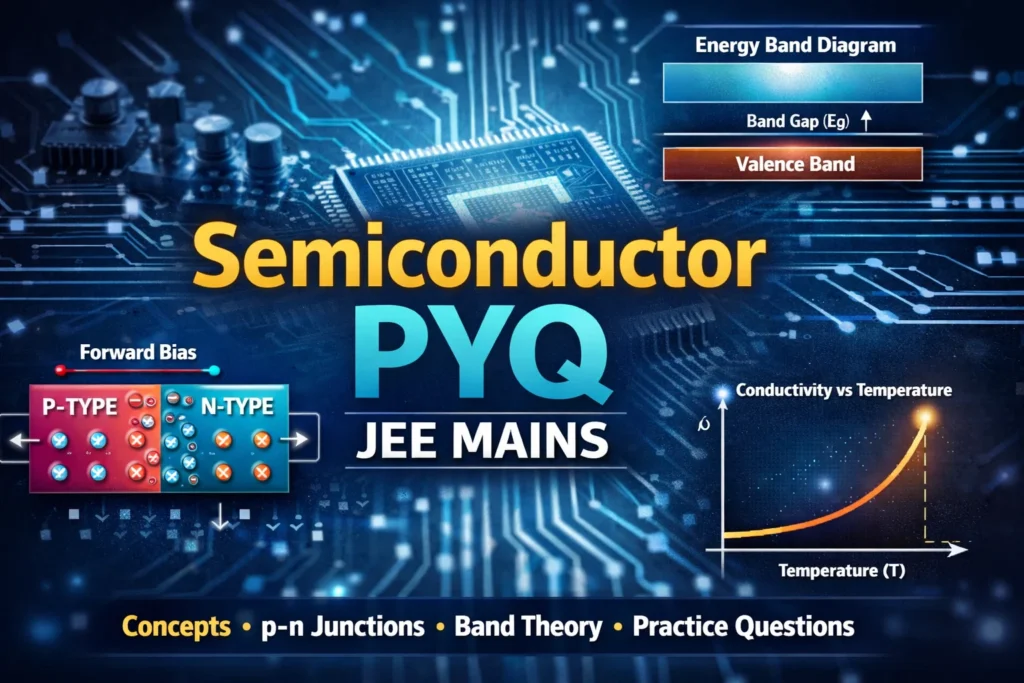
Table of Contents
ToggleSemiconductor JEE Mains PYQ -PDF Download
Semiconductor is one of the most important and scoring chapters in JEE Mains Physics. Every year, multiple questions are asked from this topic, mainly focusing on basic concepts such as intrinsic and extrinsic semiconductors, charge carriers, energy band theory, and p–n junctions. Practicing Semiconductor JEE Mains PYQ helps students clearly understand the exam pattern and frequently repeated concepts.
📘 Semiconductor PYQ JEE Mains – Download PDF
Previous Year Questions with detailed practice for JEE Mains
Download PDFWhy Semiconductor PYQ Is Important for JEE Mains
The semiconductor chapter is part of modern physics and is known for conceptual and direct questions in JEE Mains. By solving previous year questions, students can identify important trends and repeated question types. Semiconductor PYQs usually require clarity of fundamentals rather than lengthy calculations, making this chapter highly scoring.
Core Concepts Covered in Semiconductor PYQ
1. Intrinsic and Extrinsic Semiconductors
Intrinsic semiconductors are pure materials like silicon and germanium, whereas extrinsic semiconductors are formed by doping impurities. PYQs frequently test the difference between p-type and n-type semiconductors.
2. Charge Carriers
Electrons and holes are the main charge carriers in semiconductors. In n-type semiconductors, electrons are the majority carriers, while in p-type semiconductors, holes dominate. Many JEE Mains PYQs directly ask about majority and minority carriers.
3. Energy Band Theory
The concept of valence band, conduction band, and band gap is essential. Semiconductor PYQs often ask comparisons between conductors, semiconductors, and insulators based on band gap values.
4. Conductivity and Temperature Dependence
Unlike metals, the conductivity of semiconductors increases with temperature due to an increase in charge carrier concentration. This concept appears repeatedly in Semiconductor PYQ JEE Mains.
Types of Semiconductor Questions Asked in JEE Mains
- Concept-based multiple choice questions
- Assertion–reason questions
- Numerical problems on conductivity
- Graph-based questions
- Application-based questions on p–n junction diodes
Important PYQ Patterns from Semiconductors
| Topic | Frequently Asked Area |
|---|---|
| p-type Semiconductor | Majority carriers and doping impurity |
| n-type Semiconductor | Electron concentration and conductivity |
| Energy Band Gap | Comparison with conductors and insulators |
| Temperature Effect | Increase in conductivity |
| p–n Junction | Forward and reverse bias behavior |
How to Solve Semiconductor PYQ Effectively
Start by understanding the theory thoroughly before attempting PYQs. Focus on diagrams such as band diagrams and p–n junctions. Solve questions without looking at answers initially, and then analyze your mistakes. Repeated revision of Semiconductor PYQ JEE Mains improves accuracy and confidence.
Common Mistakes Students Should Avoid
- Confusing majority and minority carriers
- Incorrect interpretation of temperature dependence
- Ignoring mobility while comparing conductivity
- Not practicing previous year questions regularly
Revision Strategy Using Semiconductor PYQ
For best results, revise semiconductor PYQs at least three times before the exam. Prepare short notes on formulas, graphs, and key definitions. Using previous year questions along with concept revision ensures strong performance in JEE Mains.
Conclusion
Semiconductor is a high-weightage and easy-to-score chapter in JEE Mains Physics if prepared correctly. Practicing Semiconductor PYQ JEE Mains allows students to master concepts, understand exam trends, and improve problem-solving speed. Download the PDF, practice consistently, and revise regularly to maximize your score in this chapter.
JEE Mains Physics PYQ Links
- Unit and Dimension PYQ JEE Mains
- Motion in a Straight Line PYQ JEE Mains
- Laws of Motion JEE Mains PYQ PDF
- Work Power Energy JEE Mains PYQ
- Rotational Motion JEE PYQ PDF
- Gravitation JEE Mains PYQ PDF
- Mechanical Properties of Solids JEE Mains PYQ
- Mechanical Properties of Fluids JEE Mains PYQ
- Oscillation JEE Mains PYQ PDF
- Waves JEE Mains PYQ PDF
- Kinetic Theory of Gases JEE Mains PYQ PDF
Frequently Asked Questions – Semiconductor JEE Mains PYQ
What is Semiconductor PYQ JEE Mains?
Semiconductor PYQ JEE Mains refers to previous year questions asked from the Semiconductor chapter in JEE Mains Physics. These questions help students understand important concepts and exam patterns.
Is the Semiconductor chapter important for JEE Mains?
Yes, the Semiconductor chapter is very important for JEE Mains. Every year, 1–2 questions are asked, making it a high-scoring topic with comparatively less numerical difficulty.
What type of questions are asked from Semiconductor in JEE Mains?
Most questions are conceptual and theory-based, including p-type and n-type semiconductors, majority and minority charge carriers, energy band theory, and p–n junction behavior.
How many questions are usually asked from Semiconductor in JEE Mains?
Generally, 1 to 2 questions are asked from the Semiconductor chapter in each JEE Mains attempt.
Are Semiconductor PYQs enough for JEE Mains preparation?
Yes, practicing Semiconductor PYQs along with basic theory revision is usually sufficient, as questions are often repeated in concept and pattern.
Is Semiconductor an easy chapter for JEE Mains?
Semiconductor is considered one of the easiest chapters in JEE Mains Physics because it requires strong conceptual understanding rather than lengthy calculations.
What are the most important topics in Semiconductor for JEE Mains?
Important topics include intrinsic and extrinsic semiconductors, p-type and n-type materials, energy band gap, temperature dependence of conductivity, and p–n junction diodes.
Does Semiconductor involve numerical problems in JEE Mains?
Very few numerical problems are asked. Most questions are direct, conceptual, or application-based.
How should I revise Semiconductor PYQs before the exam?
Revise by solving PYQs multiple times, making short notes of key points, revising diagrams, and practicing MCQs under timed conditions.
Are Semiconductor PYQs useful for board exams?
Yes, Semiconductor PYQs are also very helpful for Class 12 board exams and other engineering entrance examinations.