
📅 Published on: 19.01.2026
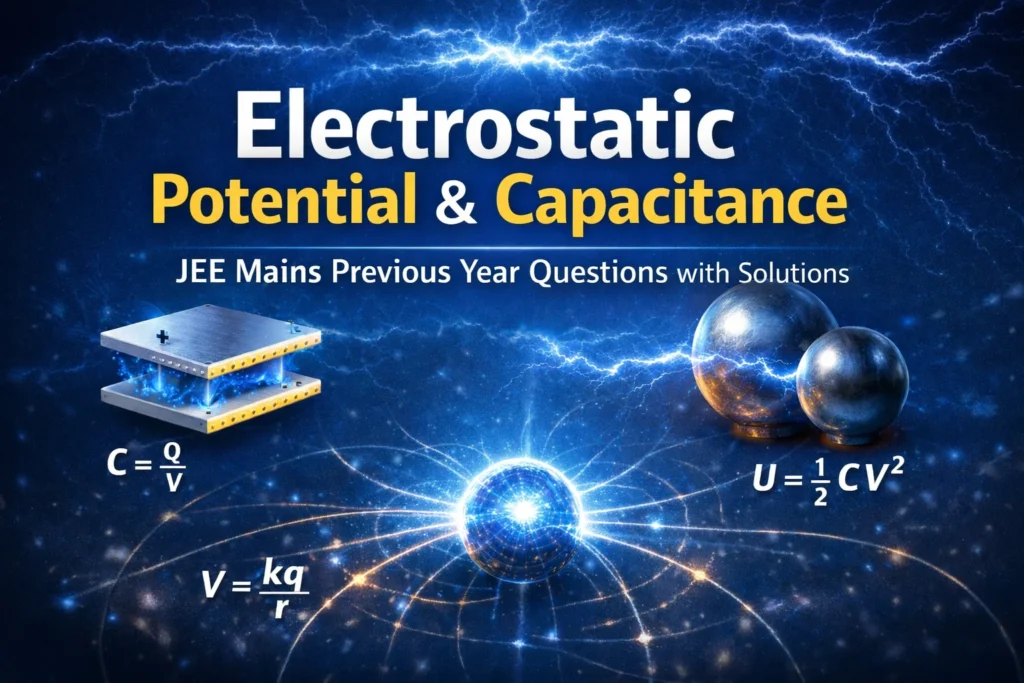
Table of Contents
ToggleElectrostatic Potential and Capacitance JEE Mains PYQ
Electrostatics is one of the most important and high-weightage units in JEE Main Physics. Among its subtopics, electrostatic potential and capacitance JEE Mains PYQ questions appear regularly due to their strong conceptual base and numerical relevance. These topics help students understand how electric fields store energy, how charge distribution occurs, and how potential differences influence electrical systems.
📘 Electrostatic Potential & Capacitance – PYQ PDF
Download JEE Mains Previous Year Questions PDF for quick revision and practice.
Download PDFWhat is Electrostatic Potential?
Electrostatic potential at a point is defined as the work done per unit positive test charge in bringing the charge from infinity to that point against the electric field. It is denoted by V and measured in volts (V). Unlike electric field, electrostatic potential is a scalar quantity, which makes calculations comparatively easier.
In JEE Main, questions related to electrostatic potential often test conceptual understanding, such as identifying regions of high or low potential, comparing potentials of different points, and analyzing potential graphs.
Relation Between Electric Field and Potential
One of the most important relations in electrostatics is the connection between electric field and potential:
E = −dV/dr
This relation shows that electric field is the negative gradient of electric potential. JEE Mains frequently asks conceptual MCQs based on this relation, especially where potential varies with distance.
Electrostatic Potential Energy
Electrostatic potential energy is the energy possessed by a system of charges due to their relative positions. For two point charges, it depends on the product of charges and the distance between them.
In electrostatic potential and capacitance JEE Mains PYQ, students are often required to calculate the total potential energy of multiple charge systems or analyze changes in energy when configurations are modified.
What is Capacitance?
Capacitance is the ability of a conductor or system of conductors to store electric charge. It is defined as the ratio of charge stored to the potential difference applied:
C = Q / V
Capacitance depends only on the geometry of the system and the medium between conductors, not on charge or voltage. This concept is repeatedly tested in JEE Mains PYQs.
Capacitance of Important Systems
Some standard systems whose capacitance formulas must be remembered for JEE Main include:
- Parallel plate capacitor
- Spherical capacitor
- Isolated spherical conductor
Problems are often twisted using partial dielectrics, multiple layers, or equivalent capacitor networks.
Effect of Dielectric on Capacitance
When a dielectric material is introduced between capacitor plates, the capacitance increases by a factor called the dielectric constant. JEE Mains frequently asks questions where the battery is either connected or disconnected while introducing the dielectric.
Understanding charge conservation and voltage behavior is crucial for solving such problems accurately.
Energy Stored in a Capacitor
The energy stored in a capacitor is given by:
U = ½ CV²
Questions related to energy loss, redistribution of charge, and comparison of energies before and after connecting capacitors are very common in JEE Main previous year papers.
Important JEE Mains PYQ Patterns
From past trends, the most common PYQ patterns include:
- Capacitance calculation with dielectrics
- Energy loss after connecting capacitors
- Conceptual MCQs on potential and electric field
- Assertion–reason type questions
Preparation Strategy for JEE Mains
To master electric potential and capacitance JEE Mains PYQ, students should:
- Revise formulas regularly
- Solve PYQs topic-wise
- Focus on conceptual clarity
- Practice numerical problems under time limits
Conclusion
Electrostatic potential and capacitance form the backbone of electrostatics in JEE Main Physics. With strong conceptual understanding and consistent practice of previous year questions, this topic can become a guaranteed scoring area. Solving PYQs not only improves accuracy but also builds confidence for the actual exam.
JEE Mains Physics PYQ Links
- Unit and Dimension PYQ JEE Mains
- Motion in a Straight Line PYQ JEE Mains
- Laws of Motion JEE Mains PYQ PDF
- Work Power Energy JEE Mains PYQ
- Rotational Motion JEE PYQ PDF
- Gravitation JEE Mains PYQ PDF
- Mechanical Properties of Solids JEE Mains PYQ
- Mechanical Properties of Fluids JEE Mains PYQ
- Oscillation JEE Mains PYQ PDF
- Waves JEE Mains PYQ PDF
- Kinetic Theory of Gases JEE Mains PYQ PDF
Frequently Asked Questions (FAQs)
Electrostatic potential is the work done per unit positive charge to bring it from infinity to a point in an electric field. It is a scalar quantity and is measured in volts.
Electric field is a vector quantity that represents force per unit charge, while electric potential is a scalar quantity representing work done per unit charge. Electric field depends on direction, but potential does not.
Capacitance depends only on the geometry of the conductors and the medium between them. It does not depend on how much charge is stored or the applied potential difference.
A dielectric increases the capacitance of a capacitor by reducing the effective electric field between the plates. The increase factor is equal to the dielectric constant of the material.
Yes, electrostatic potential and capacitance is a high-weightage topic in JEE Mains. Every year, at least 1–2 questions are asked directly or indirectly from this chapter.