📅 Published on: 20.01.2026
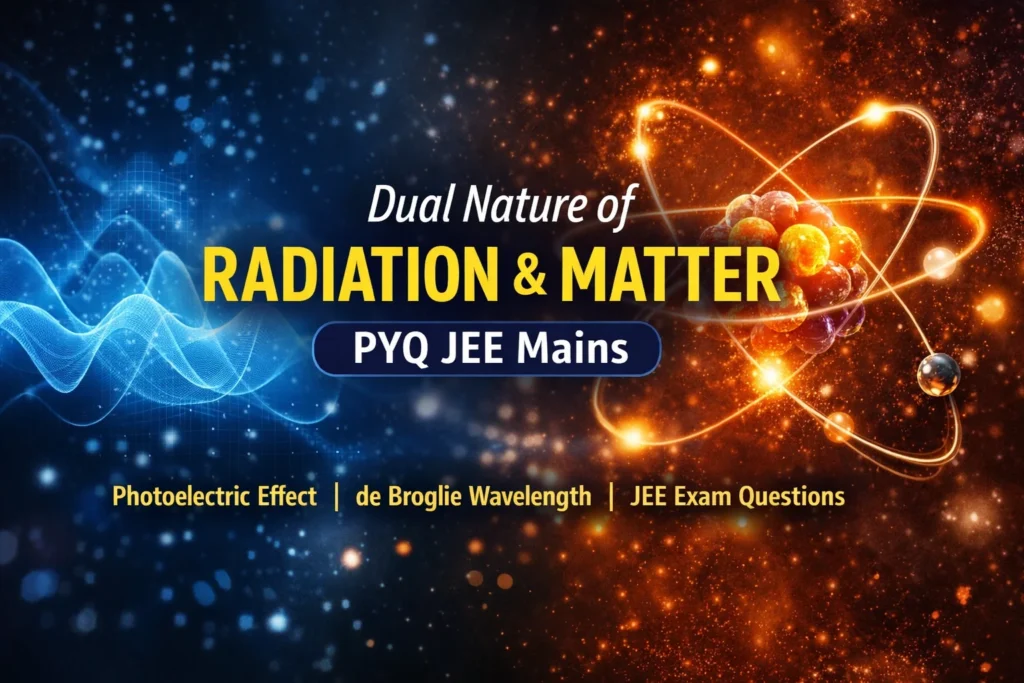
Table of Contents
ToggleDual Nature of Radiation and Matter PYQ JEE Mains
The dual nature of radiation and matter is one of the most important and high-scoring chapters in Modern Physics for JEE Mains. Almost every year, questions are asked from this chapter, making dual nature of radiation and matter PYQ JEE Mains extremely valuable for aspirants. This chapter explains how light and matter can behave both as waves and as particles, marking a major shift from classical physics to quantum mechanics.
📘 Dual Nature of Radiation & Matter – PYQ PDF
Previous Year Questions with exam-level practice for JEE Mains
Download PDFDual Nature of Matter and Radiation JEE Mains PYQ
The concept of dual nature of matter and radiation came into existence when experiments failed to explain the behavior of light using classical wave theory alone. Light, which was once considered only a wave, showed particle-like properties, while particles such as electrons exhibited wave-like behavior. This dual behavior forms the backbone of many dual nature of matter and radiation JEE Mains PYQ.
In JEE Mains, most questions from this chapter are numerical and concept-based, requiring a clear understanding of formulas rather than lengthy derivations.
Photoelectric Effect – Particle Nature of Radiation
The photoelectric effect is one of the most frequently tested topics in dual nature of radiation and matter PYQ JEE Mains. According to this phenomenon, electrons are emitted from a metal surface when radiation of sufficient frequency falls on it.
- Photoelectric current depends on the intensity of light
- Kinetic energy of electrons depends on frequency, not intensity
- Each metal has a definite threshold frequency
- Electron emission is instantaneous
Einstein explained the photoelectric effect by introducing photons with energy E = hν. JEE Mains PYQs often ask students to calculate stopping potential, threshold frequency, or maximum kinetic energy of electrons.
de Broglie Hypothesis – Wave Nature of Matter
The wave nature of matter was proposed by de Broglie, who suggested that every moving particle has an associated wavelength known as the de Broglie wavelength.
The formula is given by: λ = h / mv
In dual nature pyq JEE Mains, numericals based on electrons accelerated through a potential difference are very common. These questions are simple and scoring if formulas are remembered correctly.
Dual Nature PYQ JEE Mains – Exam Trend
Analysis of dual nature pyq JEE Mains shows that the exam focuses more on direct application of formulas rather than theoretical explanations. Common question patterns include:
- Stopping potential calculation
- Threshold wavelength and frequency
- de Broglie wavelength comparison
- Conceptual statements on photoelectric effect
Students who regularly practice PYQs from this chapter often find it to be one of the easiest sections in JEE Mains Physics.
Conclusion
The dual nature of radiation and matter is a compact yet extremely important chapter for JEE Mains. Consistent practice of dual nature of radiation and matter PYQ JEE Mains helps students understand the exam pattern, improve accuracy, and secure easy marks. By focusing on PYQs, formulas, and core concepts, aspirants can master this chapter and significantly boost their Physics score.
📘 JEE Physics Previous Year Questions (PYQ)
- 🔹 Magnetism and Matter – JEE Main PYQ
- 🔹 Units and Dimensions – JEE Mains PYQ
- 🔹 Motion in a Straight Line – JEE Mains PYQ
- 🔹 Laws of Motion – JEE Mains PYQ
- 🔹 Work, Power & Energy – JEE Mains PYQ
- 🔹 Rotational Motion – JEE PYQ
- 🔹 Gravitation – JEE Mains PYQ
- 🔹 Mechanical Properties of Solids – JEE Mains PYQ
- 🔹 Mechanical Properties of Fluids – JEE Mains PYQ
- 🔹 Oscillations – JEE Mains PYQ
- 🔹 Waves – JEE Mains PYQ
- 🔹 Agniveer Vayu Previous Year Question Papers
Frequently Asked Questions (FAQs)
The dual nature of radiation and matter means that light and matter exhibit both wave-like and particle-like properties depending on the experimental situation.
This chapter is highly important for JEE Mains because it is asked almost every year and most questions are direct, formula-based, and scoring.
The most frequently asked topics include the photoelectric effect, Einstein’s photoelectric equation, de Broglie wavelength, and threshold frequency or wavelength numericals.
Yes, JEE Mains mainly focuses on numerical and concept-based questions in this chapter, with very little emphasis on theoretical explanations.
On average, 1 to 2 questions are asked every year from the dual nature of radiation and matter, making it a high-weightage topic.
Solving PYQs is usually sufficient if concepts and formulas are clear. However, basic theory revision along with PYQs gives the best results.
Yes, due to its small syllabus and formula-based nature, the dual nature of radiation and matter chapter can be revised effectively in a short time.