📅 Published on: 24.12.2025
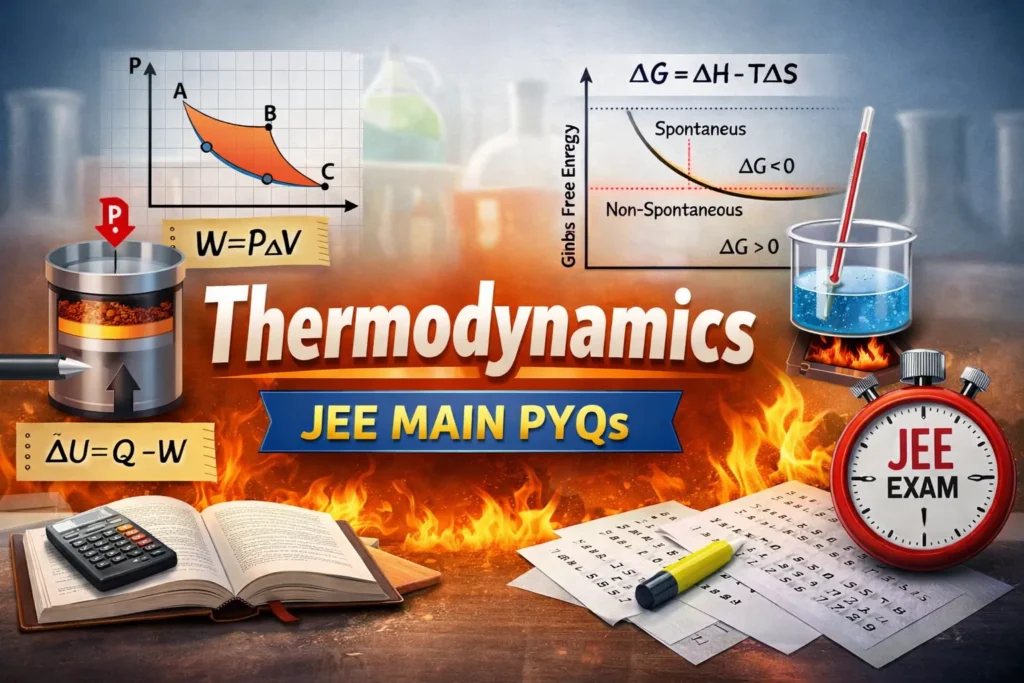
Thermodynamics JEE Main PYQs – Complete GuideThermodynamics – JEE Main PYQs
Thermodynamics is one of the most important and scoring chapters for JEE Main aspirants.
Questions from this chapter appear every year in both Physics and Chemistry sections.
With clear concepts and regular practice of previous year questions (PYQs), students can
easily secure marks from this unit.
Why Thermodynamics is Important for JEE
Thermodynamics deals with the relationship between heat, work, and energy.
In JEE Main, this chapter is considered highly predictable because questions are usually
formula-based and concept-oriented.
- Questions appear almost every year in JEE Main
- Common concepts for both Physics and Chemistry
- Most questions are direct numerical or logical
- Requires less time compared to lengthy chapters
- Helpful for related topics like equilibrium and electrochemistry
Once the basic laws and sign conventions are clear, thermodynamics becomes an easy scoring chapter.
Thermodynamics Previous Year Question Paper – JEE Main
Solving previous year question papers helps students understand the actual exam pattern,
difficulty level, and frequently repeated concepts.
In JEE Main, thermodynamics questions generally include:
- Work done during isothermal and adiabatic processes
- Heat absorbed or released using the first law
- Change in internal energy and enthalpy
- Entropy change and spontaneity of reactions
- Gibbs free energy based conclusions
Practicing PYQs from the last 10–15 years is sufficient to cover almost all important question patterns.
Thermodynamics PYQs for JEE
Thermodynamics PYQs for JEE Main can be divided into Physics-based and Chemistry-based questions.
Physics PYQs
- First law of thermodynamics applications
- Heat and work relation for ideal gases
- Isothermal and adiabatic expansion
- Relation between Cp and Cv
- Efficiency of heat engines
Chemistry PYQs
- Enthalpy and internal energy change
- Thermochemical equations and Hess’s law
- Entropy change of reactions
- Gibbs free energy and spontaneity
- Temperature dependence of reactions
Most questions are straightforward but require correct application of formulas and sign conventions.
Important Topics of Thermodynamics for JEE
Physics
- Zeroth, First and Second Laws of Thermodynamics
- Thermodynamic processes (isothermal, adiabatic, isobaric)
- Work done by gases
- Heat capacity and calorimetry
- State functions and path functions
Chemistry
- First law applied to chemical reactions
- Enthalpy (ΔH) and internal energy (ΔU)
- Thermochemical equations
- Entropy (ΔS)
- Gibbs free energy (ΔG = ΔH − TΔS)
Preparation Tips
- Understand concepts before memorizing formulas
- Practice PYQs topic-wise regularly
- Maintain a short formula sheet for quick revision
- Be careful with sign conventions of heat and work
- Solve questions in a time-bound manner
- Avoid overthinking; JEE Main questions are usually direct
Conclusion- Thermodynamics JEE MAIN PYQS
Thermodynamics is a highly scoring chapter for JEE Main when prepared strategically.
With limited theory, fixed formulas, and repeated question patterns, it offers an excellent
opportunity to boost your score.
Regular practice of previous year questions, clarity of concepts, and smart revision
can make thermodynamics one of your strongest chapters. Use the provided PYQs PDF
consistently and revise formulas frequently for the best results.