
📅 Published on: 23.12.2025
Table of Contents
ToggleStructure of Atom JEE Main PYQ
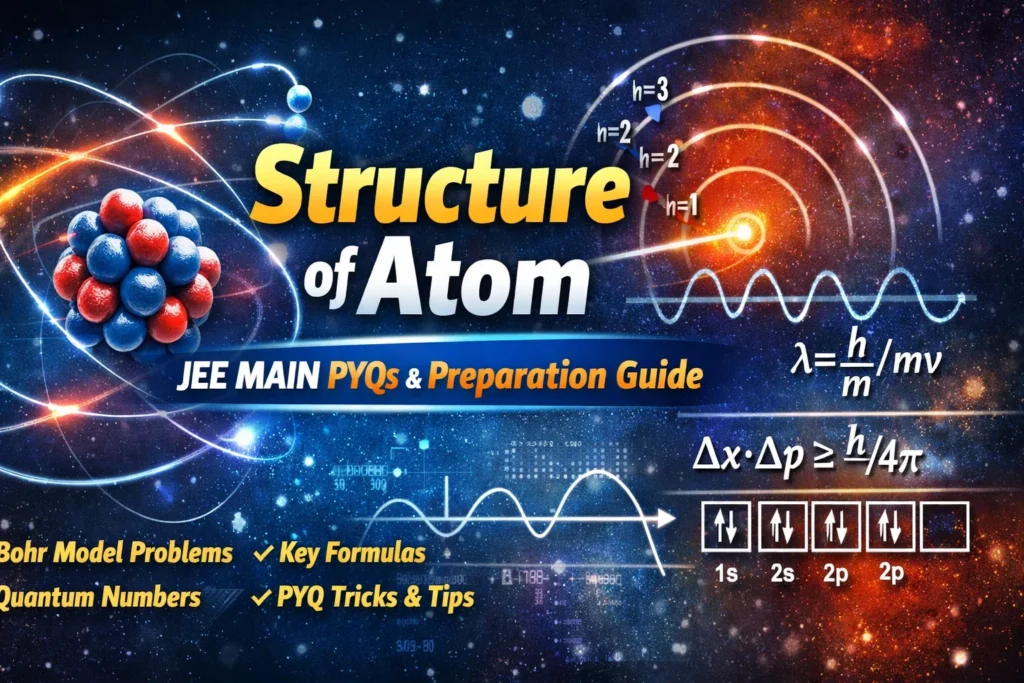
Structure of Atom – JEE Main PYQ Based Powerful Guide
Introduction
The Structure of Atom is one of the most fundamental and high-weightage chapters in JEE Main Chemistry. Almost every year, at least 1–2 questions are asked directly or indirectly from this chapter. Most questions are numerical, formula-based, and concept-driven, making it a highly scoring topic for students who prepare it properly.
This chapter forms the foundation for advanced topics such as Chemical Bonding, Periodic Table, Coordination Compounds, and Spectroscopy. A strong grip on Structure of Atom not only helps in JEE Main but also improves understanding of physical chemistry as a whole.
Why Structure of Atom Is Important for JEE Main
JEE Main focuses heavily on conceptual clarity and application of formulas. The Structure of Atom chapter is considered predictable because:
- Questions are mostly numerical and direct
- Formulas are fixed and easy to revise
- PYQ patterns repeat frequently
- Most questions are NCERT-based
On average, this chapter contributes 4–8 marks in the Chemistry section, which can significantly improve the overall score.
Important Topics from Structure of Atom (PYQ Focus)
1. Bohr’s Atomic Model
Bohr’s model is one of the most frequently asked topics in JEE Main PYQs. Questions are usually based on:
- Energy of electron in nth orbit
- Radius of orbit
- Wavelength of emitted or absorbed radiation
- Hydrogen-like species such as He⁺ and Li²⁺
Key formulas:
Energy: En = −13.6 (Z² / n²) eV
Radius: rn = 0.529 (n² / Z) Å
Most PYQs from this section are single-step and calculation-based.
2. Dual Nature of Matter (de Broglie Equation)
This topic appears regularly in JEE Main. Questions usually involve calculating the wavelength of particles like electrons or protons.
de Broglie equation:
λ = h / mv
Special attention should be given to problems involving electrons accelerated through a potential difference. Shortcut formulas save a lot of time in the exam.
3. Heisenberg Uncertainty Principle
This is a conceptually simple yet important topic. JEE Main often asks direct numerical or theoretical questions.
Formula:
Δx · Δp ≥ h / 4π
Questions are usually straightforward and require direct substitution.
4. Quantum Mechanical Model of Atom
This section is more theoretical in nature. PYQs often focus on:
- Meaning of wave function (ψ)
- Physical significance of ψ²
- Difference between orbit and orbital
- Nodes (radial and angular)
Statement-based and conceptual MCQs are common from this topic.
5. Quantum Numbers (Highly Repeated Topic)
Quantum numbers are among the most repeated topics in JEE Main PYQs.
- Number of orbitals in a shell or subshell
- Allowed and forbidden combinations of quantum numbers
- Maximum number of electrons
Important relations:
Maximum electrons in a shell = 2n²
Number of orbitals in a subshell = 2l + 1
At least one direct question from this topic is expected.
6. Electronic Configuration
Electronic configuration questions are generally easy and scoring. PYQs include:
- Correct filling of orbitals
- Exceptions like chromium and copper
- Stability of half-filled and fully-filled orbitals
PYQ Trend Analysis (Last 10 Years)
- Bohr model and hydrogen spectrum dominate
- Quantum numbers show high repetition
- About 70% questions are numerical-based
- About 30% questions are theory-based
Most questions strictly follow NCERT content.
How to Prepare Structure of Atom for JEE Main
Step 1: NCERT First
Read NCERT line-by-line. Focus on definitions, diagrams, and highlighted points.
Step 2: Formula Mastery
Memorize all important formulas and practice their application.
Step 3: Solve PYQs
Solve at least the last 15 years JEE Main PYQs and analyze repeating patterns.
Step 4: Avoid Common Mistakes
- Confusing orbit with orbital
- Ignoring units
- Using incorrect quantum number values
Conclusion
The Structure of Atom is one of the most scoring and reliable chapters in JEE Main Chemistry. With limited syllabus, fixed formulas, and repeated PYQ patterns, it offers a great opportunity to score full marks.
If prepared smartly using NCERT, formula revision, and PYQ practice, this chapter can act as a confidence booster and significantly improve your JEE Main rank.
Final Tip: Do not skip Structure of Atom — it is small, powerful, and always rewarding.