
📅 Published on: 27.12.2025
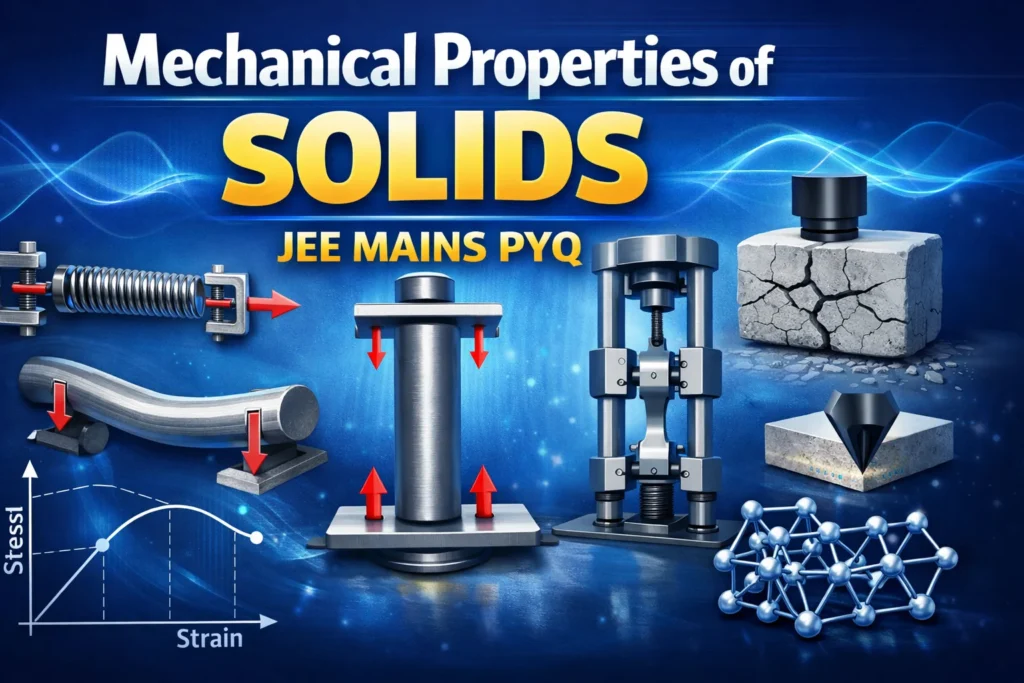
Table of Contents
ToggleMechanical Properties of Solids JEE Mains PYQ
Mechanical Properties of Solids is an important chapter of JEE Main Physics under Mechanics. This topic helps you understand how solids react to external forces like tension, compression, and shear. JEE Mains frequently includes numerical and conceptual questions from stress–strain relations, Hooke’s Law, elastic constants, and stress–strain graphs.
Download PDF for JEE Mains PYQ
Key Concepts
1. Stress (σ)
It is the force applied per unit area of cross section.
Formula: σ = F / A
Unit: Pascal (Pa)
2. Strain (ε)
It represents deformation produced per unit original dimension.
Formula: Longitudinal strain = ΔL / L
Characteristic: Dimensionless
3. Hooke’s Law
Within elastic limit, stress is directly proportional to strain.
σ ∝ ε → σ = Eε
4. Elastic Moduli
| Modulus | Definition | Formula |
|---|---|---|
| Young’s Modulus (E) | Tensile stress / tensile strain | E = σ / ε |
| Bulk Modulus (K) | Resistance to volume compression | K = -V (dP/dV) |
| Shear Modulus (G) | Shear stress / shear strain | G = τ / θ |
5. Poisson’s Ratio (ν)
Ratio of lateral strain to longitudinal strain.
Formula: ν = - (εlateral / εlongitudinal)
Relations:
- E = 2G(1 + ν)
- K = E / [3(1 − 2ν)]
6. Energy Stored in a Stretched Wire
U = (1/2) σ ε V = (1/2) kx²
7. Stress–Strain Graph
Understanding points:
- Proportional limit
- Elastic limit
- Yield point
- Ultimate tensile strength
- Fracture point
Mechanical Properties of Solids jee mains pyq pdf
- Relations among E, G, K, ν
- Extension of wires and springs
- Energy stored in elastic deformation
- Stress–strain graph interpretation
PYQ Style Questions
Q1. A wire of length L and cross-sectional area A is stretched by force F. What is extension?
Formula: ΔL = FL / (AE)
Q2. Find Young’s modulus if bulk modulus and Poisson’s ratio are known.
Formula: E = 3K(1 − 2ν)
Q3. Area under stress–strain curve equals?
Answer: Energy absorbed before fracture (resilience)
Preparation Tips
- Memorize modulus relations & units
- Practice extension & energy-based numeric problems
- Study stress–strain graph carefully — slope gives E
- Practice PYQs from provided PDF
Conclusion
This chapter is highly scoring if concepts and formula relations are clear. Regular practice using JEE Mains PYQs will boost accuracy and speed during the exam.





Frequently Asked Questions – Mechanical Properties of Solids
Young’s modulus, Hooke’s Law, stress–strain relation, and elastic moduli relations are the most repeated topics in JEE Mains.
Solving 20–40 PYQs gives strong conceptual clarity and helps you recognize commonly repeated question patterns.
The relation E = 2G(1 + ν) and E = 3K(1 − 2ν) are used frequently to convert one modulus into another.
Numerical questions dominate, but small conceptual questions from graphs and energy stored also appear regularly.
Direct formula-based numerical problems related to extension, stress, and strain are straightforward and high scoring.
Focus on identifying the linear elastic region, yield point, and ultimate tensile strength — the slope of the first part gives Young’s modulus.
Poisson’s ratio relates longitudinal and lateral strain. It connects elastic moduli, making it essential for modulus conversion problems.
Yes, it gives 1–2 questions almost every year, and those who practice PYQs can score full marks from this topic.
No, Hooke’s law works only within the elastic region where stress is proportional to strain.
Revise formulas, solve 10 PYQs, analyze one stress–strain graph, and practice a few numeric conversions between E, G, K, and ν.