Rotational Motion JEE PYQ- Pdf Download

📅 Published on: 27.12.2025

Rotational Motion JEE PYQ- Pdf Download
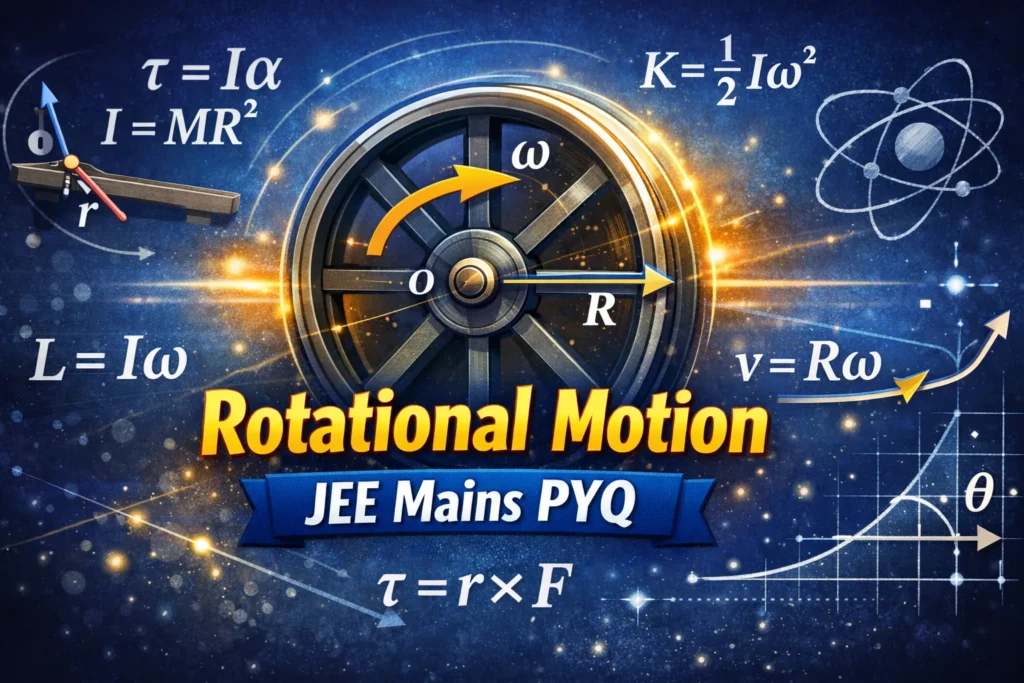
Rotational Motion JEE Mains PYQ

Rotational Motion JEE PYQ

Rotational motion holds a major weightage in JEE Mains Physics, testing your understanding of concepts like moment of inertia, torque, angular momentum, and rolling motion. Practicing Previous Year Questions (PYQs) strengthens concepts and builds numerical accuracy.

Download PDF – Rotational Motion PYQs

Rotational Motion PYQ JEE Mains

Solving rotational motion questions from JEE Mains helps students:

  • Identify repeatedly asked concepts like rolling motion, torque, inertia
  • Understand question framing and pattern
  • Improve calculation speed for multi-step problems

Frequently asked areas in PYQs:

  • Moment of Inertia & Parallel/Perpendicular Axis Theorem
  • Torque & Angular Acceleration
  • Energy in Rotational Systems
  • Rolling Without Slipping
  • Conservation of Angular Momentum

PYQ of Rotational Motion JEE

📍 Moment of Inertia

JEE repeatedly asks moment of inertia of basic & composite rigid bodies.

📍 Torque & Angular Acceleration

Torque relates force to rotational change:
τ = Iα

📍 Rolling Motion

Relation between translational and rotational motion:
v = Rω

📍 Rotational Kinetic Energy

Energy stored in rotation:
K = (1/2) I ω²

📍 Conservation Laws

Angular momentum remains conserved in absence of external torque.

Rotation PYQ JEE

Important formulas to revise through PYQs:

QuantityFormula
Angular Velocityω = dθ/dt
Angular Accelerationα = dω/dt
Rolling Conditionv = Rω
Rotational Kinetic EnergyK = (1/2) Iω²
Torqueτ = r × F

Strategy to solve rotational motion problems:

  • Draw free body diagrams
  • Break compound systems into simple bodies
  • Apply parallel/perpendicular axis theorem carefully
  • Use conservation laws wherever possible

Tips to Ace Rotational Motion in JEE Mains

  • Practice at least 5–7 years of PYQs
  • Memorize standard moment of inertia values
  • Be fluent in unit conversions (rad, Hz, RPM)
  • Solve numericals under time constraints

Connect with Us

WhatsApp Group
Join Now
Telegram Group
Join Now
Facebook Profile
Open
YouTube Channel
Subscribe
Q1. Why is rotational motion important for JEE Mains?
Rotational motion carries high value in JEE Mains and builds core understanding for rigid body mechanics and rolling motion.
Q2. How many rotational motion PYQs should I solve?
Solving at least 8–10 years of PYQs helps recognize repeated formulas, concepts, and numerical patterns.
Q3. Which formulas are most important for rotational motion?
Moment of inertia values, rolling condition (v = Rω), torque (τ = Iα), and conservation of angular momentum are key formulas.
Q4. Are rotational motion questions mostly numerical?
Yes, most questions are numerical involving calculations of inertia, torque, angular acceleration, and rolling motion.
Q5. How do I remember moment of inertia formulas?
Understand their derivation once, then remember standard values using patterns like rods, discs, spheres, and rings.
Q6. Does rotational motion require calculus?
Basic calculus helps, but most PYQs rely on direct formulas and algebraic manipulation instead of differentiation.
Q7. Which type of questions repeat frequently?
Rolling without slipping, angular momentum conservation, and parallel axis theorem are often repeated topics.
Q8. Is rotational motion connected with circular motion?
Yes, circular motion forms the base; rotational motion expands it to rigid bodies with angular variables.
Q9. Does moment of inertia vary with axis?
Yes, moment of inertia changes when the axis changes, which is why parallel and perpendicular axis theorems are needed.
Q10. How do I speed up problem solving?
Memorize standard inertia values, practice mixed PYQs, and avoid unnecessary derivation during timed practice.

Leave a Comment

Your email address will not be published. Required fields are marked *

Scroll to Top