📅 Published on: 27.12.2025
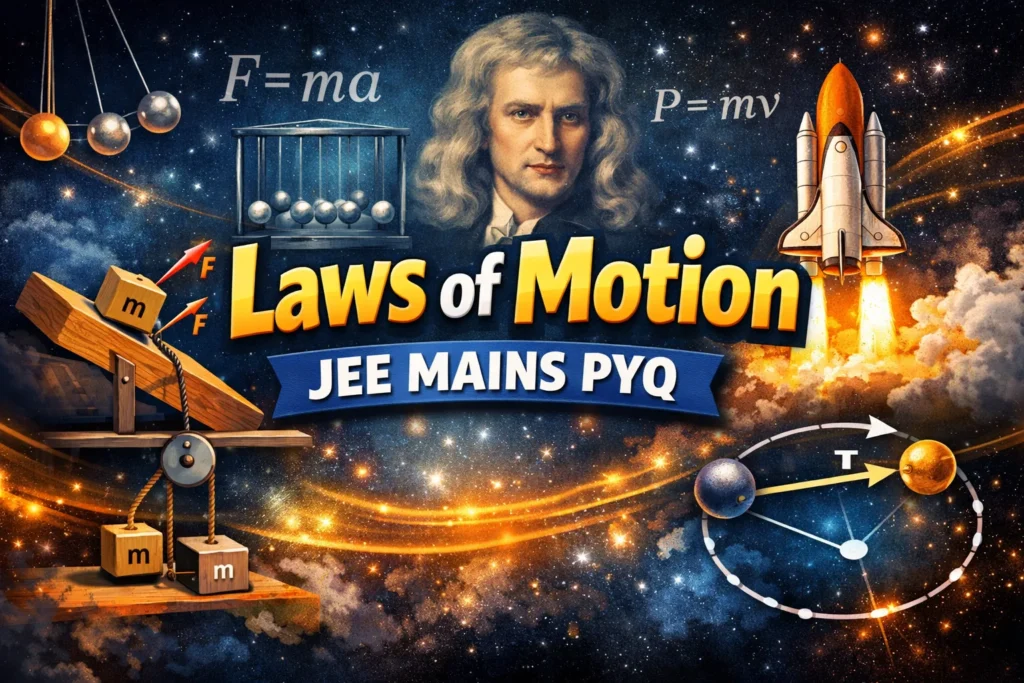
Table of Contents
ToggleLaws of Motion JEE Mains PYQ
The Laws of Motion is one of the most repeated and high-weightage chapters in JEE Mains Physics. It covers Newton’s laws, friction, pseudo force, momentum, impulse and applications in pulley-system and inclined plane questions. Solving previous year questions (PYQs) helps students understand frequently asked concepts and improve accuracy in problem-solving.
Download Laws of Motion PYQ PDF
Laws of Motion PYQ JEE Mains
Newton’s laws are the foundation of motion-based numerical problems in JEE Mains. Most PYQ problems focus on identifying forces, drawing Free Body Diagrams (FBD), and calculating acceleration using net force.
Important Concepts Asked in PYQs
- Balanced and unbalanced forces
- Mass vs Weight
- Normal reaction and tension forces
- Pulley system acceleration
Example PYQ Style:
A block of mass m is pulled by force F on a frictionless surface.
Find acceleration: a = F / m
Laws of Motion JEE PYQ
Newton’s Second Law is used to connect applied forces with acceleration. Questions also combine momentum and impulse to test deeper understanding.
- Impulse and change in momentum: J = Δp = FΔt
- Recoil motion & bullet-block systems
- Systems with multiple bodies connected by ropes
Laws of Motion PYQ JEE
Circular motion and friction problems are often linked with Newton’s laws. Students must identify whether friction acts with or against motion depending on direction.
- Maximum friction: Fmax = μsN
- Kinetic friction: Fk = μkN
- Centripetal force questions using tension
Newton Law of Motion JEE PYQ
Newton’s First Law – Law of Inertia
A body in motion remains in motion unless acted upon by net external force. Common PYQ trap: Equilibrium does not mean no forces — it means net force is zero.
Newton’s Second Law – Force & Acceleration
Foundation of JEE numerical problems.
F = ma helps derive acceleration in almost every system.
Newton’s Third Law – Action-Reaction
Action and reaction forces are equal and opposite but act on different bodies. JEE often tests this with objects pushing or pulling each other.
Tips to Score High in Laws of Motion
- Always draw free body diagrams first
- Identify type of force: tension, normal, friction
- Break forces into components on inclined planes
- Practice mixed-topic questions with friction + pulley + circular motion
Conclusion:
Mastering the Laws of Motion through PYQs improves conceptual understanding and builds confidence for JEE Mains mechanics topics. Regular practice of FBD-based questions ensures accuracy and fast problem-solving in exams.