📅 Published on: 27.12.2025
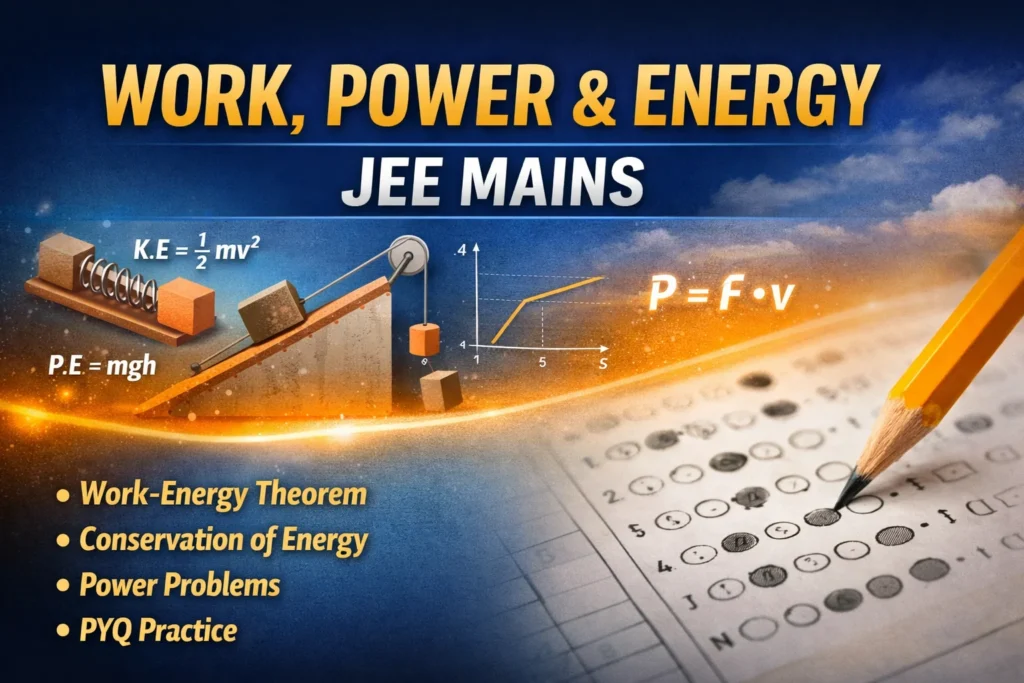
Table of Contents
ToggleWork, Power & Energy JEE Mains PYQ – Full Article
work power energy jee mains pyq
Work, Power, and Energy is one of those chapters in Physics where concepts seem straightforward at first glance, yet the real understanding gets tested when questions mix motion, force, and energy considerations. In JEE Mains, PYQs from this chapter regularly focus on three connected parts — work done by different forces, energy transformations, and power delivered under changing motion conditions. These topics help students convert physical situations into equations that reveal how objects speed up, slow down, and store energy.
The core definition of work is simply force multiplied by displacement, but JEE takes it deeper. Instead of direct substitution, many PYQs give force as a function of displacement, requiring integration to calculate total work. A common trick appears in force–displacement graphs: here, the area under the graph equals work, and students who master graphical representation gain an easy advantage.
Energy brings a bigger picture to the chapter. Using the Work–Energy Theorem, students can bypass lengthy kinematics and still find velocity or displacement. PYQs often present motion with gravity, springs, or in constrained systems — the ability to apply conservation of mechanical energy is frequently rewarded. Meanwhile, power enters when time matters: average power simplifies lengthy steps, but instantaneous power = F · v remains the most tested formula for conceptual clarity.
work energy and power jee mains pyq
Analyzing previous year questions shows that this chapter consistently contributes marks across exams. Even though the number of questions per paper may not be high, their strategic value is large because this chapter connects with Kinematics, Laws of Motion, Rotation, and even Collisions. Therefore, mastering PYQs here helps across multiple Physics sections.
Work and energy-based PYQs involving elastic collisions appear in disguised forms. For example, when a bouncing ball loses energy after every collision, students are expected to calculate either total distance traveled or fraction of energy lost. JEE expects students to link energy to motion patterns instead of memorizing sequences.
Springs are another favorite. Using U = ½kx², maximum compression or elongation questions often require students to compare initial energy with total stored elastic energy and friction loss. Many students struggle only because they treat springs as separate from motion; PYQs prove that they are part of the same energy flow.
work energy and power jee pyq
Looking into detailed PYQs, mechanical energy conservation plays the central role. If friction or external non-conservative forces are absent, the sum of kinetic and potential energy stays constant. This simple statement helps solve complex-seeming problems in seconds. It is especially useful for pulley setups, block–spring systems, and bodies sliding on inclines.
Another repeated JEE trick concerns constant power. When a machine delivers constant power, students intuitively expect constant acceleration — but that’s incorrect. Instead, velocity increases with the square root of time: v ∝ √t. Many previous questions evaluate whether students can spot this relation without detailed calculation.
Work-based interpretation in graph questions is another high-frequency style. Whether the graph is of force, velocity, energy, or power, the ability to extract physical meaning quickly sets toppers apart. PYQs encourage reading graphs as if they represent stories of motion.
work energy power pyq jee mains
In the end, Work, Power, and Energy becomes a scoring topic when students think in transformations rather than in separate formulas. PYQs consistently demonstrate that work is the pathway, energy is the language, and power is the pace of change. If students solve at least 30 to 40 PYQs from this chapter, accuracy improves naturally because every new question feels connected to the previous ones.
Top strategy based on PYQs:
- Convert motion questions into energy form whenever possible
- Use conservation to simplify complicated multi-body systems
- Remember proportionalities for constant power & spring cases
- Avoid memorizing — understand what energy transfers mean
Therefore, this chapter is more than formulas — it’s the logic of how physical systems exchange energy, perform work, and evolve over time. Mastering PYQs ensures that these ideas turn into marks on exam day.