📅 Published on: 23.12.2025
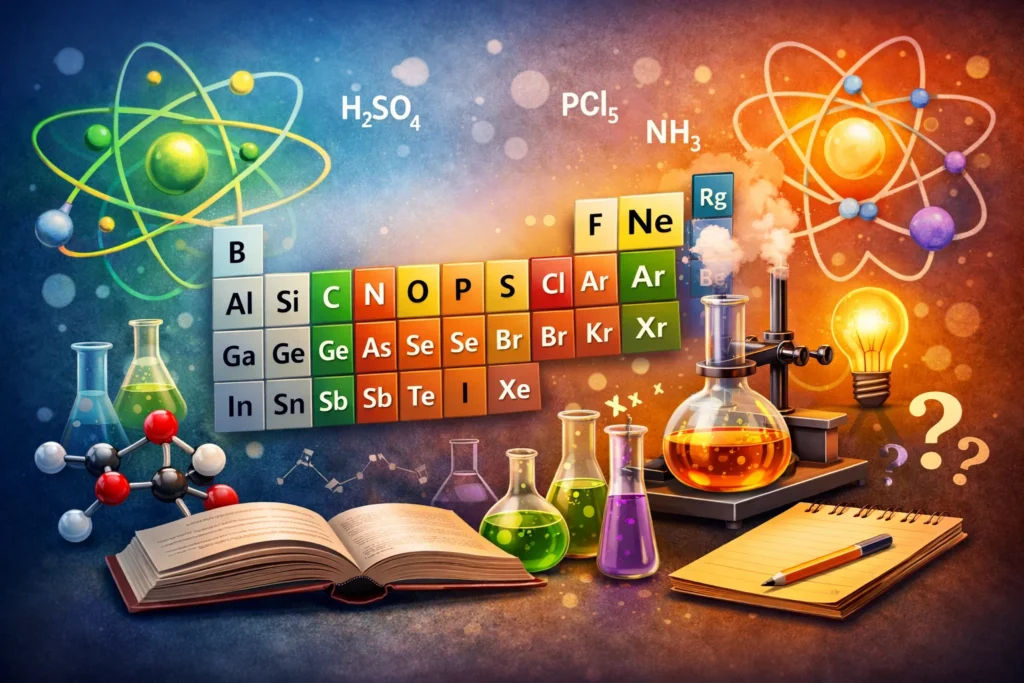
Table of Contents
ToggleP-Block Elements – JEE Main Previous Year Questions (PYQs)
Introduction
P-Block Elements form one of the most important chapters of Inorganic Chemistry for JEE Main. These elements belong to Groups 13 to 18 of the periodic table and include a wide range of metals, non-metals, and metalloids. Due to their diverse properties and applications, questions from P-Block Elements are frequently asked in JEE Main examinations.
Why P-Block Elements Are Important for JEE Main
Every year, several questions in JEE Main Chemistry are directly or indirectly based on P-Block Elements. This chapter tests a student’s understanding of periodic trends, oxidation states, chemical reactivity, and properties of compounds.
- Regular appearance of conceptual MCQs
- High weightage in inorganic chemistry
- Questions based on trends, reactions, and properties
- Helpful for scoring quick and accurate marks
What Are P-Block Elements?
P-Block elements are those elements in which the last electron enters the p-orbital of the valence shell. Their general electronic configuration is ns²np¹–⁶. These elements show a wide variation in physical and chemical properties.
Important Groups in P-Block Elements
- Group 13 (Boron Family): Oxidation states, electron deficiency
- Group 14 (Carbon Family): Allotropy, inert pair effect
- Group 15 (Nitrogen Family): Oxides and hydrides
- Group 16 (Oxygen Family): Acidic nature of oxides
- Group 17 (Halogens): Reactivity and displacement reactions
- Group 18 (Noble Gases): Stability and rare compounds
Types of PYQs Asked in JEE Main
- Periodic trend-based questions
- Oxidation state and stability questions
- Acidic, basic, and amphoteric nature of oxides
- Reaction-based multiple choice questions
- Assertion–Reason type questions
How to Use P-Block Elements PYQs PDF
The provided PDF contains carefully selected previous year questions for practice. To get maximum benefit:
- Revise theory before attempting questions
- Solve PYQs without checking answers first
- Analyze mistakes and revise weak areas
- Repeat revision before the final exam
Preparation Tips for P-Block Elements
- Focus on understanding trends rather than rote learning
- Remember important exceptions and special cases
- Practice PYQs regularly for confidence
- Revise key reactions and properties multiple times
Conclusion
P-Block Elements is a scoring chapter in JEE Main if prepared properly. Practicing previous year questions helps in understanding exam patterns and boosts accuracy. Make sure to use the provided PDF effectively and revise concepts regularly to maximize your score in JEE Main Chemistry.



Frequently Asked Questions (FAQs)
1. How many questions are asked from P-Block Elements in JEE Main?
On average, 2–3 questions are asked from P-Block Elements in JEE Main every year. These questions are mostly conceptual and trend-based.
2. Is P-Block Elements a scoring chapter for JEE Main?
Yes, P-Block Elements is considered a scoring chapter because many questions are direct and based on well-defined periodic trends and properties.
3. Which groups of P-Block Elements are most important for PYQs?
Groups 13 to 17 are highly important for PYQs, especially topics like oxidation states, oxides, hydrides, and halogen reactions.
4. Are PYQs enough to prepare P-Block Elements?
PYQs are extremely helpful, but they should be solved after understanding basic theory. PYQs help in revision and understanding exam patterns.
5. How should I revise P-Block Elements before the exam?
Revise periodic trends, important reactions, oxidation states, and exceptions. Solving PYQs multiple times helps in quick recall during the exam.
6. Where can I download P-Block Elements JEE Main PYQs PDF?
You can download the P-Block Elements JEE Main PYQs PDF from the link provided at the top of this article for free practice.