📅 Published on: 24.12.2025
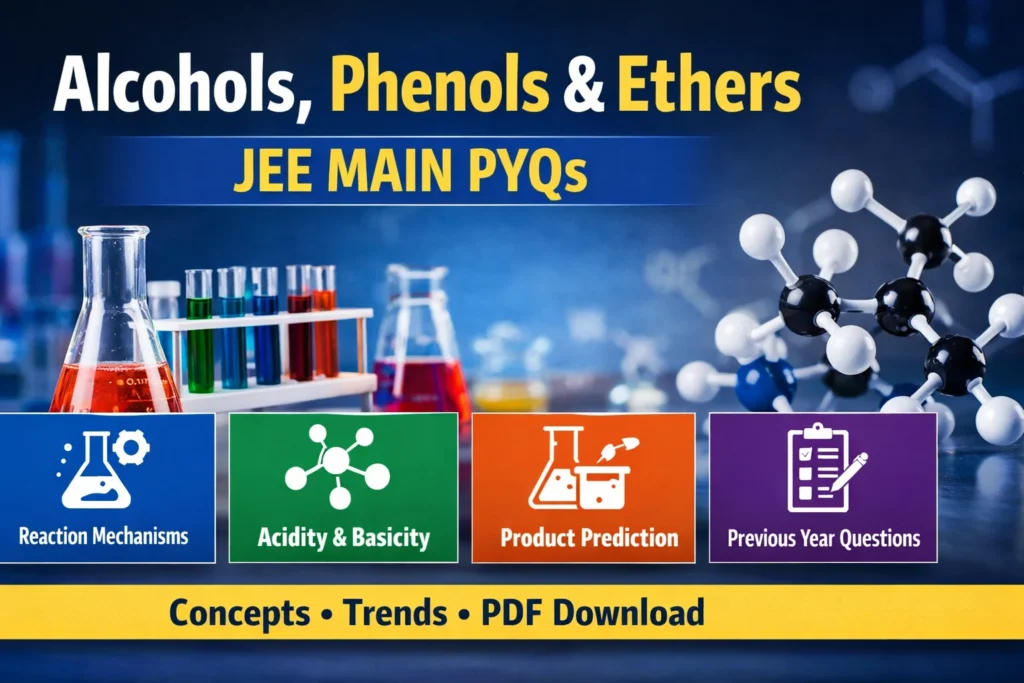
Table of Contents
ToggleAlcohols, Phenols, and Ethers – JEE Main PYQs
A complete exam-oriented guide covering important concepts, reaction trends, and previous year question patterns for JEE Main.
Introduction
Alcohols, Phenols, and Ethers form an important and scoring chapter of Organic Chemistry in JEE Main. Every year, questions are asked that test conceptual clarity, reaction mechanisms, and comparative reasoning. A strong grip on this chapter can easily fetch 4–8 marks in the exam.
Syllabus Overview
- Classification and nomenclature
- Methods of preparation
- Physical properties and hydrogen bonding
- Chemical reactions of alcohols, phenols, and ethers
- Acidity and basicity comparison
- Important name reactions
JEE Main PYQs Trend Analysis
From previous year papers, Alcohols, Phenols, and Ethers contribute 2–4 direct or application-based questions. Most questions are reaction-oriented and focus on product prediction or conceptual reasoning.
| Topic | Weightage | PYQ Focus |
|---|---|---|
| Alcohols | High | Oxidation, dehydration, classification |
| Phenols | Very High | Acidity, EAS reactions, resonance |
| Ethers | Moderate | Williamson synthesis, cleavage reactions |
Alcohols – Important PYQ Concepts
- Preparation using reduction of aldehydes and ketones
- Distinction between 1°, 2°, and 3° alcohols
- Dehydration reactions forming alkenes
- Oxidation reactions and reagents used
- Role of hydrogen bonding in boiling point
JEE Main frequently asks questions where students must identify products or choose the correct reagent based on the type of alcohol.
Phenols – Important PYQ Concepts
- Higher acidity of phenols compared to alcohols
- Resonance stabilization of phenoxide ion
- Electrophilic aromatic substitution reactions
- Ortho-para directing nature of –OH group
- Reimer–Tiemann reaction and Kolbe reaction
Most PYQs from phenols test conceptual clarity of acidity and directing effects rather than memorization.
Ethers – Important PYQ Concepts
- Preparation by Williamson ether synthesis
- Acidic cleavage using HI or HBr
- Symmetric vs asymmetric ether behavior
- SN1 vs SN2 reaction pathways
- Physical properties and polarity
Questions often involve predicting major products in ether cleavage reactions.
Commonly Asked PYQ Themes
| Concept | Question Type |
|---|---|
| Acidity comparison | Assertion–Reason / MCQ |
| Reaction mechanism | Product prediction |
| Williamson synthesis | Best method selection |
| Phenol EAS reactions | Major product identification |
Preparation Tips for JEE Main
- Focus on reaction mechanisms instead of rote learning
- Practice previous 10–15 years of PYQs
- Memorize reagent-specific reactions
- Compare acidity and basicity using resonance concepts
- Revise name reactions with examples
Download Alcohols, Phenols, and Ethers JEE Main PYQs PDF
Click Here to Download PDFConclusion
Alcohols, Phenols, and Ethers is a high-scoring chapter when prepared strategically. Understanding reaction trends, acidity order, and mechanisms can help students solve even tricky PYQs with confidence. Regular practice of previous year questions is the key to mastering this topic for JEE Main.
FAQs – Alcohols, Phenols, and Ethers (JEE Main PYQs)
1. Is Alcohols, Phenols, and Ethers important for JEE Main?
Yes, this chapter is very important for JEE Main. Every year, around 2–4 questions are asked directly or indirectly from this topic, making it a high-scoring unit in Organic Chemistry.
2. What type of questions are mostly asked from this chapter in JEE Main?
Most questions are based on reaction mechanisms, product prediction, acidity comparison, and correct reagent identification. Conceptual clarity is tested more than rote memorization.
3. Which part is most important: alcohols, phenols, or ethers?
Phenols usually have the highest weightage due to questions on acidity and electrophilic substitution reactions. Alcohols come next, followed by ethers.
4. How are acidity-related questions asked from phenols?
Acidity questions are generally based on resonance stabilization, inductive effect, and comparison between phenols, substituted phenols, and alcohols.
5. Is Williamson ether synthesis important for JEE Main?
Yes, Williamson ether synthesis is a frequently asked concept. Questions focus on selecting the correct alkyl halide and alcohol for effective ether formation.
6. Are reaction mechanisms necessary to learn for this chapter?
Absolutely. Understanding reaction mechanisms helps in solving product-based and assertion–reason questions, especially in dehydration, oxidation, and ether cleavage reactions.
7. How many years of PYQs should be practiced for this chapter?
Practicing the last 10–15 years of JEE Main PYQs is recommended to clearly understand question patterns and repeated concepts.
8. Which reagents are most important to remember for exams?
Important reagents include PCC, KMnO₄, K₂Cr₂O₇, HI, HBr, NaOH, and reagents involved in Reimer–Tiemann and Kolbe reactions.
9. Can this chapter be prepared in a short time?
Yes, with focused study of concepts, reaction trends, and PYQs, this chapter can be effectively revised in 2–3 days.
10. Is solving PYQs enough to score well in this chapter?
Solving PYQs is essential, but it should be combined with strong conceptual understanding and regular revision to score maximum marks from this chapter in JEE Main.