Surface Chemistry JEE Mains PYQs – Complete Concept & Previous Year Analysis
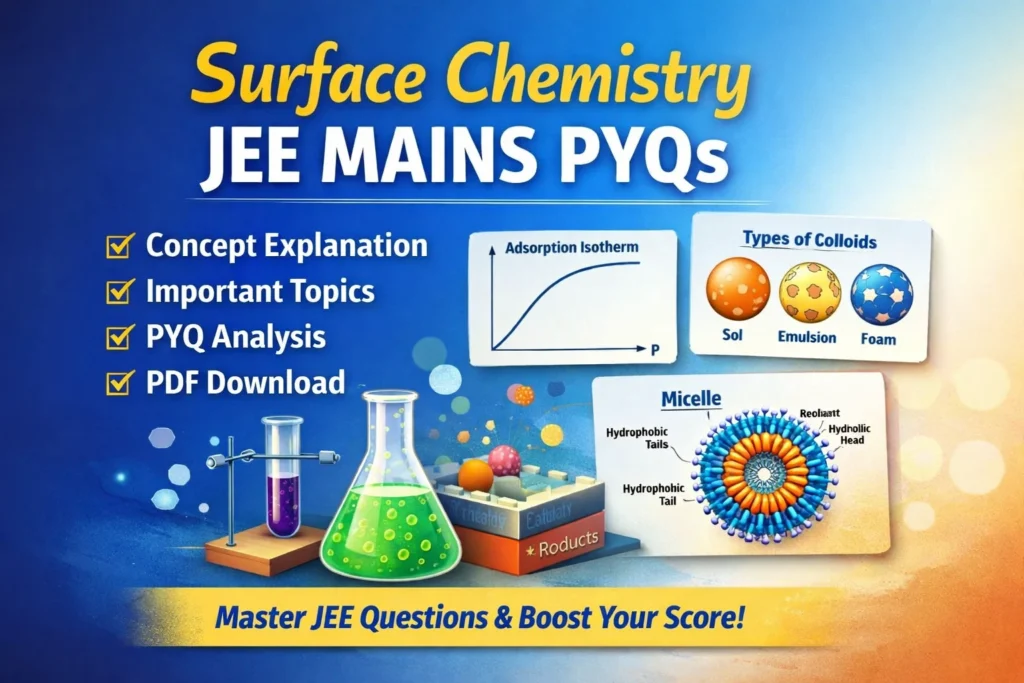
Surface Chemistry is one of the most scoring chapters in Physical Chemistry. Every year, Surface Chemistry JEE Mains PYQs appear as direct and concept-based questions. With limited theory and repeated patterns, this chapter offers high returns with minimum effort.
Download Surface Chemistry JEE Mains PYQs PDF
Surface Chemistry PYQs
JEE Mains Previous Year Questions (Topic-wise)
Download PDF
Quick Revision Use
Ideal for last-minute preparation and mock test revision
Get PDF
Why Surface Chemistry JEE Mains PYQs Are Important
Practicing Surface Chemistry JEE Mains PYQs helps students understand how NCERT concepts are converted into exam questions. Most questions are direct, theory-based, and require conceptual clarity rather than lengthy calculations.
- 1–2 questions appear almost every year
- Mostly NCERT-based theory
- Very less numerical calculation
- High accuracy with proper revision
Important Topics from Surface Chemistry for JEE Main
Adsorption
- Physical vs Chemical adsorption
- Factors affecting adsorption
- Freundlich adsorption isotherm
- Langmuir adsorption isotherm
Catalysis
- Homogeneous and heterogeneous catalysis
- Role of catalyst in reaction mechanism
- Enzyme catalysis
Colloids
- Classification of colloids
- Tyndall effect
- Brownian movement
- Coagulation and Hardy–Schulze rule
Surface Phenomena
- Surface tension
- Emulsions and emulsifying agents
- Micelles and CMC
Trend Analysis of Surface Chemistry JEE Mains PYQs
Analysis of previous year questions clearly shows that adsorption and colloids dominate this chapter. Statement-based and assertion–reason questions are common.
- Direct conceptual MCQs
- Matching-type questions
- Graph-based adsorption questions
Sample Surface Chemistry JEE Mains PYQs
Q1. Physical adsorption increases with increase in:
a) Temperature b) Volume c) Surface area d) Reaction rate
Q2. Which system shows Tyndall effect?
a) True solution b) Suspension c) Colloidal solution d) Saturated solution
Q3. A catalyst mainly works by:
a) Changing equilibrium b) Increasing temperature c) Lowering activation energy d) Increasing yield
Answers: Q1 – c | Q2 – c | Q3 – c
Conclusion
Surface Chemistry is one of the easiest chapters to score in JEE Main. With proper NCERT study and regular practice of Surface Chemistry JEE Mains PYQs, students can secure assured marks. Use the PDF for revision, focus on concepts, and this chapter will become your strength.