📅 Published on: 23.12.2025
Click here to download PDF
Table of Contents
ToggleRedox Reaction – JEE Main PYQs Complete Guide
Redox reactions are one of the most important chapters of Physical Chemistry for JEE Main aspirants. Every year, at least one direct or indirect question is asked from this topic. The questions are generally conceptual, formula-based, or numerical in nature, making it a highly scoring chapter when prepared properly. Practicing previous year questions (PYQs) of Redox Reactions helps students understand the exact exam pattern and the depth of questions asked in JEE Main.
What is a Redox Reaction?
A redox reaction is a chemical reaction in which oxidation and reduction take place simultaneously. Oxidation refers to the loss of electrons or increase in oxidation number, while reduction refers to the gain of electrons or decrease in oxidation number. Since electrons lost by one species are gained by another, oxidation and reduction always occur together.
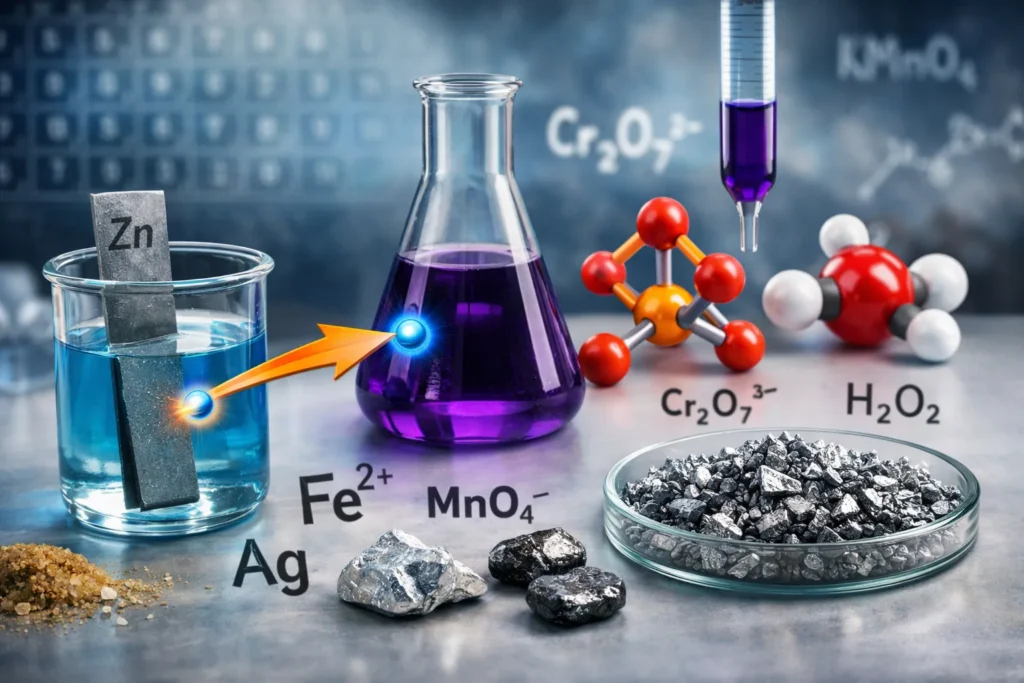
For example, when zinc reacts with copper ions, zinc gets oxidized by losing electrons and copper ions get reduced by gaining electrons. Understanding this basic concept is essential to solve almost all redox PYQs in JEE Main.
Importance of Redox Reaction in JEE Main
Redox Reaction is a foundation chapter that connects with many other topics such as electrochemistry, chemical kinetics, metallurgy, corrosion, and even some parts of inorganic chemistry. JEE Main questions from this chapter usually test clarity of concepts rather than lengthy calculations.
- High probability of at least one question in JEE Main
- Simple rules but concept-driven questions
- Helpful in electrochemistry and titration problems
- Scoring chapter if PYQs are practiced well
Important Topics Asked in JEE Main PYQs
1. Oxidation Number Concept
Most JEE Main PYQs are based on calculating oxidation numbers of elements in compounds and ions. Questions may ask for oxidation state of a particular element or identification of oxidizing and reducing agents in a reaction. Compounds containing transition metals, peroxides, superoxides, and polyatomic ions are frequently tested.
2. Identifying Oxidizing and Reducing Agents
Students are often asked to identify which species is acting as an oxidizing agent and which one is acting as a reducing agent. These questions require careful observation of electron transfer and oxidation state changes.
3. Balancing Redox Reactions
Balancing redox equations using the oxidation number method or half-reaction method is another important area. PYQs may ask for the number of electrons transferred or the correctly balanced equation in acidic or basic medium.
4. Disproportionation Reactions
In disproportionation reactions, the same element undergoes both oxidation and reduction. JEE Main often includes conceptual questions where students have to identify whether a given species can undergo disproportionation or not.
5. Redox Titration Based Numericals
Numerical questions involving redox titrations, especially those using potassium permanganate or potassium dichromate, are also common. These questions test both redox concepts and basic stoichiometry.
How PYQs Help in Redox Reaction Preparation
Solving previous year questions gives a clear idea about the level of difficulty and frequently repeated concepts. Many JEE Main redox questions are directly repeated with slight changes in values or options. PYQs also help students avoid common mistakes related to oxidation number calculation and balancing reactions.
- Improves conceptual clarity
- Boosts confidence before the exam
- Helps in identifying important subtopics
- Enhances speed and accuracy
Preparation Strategy for Redox Reaction JEE Main
To score well in Redox Reaction questions, students should first revise all oxidation number rules and practice assigning oxidation states in complex compounds. After that, focus on balancing redox equations in acidic and basic medium. Finally, solve all PYQs year-wise to understand question trends.
Using the provided PDF of Redox Reaction JEE Main PYQs will help you practice authentic exam-level questions and strengthen your preparation.
Conclusion
Redox Reaction is a small yet powerful chapter in JEE Main Chemistry. With clear understanding and consistent practice of previous year questions, students can easily secure full marks from this topic. Download the PYQ PDF, practice regularly, and revise the concepts to make Redox Reactions one of your strongest scoring areas in JEE Main.

FAQs – Redox Reaction JEE Main PYQs
1. How many questions are asked from Redox Reactions in JEE Main?
Usually 1 question is asked directly or indirectly from Redox Reactions in JEE Main. Sometimes it is combined with stoichiometry or electrochemistry concepts.
2. Is Redox Reaction an easy chapter for JEE Main?
Yes, Redox Reaction is considered an easy and scoring chapter because most questions are concept-based and follow standard rules of oxidation number and electron transfer.
3. Which topic is most important in Redox Reaction for JEE Main?
Oxidation number calculation is the most important topic. Questions related to identifying oxidizing and reducing agents are also very common.
4. Are numerical questions asked from Redox Reactions?
Yes, numerical questions are often asked, especially from redox titrations and balancing reactions where the number of electrons transferred is calculated.
5. Do JEE Main PYQs repeat from Redox Reaction?
Yes, many PYQs are repeated with slight changes in values or options. Practicing previous year questions significantly increases the chances of scoring well.
6. Is balancing redox equations important for JEE Main?
Yes, balancing redox equations using oxidation number or half-reaction method is an important skill and is frequently tested in JEE Main.
7. Are disproportionation reactions asked in JEE Main?
Yes, conceptual questions based on disproportionation reactions are asked, where students have to identify whether a given species can undergo both oxidation and reduction.
8. Which oxidizing agents are frequently asked in PYQs?
Common oxidizing agents asked in JEE Main PYQs include KMnO4, K2Cr2O7, H2O2, and halogens.
9. Can Redox Reaction help in other chemistry chapters?
Yes, Redox Reaction concepts are very helpful in electrochemistry, corrosion, metallurgy, and chemical kinetics, making it a foundation chapter.
10. How should I prepare Redox Reaction using PYQs?
First revise oxidation number rules, then practice balancing reactions, and finally solve PYQs year-wise. Analyzing mistakes after solving PYQs is key to mastering this chapter.