📅 Published on: 13.12.2025
Table of Contents
ToggleWork and Energy Class 9 Numericals with Solutions Pdf
Work and Energy is one of the most important chapters in Class 9 Physics because it introduces students to fundamental concepts like work, power, kinetic energy, and potential energy through practical numerical problems. Solving Work and Energy Class 9 numericals with solutions helps students clearly understand formulas, units, and real-life applications of energy transfer. These numericals strengthen problem-solving skills, improve accuracy in calculations, and build confidence for school exams as well as competitive tests. Regular practice of solved numericals also helps students avoid common mistakes and develop a strong conceptual base for higher classes.
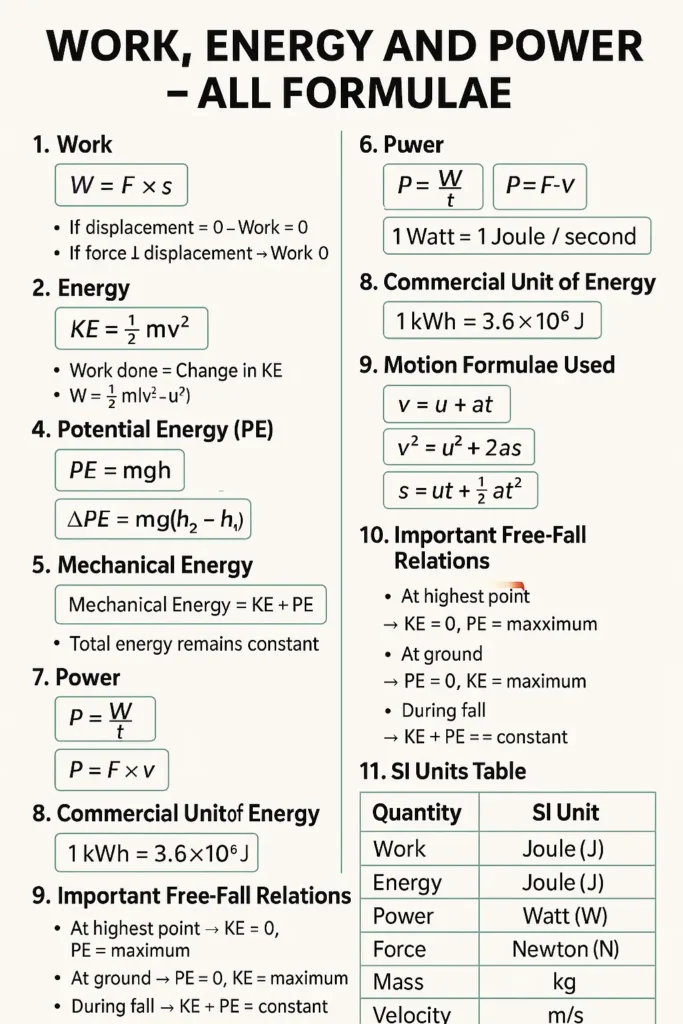
Work, Energy and Power – All Formulae (Class 9)
1. Work
- If displacement = 0 → Work = 0
- If force ⟂ displacement → Work = 0
2. Energy
- Energy = Capacity to do work
- SI unit: Joule (J)
3. Kinetic Energy (KE)
4. Potential Energy (PE)
5. Mechanical Energy
6. Law of Conservation of Energy
- Total energy remains constant
7. Power
8. Commercial Unit of Energy
9. Motion Formulae Used
10. Important Free-Fall Relations
- At highest point → KE = 0, PE = maximum
- At ground → PE = 0, KE = maximum
- During fall → KE + PE = constant
11. SI Units Table
| Quantity | SI Unit |
|---|---|
| Work | Joule (J) |
| Energy | Joule (J) |
| Power | Watt (W) |
| Force | Newton (N) |
| Mass | kg |
| Velocity | m/s |
Work and Energy Class 9 Numericals with Solutions
Class 9 – Work and Energy (Numericals)
Q1. A force of 10 N causes a displacement of 2 m in a body in its own direction. Calculate the work done by force.
Force (F) = 10 N
Displacement (s) = 2 m
Formula:
W = F × s
Calculation:
W = 10 × 2 = 20 J
Answer: 20 J
Q2. How much force is applied on the body when 150 J of work is done in displacing the body through a distance of 10 m in the direction of force?
Work (W) = 150 J
Displacement (s) = 10 m
Formula:
W = F × s
Calculation:
F = W ÷ s = 150 ÷ 10 = 15 N
Answer: 15 N
Q3. An engine works 54,000 J by exerting a force of 6000 N. What is the displacement of the force?
Work (W) = 54,000 J
Force (F) = 6000 N
Formula:
W = F × s
Kinetic Energy – Questions with Answers (Class 9)
Q4. A moving body of 30 kg has 60 J of kinetic energy. Calculate the speed.
Q5. A body of mass 2 kg is moving with a speed of 20 m/s. Find its kinetic energy.
Q6. A hammer of mass 1 kg falls freely from a height of 2 m. Calculate velocity and KE just before touching the ground.
KE = ½ × 1 × (6.29)² = 19.6 J
Velocity does not depend on mass.
Q7. What change is required in velocity to keep KE same if mass becomes 4 times?
Q8. Calculate the work required to stop a car of mass 1500 kg moving at 60 km/h.
Q9. Work done to increase speed of a car from 30 km/h to 60 km/h (mass = 1500 kg).
Q10. KE of a body is 25 J at 5 m/s. Find KE when velocity is doubled and tripled.
Velocity tripled → KE = 225 J
Q11. A force changes velocity of a 20 kg mass from 5 m/s to 2 m/s. Find work done.
Q12. Work required to stop a car of mass 1500 kg moving at 60 km/h.
Q13. How fast should a 60 kg man run to have KE of 750 J?
Q14. Find mass of a body having KE = 5 J at speed 2 m/s.
Q15. A ball of mass 250 g is kicked at 10 m/s. Find work done.
Q16. A 5 kg body is acted upon by a force of 20 N for 10 s. Find KE.
Q17. A 20 g bullet enters a tree at 500 m/s and exits at 400 m/s. Find work done.
Q18. Find KE of a 15 kg object moving at 4 m/s.
Class 9 – Kinetic Energy Numericals (Solved)
Q19. A bullet of mass 0.03 kg moving with a velocity of 400 m/s penetrates 12 cm into a wooden block. Find the resistive force and initial kinetic energy.
Work done = Force × distance
2400 = F × 0.12
F = 20000 N
Q20. Two bodies of equal masses move with velocities v and 3v. Find ratio of KE.
Ratio = v² : (3v)² = 1 : 9
Answer: 1 : 9
Q21. Mass of ball A is double of B. A moves with half the speed of B. Find ratio of KE.
A : B = (2m × (v/2)²) : (m × v²) = 1 : 2
Answer: 1 : 2
Q22. A truck weighing 5000 kgf and a cart weighing 500 kgf move with same speed. Compare KE.
Ratio = 5000 : 500 = 10 : 1
Answer: 10 : 1
Q23. A bullet of mass 20 g passes two points 30 m apart in 4 s. Find KE.
Mass = 0.02 kg
KE = ½ × 0.02 × 7.5² = 0.5625 J
Q24. How fast should a man of 50 kg run to have KE = 625 J?
v² = 25 → v = 5 m/s
Q25. Find KE of a body of mass 1 kg moving at 2 m/s.
Q26. Find momentum of a body of mass 100 g having KE = 20 J.
p = √(2mKE) = √(2 × 0.1 × 20)
p = 2 kg·m/s
Q27. Two equal masses move with speeds 2 m/s and 6 m/s. Find ratio of KE.
Ratio = 2² : 6² = 4 : 36 = 1 : 9
Q28. A 2 kg body falls from rest. Find KE after 2 s (g = 10 m/s²).
KE = ½ × 2 × 20² = 400 J
Q29. A scooter slows from 10 m/s to 5 m/s. Mass = 150 kg. Find work done by brakes.
= ½ × 150 × (25 − 100)
W = −5625 J
Work and Energy Class 9 Numericals with Solutions Pdf Download
Potential Energy & Law of Conservation of Energy – Class 9
Q30. A body of 5 kg is raised to a height of 2 m. Find the work done.
= 5 × 9.8 × 2
Work done = 98 J
Q31. If g = 10 m/s², find the potential energy of a 1 kg body kept at a height of 5 m.
Potential Energy = 50 J
Q32. A work of 4900 J is done to lift a 50 kg load. Find the height.
4900 = 50 × 9.8 × h
h = 10 m
Height = 10 m
Q33. A bag of wheat of mass 200 kg has PE = 9800 J. Find the height (g = 9.8 m/s²).
h = 5 m
Height = 5 m
Q34. Two bodies of equal masses are kept at heights h and 2h. Find ratio of their potential energies.
Ratio = h : 2h = 1 : 2
Q35. Find the energy of a stone of mass 10 kg kept at a height of 5 m.
Potential Energy = 490 J
Q36. If 196 × 10² J energy is used to raise a 40 kg boy, find the height.
19600 = 40 × 9.8 × h
h = 50 m
Height = 50 m
Q37. Work done to lift a 10 kg body is 490 J. Find the height.
h = 5 m
Height = 5 m
Q38. A 4 kg body is moved from 5 m to 10 m height. Find increase in potential energy.
= 4 × 9.8 × (10 − 5)
Increase in PE = 196 J
Q39. A 1 kg object is raised through height h. Its PE increases by 1 J. Find h.
1 = 1 × 9.8 × h
h = 1/9.8 m
Q40. A 5 kg ball is thrown upwards with speed 10 m/s. Find (a) PE at highest point (b) maximum height.
At highest point KE = 0 ⇒ PE = 250 J
h = PE / mg = 250 / (5 × 10) = 5 m
Q41. A 5 kg ball is dropped from height 10 m. Find PE, KE before ground, velocity.
KE before ground = 490 J
v = √(2gh) = √(196) = 14 m/s
Q42. A body is thrown up with KE 10 J and reaches height 5 m. Find mass.
m = 0.2 kg
Q43. A rocket of mass 3×10⁶ kg reaches height 25 km with speed 1 km/s. Find PE and KE.
PE = −7.5 × 10¹¹ J
KE = ½mv² = ½ × 3×10⁶ × (1000)²
KE = 1.5 × 10¹² J
Q44. Find energy of a 10 kg object at height 6 m (g = 9.8).
Q45. A 5 kg body falls from 5 m. How much energy does it possess?
Q46. A 12 kg object has PE 480 J. Find height (g = 10).
h = 4 m
Q47. Find increase in PE when a 2 kg block is lifted through 2 m.
Q48. A 1 kg ball is dropped from 5 m. Find KE before ground and speed.
v = √(2gh) = √(98) = 9.87 m/s
work and energy and power class 9 numericals with solutions
Work, Energy & Power – Class 9 (Solved Numericals)
Q51. A spring is compressed by a 150 g toy cart. On release it moves with speed 0.2 m/s. Find elastic PE.
Elastic PE = 0.003 J
Q52. A 40 kg object is raised to 5 m. Find PE and KE at half-way down.
At half height, KE = 980 J
Q53. A 5.8 kg box gains 145 J PE. Find height (g = 10).
h = 2.5 m
Q54. A man gains 2268 J PE climbing a 3.6 m wall. Find mass (g = 10).
m = 63 kg
Q55. A 15 g bullet moves at 400 m/s and stops in 2 cm. Find KE and average force.
F = W/s = 1200 / 0.02 = 60000 N
KE converts into heat and sound.
Q56. A 200 g ball falls from 5 m. Find KE on reaching ground.
Q57. A 10 kg rock falls from 5 m. Find speed and KE (g = 10).
KE = ½ × 10 × 10² = 500 J
Q58. Find work done by brakes when a 1000 kg car slows from 20 m/s to 10 m/s.
= ½ × 1000 × (100 − 400)
W = −150000 J
Q59. A 100 kg body is lifted by 10 m. Find work done and PE (g = 10).
PE = 10000 J
Q60. A 50 kg boy climbs 100 m. Find work done and PE gained.
Work = 49000 J
Q61. A 150 kg box has PE = 7350 J. Find height.
h = 5 m
Q62. A 2 kg body is thrown up at 20 m/s. Find PE after 2 s.
PE = 2 × 10 × 20 = 400 J
Q63. Find work done by 1 N force moving a body 1 m.
Q64. A force of 2.5×10¹⁰ N moves a car for 2 minutes at 5 m/s. Find work done.
Work = F × s = 1.5 × 10¹³ J
Q65. A man does 2500 J work climbing a 5 m tree. Find mass.
m = 50 kg
Q66. Work done is 24.2 J over 20 cm. Find force.
F = W/s = 24.2 / 0.2
F = 121 N
Work Energy Power Important Numericals With Solution
Power – Class 9 (Solved Numericals)
70. A machine does 192 J of work in 24 Sec. What is the power of the machine?
71. A boy weighting 50 kg runs up a hill rising himself vertically 10 m in 20 Sec. Calculate power. given g = 9.8 m/s²
Power = 4900 / 20 = 245 W
72. A rickshaw puller pulls the rickshaw by applying a force of 100 N. If the rickshaw moves with constant velocity of 36 km h⁻¹. Find the power of rickshaw puller.
Power = F × v = 100 × 10 = 1000 W
73. A athlete weighing 60 kg runs up a staircase having 10 steps each of 1 m in 30 sec. Calculate power (g = 9.8 m s⁻¹)
Work = 60 × 9.8 × 10 = 5880 J
Power = 5880 / 30 = 196 W
74. What is the power of a pump which takes 10 seconds to lift 100 kg of water to a water tank situated at a height of 20 m? (g = 10 m s⁻²)
Power = 20000 / 10 = 2000 W = 2 kW
75. The heart does 1.5 J of work in each heartbeat. How many times per minute does it beat if its power is 2 watt?
Beats = 120 / 1.5 = 80 times
76. An electric bulb consumes 7.2 kJ of electrical energy in 2 minutes. What is the power of the electric bulb?
Power = 7200 / 120 = 60 W
77. When loading a truck, a man lifts boxes of 100 N each through a height of 1.5 m.
(b) Energy transferred = 150 J
(c) 4 boxes/min → Energy = 600 J/min = 10 J/s
Power = 10 W
78. A man whose mass is 50 kg climbs up 30 steps of a stair in 30 s. If each step is 20 cm high, calculate the power used in climbing stairs
Work = 50 × 10 × 6 = 3000 J
Power = 3000 / 30 = 100 W
79. A man drops a stone of mass 2 kg from the top of a building of height 15 m when it reaches the ground, find its kinetic energy. How?
80. Two girls, each of weight 400 N climb up a rope through a height of 8 m. Girl A takes 20 s while B takes 50 s. What is the power expended by each girl?
Girl A: 3200 / 20 = 160 W
Girl B: 3200 / 50 = 64 W
81. A boy of mass 50 kg runs up a staircase of 45 steps in 9 s. If the height of each step is 15 cm, find his power. Take g = 10 m s⁻².
Work = 50 × 10 × 6.75 = 3375 J
Power = 3375 / 9 = 375 W
Class 10 Question